
1st Mississippi Light Artillery

The 1st Mississippi Light Artillery, also known as Withers’ Light Artillery, comprised several companies raised across Mississippi, participating in key battles during the Civil War. Initially assembled in May 1862, the regiment played a crucial role in the defense of Vicksburg against Union forces, with notable contributions at Chickasaw Bayou and the Vicksburg campaign. Throughout its service, the artillery faced significant casualties and challenges, ultimately surrendering at Vicksburg in July 1863. Afterward, surviving members regrouped as infantry before continuing their service in various capacities.
North America Indian Names of Places in Mississippi, Alabama, Georgia, Florida, and Louisiana

The post examines the significance and origins of North American Indian place names in Mississippi, Alabama, Georgia, Florida, and Louisiana, particularly those derived from the Choctaw and Chickasaw languages. It highlights how these names reflect the rich cultural and linguistic heritage of the Native American tribes, while noting that many translations have become corrupted over time. The text provides numerous examples of place names alongside their original meanings, illustrating the deep historical connections embedded in the geography of the region.

Natchez Trace

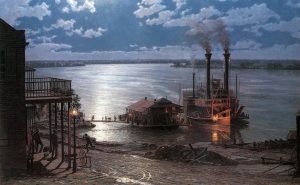
Natchez Under the Hill

In 1792, a treaty with the Chickasaw at Chickasaw Bluffs established the Natchez Trace, a significant route connecting Nashville to Natchez. Initially a thoroughfare for emigrants, it soon became infamous for outlaws like Mason and Murrell, who preyed on travelers. Despite efforts to capture these bandits, they eluded authorities until betrayal led to Mason’s demise. The Trace witnessed both lawlessness and camaraderie among its diverse users, ultimately fading from memory as it transformed into farmland, overshadowed by the bustling growth of nearby settlements.

Slave Narrative of Dora Franks

Dora Franks, an ex-slave from Aberdeen, Mississippi, recalls her life under slavery and the significant events surrounding the Civil War and her subsequent freedom. Born to a mother from Virginia and a father who was her young master, she faced discrimination due to her lighter skin. She describes the harsh realities of slave life, including punishment and limited freedom, yet also highlights moments of kindness from her white mistress. After the war, she struggled with life in the fields before marrying. Franks reflects on her faith and concerns for the younger generation’s moral decline.