A Fresh Look at Ocmulgee Bottoms

Ocmulgee in 1000AD

Many of the most fundamental assumptions by the Anthropology profession concerning the Pre-European history of the Lower Southeast were developed during the mid-20th century as a result of a massive, federally-funded excavation of archaeological sites near Macon, GA. While today, anthropologists, museums and the National Park Service present a united front stating that the body of knowledge, which resulted from the Ocmulgee Bottoms studies, was the result of comprehensive analysis, plus well-thought out consensus by some of the most brilliant men of their time, the truth is quite a bit different.
The Natural History of Ocmulgee Bottoms

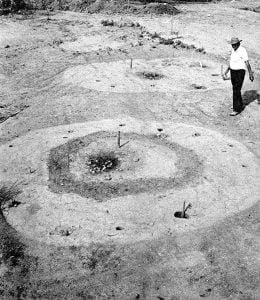
9Fu14-DrArthurKelly

Ocmulgee Bottoms is a corridor of the Ocmulgee River Flood Plain in the central region of the State of Georgia that begins at the Fall Line in Macon, GA and continues 38 miles southward to near Hawkinsville, GA. This region is located in Bibb, Twiggs, Houston, Bleckley and Pulaski Counties. The Ocmulgee River’s velocity slows dramatically upon entering the Bottoms and has a serpentine channel. Over the eons, the river here has meandered frequently across the breath of the flood plain, leaving hundreds of ponds and swamps, plus a deep layer of rich, alluvial soil. On top of the alluvial soil is from one to ten feet or red clay that was deposited during the period when cotton was cultivated in the Piedmont, upstream.

Native American History of Bibb County, Georgia

Bibb County, Georgia, part of the Macon MSA, features the significant Ocmulgee Bottoms, a vital archaeological zone where advanced Native American cultures flourished, including the birthplace of the Creek Indian Confederacy. This area was pivotal for agriculture, featuring evidence of ancient communities and trade routes. The region experienced transformative cultural exchanges with European settlers, leading to the Creek’s land cessions and loss during the 19th century. Today, descendants of Creeks maintain their heritage amid a complex historical narrative influenced by migration, intermarriage, and societal change.

Slave Narrative of Della Briscoe

Della Briscoe, a former slave from Macon, Georgia, recounts her childhood on David Ross’s plantation, revealing her family’s struggles and daily life. Separated from her mother, she grew up under the care of her grandmother. Della describes varying degrees of punishment, meager rations, and the lack of crime on the plantation. She shares experiences during the Civil War, including a raid by Union soldiers and the kindness shown to her by Mr. Ross after he learned of her warning. Now elderly and living with her granddaughter, Della reflects on her past with gratitude.

Slave Narrative of Alice Battle

In a 1936 interview, Alice Battle recounts her life as a slave on Mr. Ed Marshall’s plantation in Bibb County, Georgia. Born in the 1850s to Emanuel and Neal Anne Caldwell, Alice describes her experiences as typical for an enslaved person, noting that she was well-fed and treated humanely, albeit with occasional punishment. She recalls witnessing Union soldiers pass with Jefferson Davis following the Civil War. After emancipation, Alice initially stayed with her former masters before eventually marrying and living a life marked by mobility and dependence on family in her later years.

Slave Narrative of Berry Clay

Berry Clay, interviewed at 89 years old, reflects on his life in Macon, Georgia, where he grew up in a family of mixed heritage. Although he was never enslaved, he recounts stories from that era, including his stepfather’s unique method of punishing slaves. He describes the social dynamics of plantation life, church involvement, and the impact of the Civil War. After Emancipation, Clay worked as a painter, emphasizing the importance of self-care and a worry-free life for longevity.

Slave Narrative of Bill Austin

Bill Austin, an ex-slave from Greenwood, Florida, recounts his life and experiences under slavery. Born near the Oconee River in Georgia, he lost contact with his parents after their sale. He describes his master, Thomas Smith, as a sometimes generous but gambling man, whose fluctuating wealth affected the lives of the enslaved. Austin details his attempts to escape to Macon, ultimately leading to his emancipation when Mrs. Smith offered him freedom. Now in his old age, he manages a small farm with his large family.

Slave Narrative of Samuel Simeon Andrews

Samuel Simeon Andrews, born in 1850 in Macon, Georgia, reflects on his life as a former slave, moving through various plantations before emancipation. He describes his experiences, particularly on the A.J. Lane plantation, where he recalls kind treatment and familial ties among slaves. Andrews shares memories of plantation life, Civil War incidents, and post-emancipation education challenges. Despite a difficult past, he emphasizes community resilience, his active involvement in the African Methodist Episcopal Church, and a longevity attributed to a positive outlook on life and health practices.

Slave Narrative of Salena Taswell

Salena Taswell, born in 1844 in Perry, Georgia, reflects on her life as a child on Dr. Jameson’s plantation. She describes a childhood spent working as a servant rather than playing. Although she was treated kindly, her family’s life involved hard work: her mother was a seamstress, and her father a blacksmith. Guests at the plantation enjoyed rich meals, while Salena cleaned and waited on the table. After the Civil War, she experienced little change, continuing to live in her master’s household alongside other freed individuals.

Slave Narrative of Sarah Anderson

In an interview with Bernice Bowden, Sarah Anderson, aged 78, recounts her early memories of the Civil War and her life as a former slave. Born in Bibb County, Georgia, she moved to Arkansas at age fourteen shortly after the war. She reminisces about the arrival of Union soldiers, describing how children hid in fear. Sarah discusses her family life, including her mother and father’s treatment and her experience as a mother of fourteen, with most of her children now deceased, except for one son.

Slave Narrative of Vera Roy Bobo

Vera Roy Bobo, a 68-year-old woman from Holly Grove, Arkansas, reflects on her family’s history. Her mother, Margaret Cobb, was a house girl and seamstress whose family was enslaved by the Cobbs in Georgia. Her father, St. Roy Holmes, a light-skinned C.M.E. preacher, moved to Arkansas in 1885. Vera mentions her husband, William Bobo, whose family was also of mixed heritage and had connections to a wealthy lineage in Mississippi. She notes her parents rarely spoke of their experiences in slavery.

Hitchiti Indians

The Hitchiti tribe, part of the Muskhogean family, was historically located in what is now Chattahoochee County, Georgia, and previously along the Ocmulgee River. Known for their distinct language, they were referred to as leaders among the Lower Creeks. Notable villages included Hitchitoochee and Tuttallosag. Their population fluctuated significantly from the 18th century onwards, with a notable decline. After moving to Alabama in the early 18th century, they eventually relocated to Oklahoma, merging with the Creek Confederacy.

Edwards, Elsie Ammons – Obituary

Mrs. Elsie Harris, aged 49, of Longview, passed away on November 23 in a local hospital. Born on January 3, 1914, in Macon, Georgia, she was a dedicated member of the Kelso Assembly of God Church and worked as a swimming instructor for children with disabilities at the Longview YMCA. She is survived by her husband, Marshall, three daughters, two brothers, four sisters, and nine grandchildren.

Achese: Birthplace of the Creek Confederacy

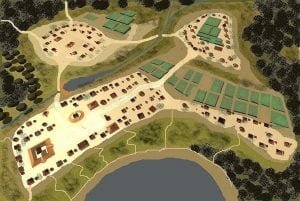
Artist rendition of the Town of Ochesee

In 1541, Hernando de Soto’s expedition encountered the ancestors of today’s Creek Indians near the Ocmulgee River in central Georgia. They stumbled upon Achese, a well-planned village that contrasted sharply with the Apalachee territories. Although the Spanish chroniclers provided limited descriptions, Achese, whose name means “Children of Corn,” was a significant cultural center with notable temple mounds. Despite its importance, the village did not meet de Soto’s expectations for wealth, as he sought cities like the Aztecs’ Tenochtitlan.

Bibb County, Georgia Marriages 1824-1850

This index of Bibb County, Georgia marriage records covers 1824 through 1850 and lists groom, bride, and marriage date entries extracted from court records. It provides a detailed historical reference for genealogical research, documenting hundreds of marriages across more than 25 years in Bibb County.

Biography of Hon. Edward Hirsch

Hon. Edward Hirsch, born in Germany in 1836 and immigrating to the U.S. in 1855, became a prominent figure in Oregon’s financial landscape. After settling in New York and then moving through various states, he established himself in Oregon, where he was elected State Treasurer in 1878. His administration saw significant improvements in public finance, including reduced tax rates and enhanced public facilities like the State Asylum and State Prison. Respected for his integrity and financial acumen, Hirsch played a vital role in Oregon’s development and held a strong reputation in the community.