History of Greene County Missouri

Greene County Missouri

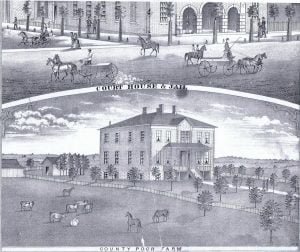
Greene County, established in 1833 in southwest Missouri, was originally part of the Osage Country, known for its Native American heritage. The region transitioned through various territorial designations before becoming its own county, named after Revolutionary War figure Nathaniel Greene. Springfield serves as the county seat and commercial hub, surrounded by several smaller towns. The area’s history is enriched by numerous biographies of prominent 19th-century citizens, offering insights into the lives that shaped Greene County’s development.
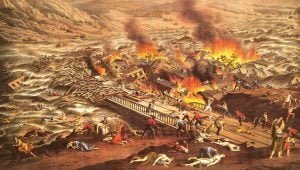
The Johnstown Pennsylvania Flood

The Great Conemaugh Valley Disaster

On May 31, 1889, following an unprecedented storm, the South Fork Dam near Johnstown, Pennsylvania, burst, unleashing a catastrophic flood. The Conemaugh River surged, reaching heights of 60 feet and traveling at 40 miles per hour, devastating the town and its surroundings. Despite warnings, many residents were caught off guard, leading to approximately 2,200 deaths. Debris fires and the destruction of structures like the Stone Bridge added to the horror, marking the flood as one of the deadliest disasters in U.S. history.

Biography and Genealogy of Western Massachusetts

West Boylston Massachusetts about 1902

These biographies were initially published in the Springfield Republican in 1854, as a newspaper initiative aimed at enriching the paper’s content. Early reader responses encouraged the transformation of the material into a more permanent publication. Motivated by the recognition of its importance, the authors worked diligently to revise and enhance the content, resulting in two volumes intended for the people of Western Massachusetts and those interested in its history.

Victorian Worthies

Dickens Dream

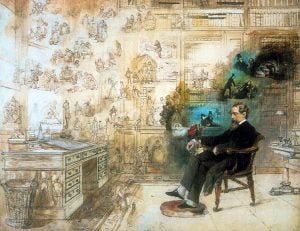
Dickens Dream” is an unfinished watercolour by Robert William Buss, painted in 1875. “Victorian Worthies” comprises sixteen biographical sketches of notable Victorian figures, aiming to educate schoolboys on significant lives such as Thomas Carlyle and Charles Dickens. The author acknowledges the challenge of competing with established critics but seeks to present well-known facts and contemporary judgments without sensationalism. The sketches serve as examples of public service across various professions, intended to inspire the younger generation while promoting civics education in schools.

Biographies of Daviess County, Missouri

Daviess County Savings Bank of Gallatin, Missouri

The Daviess County Savings Bank in Gallatin, Missouri, is located within territory initially part of St. Charles County. Over time, this area saw the formation of Howard County in 1816 and Ray County in 1820. The present-day Daviess County was subsequently organized, and this collection features 365 biographical sketches of prominent individuals who contributed to the county’s development, detailing their lives and influence in the region.

16th Century French Exploration of North America

Arx Carolina

Between 1562 and 1763, France established the region known as Florida Françoise, encompassing parts of South Carolina and Georgia, although it notably excluded the St. Johns River Basin. Led by figures like Captain René Goulaine de Laudonniére and Admiral Gaspard de Coligny, French expeditions aimed to claim lands for King Charles IX and provide refuge for Huguenots amidst religious persecution in France. Their efforts included the construction of Charlesfort and Fort Caroline, but conflicts with indigenous tribes and the Spanish ultimately hindered their colonial ambitions.

The Cherokee Land Lottery

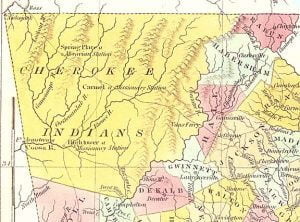
1830 Map of Cherokee Territory in Georgia

The 1832 Cherokee Land Lottery contains the names and residence of all the fortunate drawers in the Land Lottery of the Cherokee country, arranged by districts in numerical order, all carefully copied from the originals in the Executive Department and the office of the Surveyor General, designating also the lots which have been granted. We have given the quality of the lots in some instances, but not generally, deeming it altogether unimportant, from the well-known inaccuracy of the surveyors in classing their value, and from the additional fact that very few individuals engage in contracts for real estate until they are enabled by personal observation to place a proper estimate upon the premises. By reference to the numerical list, the drawer’s name and residence can be readily ascertained.

Historic Forts of North America

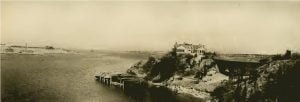
Panorama of Newport Harbor

This book provides an in-depth exploration of North America’s significant forts, reflecting the continent’s military history from Indigenous peoples to European powers and the United States. It covers key fortifications such as St. Augustine, Fort Sumter, and others, highlighting the strategic importance of these strongholds in various conflicts. The author combines personal travel experiences, photography, and historical insights, making it valuable for scholars and visitors. Through rich descriptions and archival materials, it serves as a testament to the enduring legacy of military engineering across North America.

Wisconsin Gold Star List

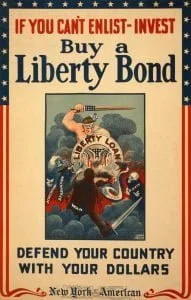
Liberty Bond

Wisconsin’s Gold Star List Soldiers, sailors, marines and nurses casualties for WWI. This extensive list of casualties from Wisconsin provides details of the hometown, age, unit, location of death, and cause of death, for those soldiers, sailors, marines, and nurses who all gave their life in World War 1.

Northeastern Oklahoma Biographies

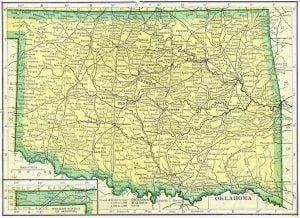
Map of Oklahoma

The 1922 biographical manuscript contains 457 biographies of notable individuals from Northeastern Oklahoma, particularly the Muskogee area. The inclusion in the manuscript was contingent upon a submission fee, resulting in the omission of some residents. Covering counties such as Adair, Cherokee, and Sequoyah, these biographies reflect a period when the region was known as Indian Territory. It is important to note that residency in this area does not necessarily indicate Native American heritage, which requires proof of tribal affiliation.

Standard History of Champaign County Illinois

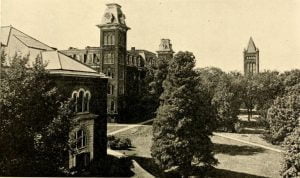
Illinois Industrial University Hall

These 475 biographies were collected from the manuscript “A Standard History of Champaign County, Illinois,” written in 1918 by J. R. Stewart. A citizen’s inclusion in this manuscript indicates only that they or someone on their behalf chose to “subscribe” to its publication.

Despite this, the presence of a biography in such works can provide family researchers with a vivid look into the lives of their ancestors. For historians, these works offer a glimpse into the events that helped shape a community. However, it’s important to remember that this type of work is not definitive proof, as the information was collected at the time and can often be misleading or even false. Stories handed down may not be true, and details of someone’s life may be altered to make them appear greater than they actually were. Therefore, researchers should verify the facts provided here with additional sources. With that in mind, please enjoy!

Boston Intentions of Marriage 1752-1808

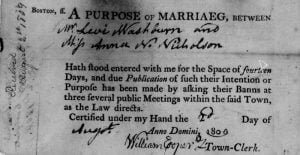
Marriage Intention

From it’s early history, Massachusetts has required couples to formerly file a marriage intention whenever they planned to marry. This specific data set contains all marriage intentions filed within the city of Boston Massachusetts during the years of 1752-1808. While most records within this data set contain references to white people, there are instances where “negro servants” “blacks” and “colored” marriage intentions were recorded. Each listing is an abstraction of the actual record, and usually contains the names of the couple and the date of filing the intention… in some instances a town is also included, when an individual did not reside in Boston.

Carlisle MA Vital Records to 1850

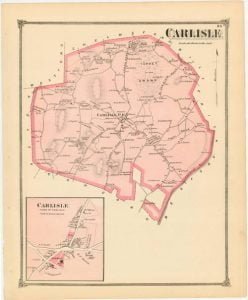
Carlisle Massachusetts Map of 1875

Carlisle Massachusetts Vital Records to 1850 includes records of births, marriages and deaths, basically all entries to be found in the books of record kept by the town clerks; in the church records; in the cemetery inscriptions; and in private records found in family Bibles, etc. These records are printed in a condensed form in which every essential particular has been preserved. All duplication of the town clerk’s record has been eliminated, but differences in entry and other explanatory matter appear in brackets. Parentheses are used when they occur in the original record; also to indicate the maiden name of a married woman.
When places other than Carlisle and Massachusetts are named in the original records, they are given in the printed copy. Marriages and intentions of marriage are printed under the names of both parties. In all records the original spelling of names is followed, and in the alphabetical arrangement the various forms should be examined, as items about the same family may be found under different spellings.

Frontier and Colonial Forts of the United States

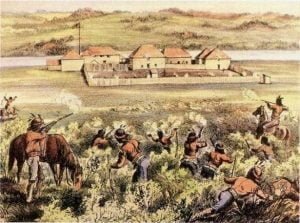
Battle of Fort Pitt

The post provides a comprehensive list of colonial and frontier forts, trading posts, and other military installations established in the United States from settlement up to 1902. Many of these structures were built by early settlers for protection, though their exact locations often remain uncertain. The list categorizes forts by name and state, highlighting those currently occupied by troops or under War Department control. This serves as a convenient reference for ongoing historical study of military infrastructure in early America.

American Prisoners Of The Revolution

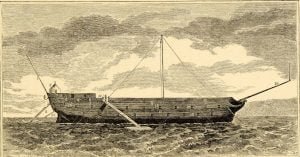
jerseyprisonship2 e1310762874847

This manuscript provides a look into the types of British prisons and the stories of the American men who were confined within during the Revolutionary War. Most notable are the stories among the men who were sentenced to stay aboard the ship “The Old Jersey.” Included within the book are names of over 8,000 confirmed prisoners of HMS Jersey. There is little that is original in the compilation. The accounts could have been given in the compiler’s own words, but they would only, thereby, have lost in strength. The original narratives are all out of print, very scarce and hard to obtain, and the writer feels justified in reprinting them in this collection, for the sake of the general reader interested in the subject, and not able to search for himself through the mass of original material, some of which she has only discovered after months of research. Her work has mainly consisted in abridging these records, collected from so many different sources.

WPA Slave Narratives

James Boyd

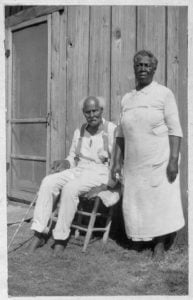
The WPA Slave Narratives, compiled by the Library of Congress from 1936 to 1938, provide firsthand accounts from surviving slaves, offering a vital perspective on Southern culture and the complexities of slavery. Despite inherent biases and transcription challenges, these narratives capture the lived experiences, thoughts, and emotions of former slaves, enriching our understanding of their relationships and life under bondage. This collection serves as essential evidence for scholars and enhances the narrative of American history by including the voices often overlooked in traditional accounts.

Battle of the Big Hole

Map of Battle of the Big Hole

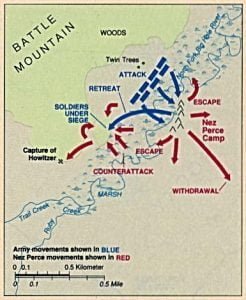
The Battle of the Big Hole, fought in August 1877 in Montana, marked a significant engagement between General Gibbon’s forces and the Nez Perce Indians. The battle showcased the Nez Perce’s fierce resistance and strategic retreat under cover of darkness. While detailing the events leading to the confrontation, including reinforcements and the earnestly fought skirmishes, the gruesome tally of casualties reflects the battle’s severity. This account emphasizes the complexity of the conflict and the narratives surrounding the Nez Perce War and their struggle for compensation from the U.S. government.

Traditions of the Caddo

Map of Caddoan Mississippi Culture

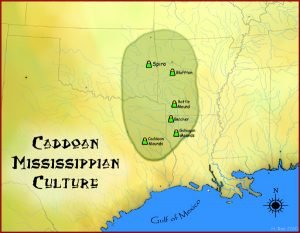
Between 1903 and 1905, tales from the Caddo people were collected as part of a study into their religious and ceremonial practices. By 1903, the Caddo population was approximately 530, residing in western Oklahoma after a series of migrations from Louisiana and Texas. They historically cultivated agriculture and interacted amicably with white settlers since 1540. The collected tales include various stories, primarily featuring the Coyote, and will be compared to other tribes’ narratives upon the study’s completion.

Sign Language Among North American Indians

fig334

Sign language among North American Indians exhibited remarkable uniformity across tribes, serving as a vital means of communication for trade and interaction. This manuscript details various signs, gestures, and the history of sign language within Indian nations, addressing the use of visual signals like smoke and fire. The research, which remains ongoing, aims to compile comprehensive information while highlighting the need for collaboration and further study. It emphasizes the importance of establishing a systematic understanding of these communicative forms, setting the foundation for future exploration.

Old Marblehead Sea Captains

shipfranklin1

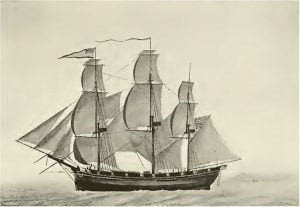
This volume is intended to be a fairly accurate list of the Old Sea Captains of Marblehead, and the vessels in which they sailed, going to and from foreign ports. The information contained in this volume has been obtained by careful and persistent research from widely distributed sources viz: the Marblehead and Salem and Beverly Custom House Records, original books of the Marblehead Marine Insurance Company, covering five thousand policies running from 1800 to 1840, list of Marblehead Soldiers and Sailors in the Revolutionary War (compiled in 1912-13 by the author), old log books, old letter books, old newspapers, list of Privateersmen of 1812 made up by Capt. Glover Broughton in a memorial to the 34th, 35th and 36th Congresses asking for grants of land for services rendered, and from the descendants of the men mentioned.