
Treaty of May 7, 1868

On May 7, 1868, at Fort Laramie, the United States and representatives of the Crow Indians signed a treaty establishing enduring peace and outlining provisions for land use, agricultural support, education, and individual land rights for the tribes. The treaty commits the federal government to provide buildings, educational resources, and agricultural assistance while mandating the Indians to uphold peace and pursue farming. Crucially, it emphasizes cooperation between parties to resolve conflicts and ensures that land and resources are preserved for the Crow’s use alone.
Treaty of July 3, 1868

On July 3, 1868, the Treaty at Fort Bridger was signed between the United States and the Shoshone and Bannack tribes, establishing peace and mutual responsibilities. Both parties committed to addressing wrongs and maintaining harmony. The treaty outlined the establishment of reservations, the construction of buildings, and provisions for education and farming support for the tribes. It granted rights to land selection and enforced compliance with agricultural education, ensuring the tribes received annual clothing and support. The treaty emphasized cooperation, protection, and the promise of a better future for both parties.

Treaty of February 18, 1861

On February 18, 1861, at Fort Wise, U.S. commissioners and chiefs of the Arapahoe and Cheyenne tribes signed a treaty whereby the tribes ceded their lands while retaining a designated reservation. The agreement aimed to establish settled agricultural practices among the tribes by assigning individual plots of land, promoting their welfare through various supports, such as financial aid and agricultural resources. The treaty emphasized the tribes’ rights and outlined provisions for education, land ownership, and future tribal assistance, reinforcing the U.S. commitment to their integration and development.

Treaty of April 29, 1868

The Treaty of April 29, 1868, marked a pivotal peace agreement between the U.S. government and various Sioux tribes. It established a promise of lasting peace, delineated a designated reservation for the Sioux, and outlined support for agricultural development and education. The treaty also mandated that both parties would ensure accountability for wrongdoing, stipulated provisions for land selection and ownership, and sought to protect Sioux rights to hunt and oppose railroads. Ultimately, the treaty sought to formalize a cooperative relationship and mitigate conflict.

Treaty of October 17, 1855

On October 17, 1855, representatives of the Blackfoot, Flathead, Nez Percé, and other tribes signed a treaty with U.S. commissioners A. Cumming and Isaac I. Stevens near the Judith River in Nebraska. The treaty established perpetual peace among the tribes and with the U.S., delineating a shared hunting ground for 99 years and granting exclusive territory to the Blackfoot Nation. It outlined mutual responsibilities, the protection of Indian lands, and provisions for annual financial support and education, while promoting civility and forbidding hostilities.

Biography of Alonzo Beal

Alonzo Beal, born on November 20, 1862, in Ohio, emerged from humble beginnings to become one of Shawnee County’s prominent landowners and cattlemen. After the death of his father, he helped support his family, moving to Iowa for better wages before settling in Kansas. His diverse experiences included farming, ranching, and clerking. Beal ultimately accumulated significant land holdings, including 1,280 acres, and became involved in local politics and civic organizations. He married twice, with his second wife being the daughter of a notable Kansas cattleman.

Biography of Edwin H. Wagner

Edwin H. Wagner was born on October 6, 1873, in Laramie City, Wyoming. He received a solid education and began his career in the auditing department of the Denver Rio Grande Railroad. Wagner later studied law and contributed to various companies before founding Edwin H. Wagner Company, certified public accountants, in 1919. A prominent figure in business, he also managed a Dallas branch and held directorships. He married Corinne Shevnin, and they had seven children. Wagner was active in community organizations and the Catholic Church.

Western Forts

Fort Phil Kearney, established in 1848, served as a crucial outpost during the Sioux War and was significant for protecting emigrant trains on the California Overland route. It became notorious due to the Kearney Massacre in December 1866, where Colonel Fetterman and his men were overwhelmed by a large force of Sioux warriors. The fort, typical of its era, was abandoned after the Union Pacific Railroad’s arrival and eventually burned by Native Americans. Other forts like Leavenworth, Fetterman, and Bridger followed similar narratives in the turbulent West.

Fort Laramie

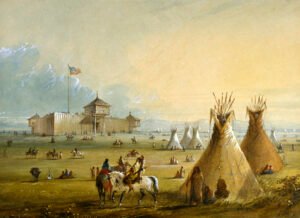
1840 Fort Laramie

Fort Laramie, established initially as a picket fort by trappers in 1834, became a significant trading post for the American Fur Company. Located on the Laramie River, it transformed into a pivotal hub for interactions between Native American tribes and traders. By 1849, ownership shifted to the United States government, which began fortifying the post. The area, once a hunting ground for various tribes, witnessed critical events, including conflicts with the Sioux and interactions with emigrants, highlighting its historical importance in the westward expansion.