
Statement No. 8a – Alexander Pellard, Jr. of Altoona
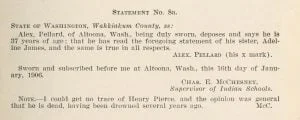
Statement No 8a

This document, communicated by the acting commissioner of Indian Affairs, addresses the rolls of specific Indian Tribes in Oregon and Washington, particularly in relation to an 1851 agreement. Statement No. 8a features Alexander Pellard, Jr., a member of the Lower Chinook Indians, affirming the accuracy of his sister Adeline’s statement in 1906. His sworn testimony, part of the McChesney Rolls, highlights the identification of enrolled Chinook individuals distinct from reservations and includes details about Pellard’s age.
1914 Lower Chinook and Clatsop Annuity Roll

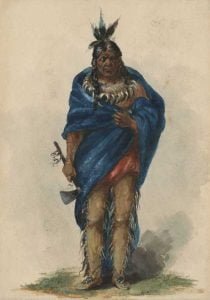
Chief Comcomly

Annuity Roll, containing the names of surviving members and immediate lineal descendants of deceased members of the Lower Band of Chinook Indians of Washington, entitled to participate in the settlement provided by the Act of August 24, 1912

Lower Chinook, Kathlamet, Tillamook, and Clatsop Indians, Alive in 1906

In 1906, Charles E. McChesney compiled a list of the Lower Chinook, Kathlamet, Tillamook, and Clatsop Indians, along with their heirs, who had treaty agreements with the U.S. government since 1851. The document includes numerous names and corresponding addresses across various locations, such as Oregon, Washington, and California. This registration underscores the ongoing recognition of these tribes and serves as an important historical record of their existence and relocations during that period.

Clatsop Indians

The Clatsop Indians, named after a term meaning dried salmon, were part of the Lower Chinook dialect within the Chinookan linguistic family. They inhabited areas around Cape Adams, extending from the Columbia River to the Pacific coast. Notable villages included Konope, Neacoxy, Neahkeluk, and others. Population estimates suggest approximately 300 Clatsop in 1780 and 1806, but by 1910, only 26 remained following their relocation to Grande Ronde Reservation. Their legacy is preserved in Clatsop County and the town of Clatsop, Oregon.

Biography of Mrs. Helen Smith

Mrs. Helen Smith, born in 1804, is a significant figure in Oregon’s history, having witnessed the state’s early settlement and development. As the daughter of Coboway, chief of the Clatsops, she learned many tribal myths and played a crucial role in mediating tensions between Native Americans and settlers. Married to Frenchman Porier, she later became the wife of Solomon Smith, with whom she settled in Clatsop Plains. Known for her bravery, she intervened in potentially violent situations, safeguarding both her community and the settlers. Smith remains a respected matriarch of Oregon’s pioneering spirit.

Clatsop Tribe

The Clatsop Indians, a Chinookan tribe, historically inhabited the southern bank of the Columbia River and extended to the Oregon coast. In 1806, Lewis and Clark noted their population at 200, residing in 14 houses. By 1875, a few Clatsop remained near Salmon River before being relocated to the Grande Ronde Reservation in Oregon. The tribe’s language is nearly extinct, and its remnants have largely been assimilated into surrounding populations. Known villages included Konope, Neacoxy, and Necotat.

Biography of Dr. John McLoughlin

Dr. John McLoughlin, often regarded as the first true governor of Oregon, was the chief factor of the Hudson’s Bay Company in the region from 1824. Born in Canada in 1784, McLoughlin gained respect from both Indigenous peoples and settlers through his leadership, intelligence, and generosity. He fostered agriculture, promoted settlement, and supported early missionaries, while maintaining the Hudson’s Bay Company’s dominance. As American settlers arrived, his influence waned, leading to his eventual disconnection from the company and eventual transition to American citizenship before his death in 1857.