Threads of ancestors, Telford – Ritchie – Mize

Threads of ancestors, Telford - Ritchie - Mize: a link among the days which binds the generations each with each

“Threads of Ancestors: Telford – Ritchie – Mize: A Link Among the Days Which Binds the Generations Each with Each,” authored by Leila Ritchie Mize and Jessie Julia Mize, explores the intricate tapestry of family lineage and migration across continents and centuries. Tracing roots back to Alexander Telford Sr., who settled near Rockbridge, Virginia around 1760, this book delves into the journeys and settlements of his descendants across the United States. Highlighting the Scotch-Irish origins of these families, the authors meticulously draw upon an extensive array of sources, including family Bibles, historical records, and personal diaries, to provide a detailed account of the Telford, Ritchie, and Mize families. Their narrative not only charts the genealogical paths of these families but also illuminates their substantial roles in the historical and cultural development of the regions they inhabited. This work stands as a testament to the enduring bonds and shared heritage that link successive generations, forming a foundational piece for both family members and historians interested in the Scotch-Irish contribution to American history.
A history of the Goshenhoppen Reformed charge, Montgomery County, Pennsylvania (1727-1819)

A history of the Goshenhoppen Reformed charge, Montgomery County, Pennsylvania

In “A History of the Goshenhoppen Reformed Charge, Montgomery County, Pennsylvania (1727-1819),” William John Hinke delves into the rich history of one of Pennsylvania’s earliest Reformed congregations. Published in 1920, this detailed account traces the evolution of the Goshenhoppen Reformed Charge, focusing on its foundational years and the pivotal role it played in the religious life of early American settlers. Drawing from an extensive collection of church records and other historical documents, Hinke’s work not only highlights the religious activities but also sheds light on the community’s social dynamics from its establishment in 1727 through the early 19th century. This book serves as an invaluable resource for historians and genealogists alike, offering insights into the development of Reformed Church communities in colonial America.

Bristol Parish Virginia Church Register

The vestry book and register of Bristol Parish, Virginia, 1720-1789

The Vestry Book and Register of Bristol Parish, Virginia, 1720-1789 includes a register of births, baptisms and deaths, the earliest and latest recorded dates of which are April 12, 1685, and March 9, 1798. The compiler has wisely reproduced the original manuscript with “all eccentricities of abbreviation and punctuation, as well as all mistakes.” A carefully prepared index greatly adds to the usefulness of the work.

Overwharton Parish Register Virginia

Aquia Church, Stafford County, Virginia

This manuscript contains an historical sketch of the old county of Stafford Virginia and the parish of Overwharton. It also contains a full transcription of the Overwharton Parish Register for the years of 1720-1760.

Lowell Massachusetts Annual Reports 1862-1928

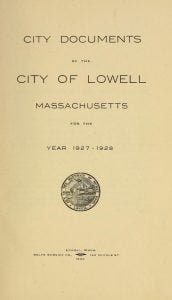
Lowell City Documents

Most towns in New England started publishing annual reports of the town’s public business in the 1800’s and many smaller towns still carry on that trait today. The following list of 52 free annual reports for Lowell Massachusetts covers the years of 1862-1928 (incomplete). Each town provided different reports in it’s annual publications, but they generally contain information on vital records (births, marriages and deaths) for the year of publication (not always included in early years), lists of public officials, lists of police officers, firemen, and other government workers, including school teachers. Don’t overlook the town’s expenditures list, as it often included payments made to town citizens for work they performed in the town’s behest. Also, many towns include payments made for the support of the indigent within the town.

The Clayhill Church Register 1887-1939

Clayhill Church Register Cover

Clayhill Church is off County Road 5511 in Brundidge, Pike County, Alabama. These images are digital representations of their complete church register covering the years of 1887-1939. This is a valuable source of genealogical information for those who comprised the membership of this church. It’s also a great complement to any transcription of it’s cemetery as it may include information on the unreadable headstones, and those who have no headstones. Included within this register are birth, baptism, death, burial and membership information. Unfortunately there was no marriage information recorded.

History of St. Joseph Church Prairie du Rocher Illinois

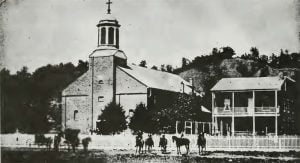
St. Joseph's Church and Rectory as originally built in 1858 and 1868 respectively

St. Joseph Church in Prairie du Rocher, Illinois, was established in 1722 as a chapel linked to the church of Ste. Anne at Fort Chartres. Following the founding of Fort Chartres in 1718 by Pierre Duque Boisbriant, the local community built a log chapel for the French settlers. Over time, the church gained prominence as Ste. Anne fell into disrepair, becoming a key parish for the French in the region. The current Romanesque church structure dates from 1858, embodying the parish’s rich history and cultural heritage.

Churches and Pastors of Seneca County New York

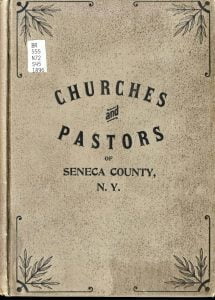
Churches and Pastors of Seneca County NY

The sketches in “Churches and Pastors of Seneca County, New York” do not aim for comprehensive history but provide a manual of local churches and pastors as of 1896. Compiled with contributions from local church members and pastors, the book organizes churches alphabetically by denomination and lists them geographically by town. It includes sketches of notable clergymen and highlights the predominance of Catholic churches, which limited their membership lists. The manual serves as a snapshot of the religious landscape of Seneca County at that time.

Illinois, Diocese of Belleville, Catholic Parish Records, 1695-1956

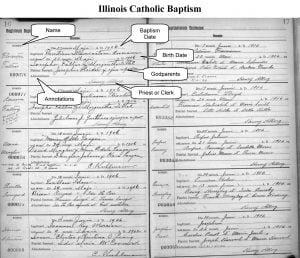
Illinois Bellville Church Records

A help guide for accessing the images of parish registers recording the events of baptism, first communion, confirmation (to 1907), marriage (to 1930) or death (to 1956) in the Diocese of Belleville (Illinois), Roman Catholic Church. The index to some volumes may reference pages within a given volume beyond current publication dates. As such, these images are not currently available. In addition to traditional parish registers, this collection includes a small number of census, church history, family and financial records. To assist the researcher I have broken down the available registers by county and name of parish, including the years covered by those parish records.

Church History of Norwich Vermont

The first generation of Norwich settlers accomplished a significant community milestone by constructing a meeting house for public worship within a decade of settlement. This project involved the entire community, showcasing their determination despite limited resources. A committee ultimately selected the location after significant debate, with the cornerstone laid in 1778. Delays due to the Revolutionary War slowed progress, but by 1785, the building was completed and became a site for various civic activities, including sessions of the Vermont Legislature. The meeting house served the town until 1817 when a new structure was erected due to growing needs.

History of the Episcopal Church at Norwich

The Episcopal Church at Norwich was organized in 1835, primarily due to Doctor Ira Davis’s efforts. From 1846 to 1850, services were conducted sporadically by Professor Hill and others. In 1851, Doctor Edward Bourne, then president of Norwich University, facilitated regular services held first in the University chapel and later in a church built in 1863, largely through Mrs. Charlotte Rogers’s contributions. Following the University’s relocation in 1866, services became infrequent, with a nearby church in Hanover becoming the main venue for worship.

History of the Baptist Church at Norwich Vermont

The Baptists in Norwich, Vermont, emerged as early dissenters against New England orthodoxy, with records indicating their presence soon after the town’s establishment. By 1799, an organized Baptist society was noted, although it lacked a dedicated minister or meeting house. Over time, membership dwindled, with some members joining the Methodists. In contrast, the nearby Sharon Baptist Church thrived, eventually constructing a meeting house in 1833. The Norwich Baptist community eventually dissolved early in the century, relocating to Sharon after a period of decline.

History of the Methodist Church at Norwich Vermont

Rev. Emanuel C. Charlton

Methodism in Vermont began to establish itself around 1796, with its first society formed in Vershire. The movement saw rapid growth, particularly in the early 19th century. In Norwich, Methodist meetings were initiated by circuit preachers by the early 1810s, leading to the construction of the first church around 1815. The current brick church at Union Village was built in 1836. Over the years, the community has faced population declines, yet the Methodist Episcopal Society of Norwich and Thetford continues to thrive, with about 150 families currently participating.

History of the Congregational Church of Norwich Vermont

Congregational Church, Norwich Village

The Congregational Church of Norwich, one of Vermont’s oldest congregational churches, was established in 1770, primarily by former members from Connecticut. Reverend Lyman Potter became its first settled minister in 1775. Early meetings were held in private homes or barns until the first meeting house was built around 1784. After several pastors, including Reverend James W. Woodward, who served from 1804 to 1821, tensions over meeting house locations led to the formation of the South Congregational Church in 1819. Despite the split, the original church maintained a strong membership.

Norwich Plain Meeting House

The Norwich Plain Meeting House was constructed in 1817 and dedicated on November 20 of the same year. Reverend R. W. Bailey served as the first pastor until 1823. Initially consisting of eleven members, the congregation grew significantly during Bailey’s ministry and subsequent leadership, including notable revivals under Reverend Doctor Roswell Shurtleff. The church moved to its current location in 1852, experiencing further growth, especially after absorbing members from the dissolved North Church in 1854. The church has had several pastors and continues to thrive.

The Ministerial Act of Vermont

The Ministerial Act, enacted by Vermont’s legislature in October 1783, mandated local taxation for building meeting houses and supporting ministers. In 1785, Norwich decided to assume the cost of its meeting house via taxation, raising £694 from its citizens. This tax, payable in various forms, equalized expenses for all, regardless of prior contributions. The meeting house became a town property, leading to new seating arrangements based on age and contribution. The Act remained until 1801, fostering a unified religious practice among Norwich’s residents.

Miscellaneous Notes In The Mackinac Registers

The Mackinac Register includes various entries related to church affairs, notably the elections of church wardens for Ste. Anne de Michilimakina. Noteworthy figures such as Charles Chaboillez and Daniel Bourassa were elected in 1787, committing to oversee the church’s interests. In 1821, new appointments were made, including William McGulpine and John Dousman, alongside instructions to manage church property and seek land for a new stone church. The records reflect the evolving religious governance within the community over the years.

First and Second Churches in Marblehead Massachusetts

The first church in Marblehead, established in 1649, initially featured Mr. Walton as a preacher until his death in 1668. On August 13, 1684, the church was formally organized with Samuel Cleever as pastor. He served for nearly fifty years until his death in 1724. The second church was formed in 1714, with a series of pastors serving over the years. The new stone church was built in 1824, reflecting the community’s evolving religious needs.