
Plans for the Colonization and Defense of Apalache, 1675

On June 15, 1675, Governor D. Pablo de Yta Salazar reported to the Spanish Crown on the suitability of Apalache for settlement due to its fertile soil and agricultural potential. He emphasized the need for Spanish families to establish farms, which would bolster local defenses against English and French encroachment. Salazar proposed importing families from the Canary Islands and suggested that Indian weavers assist with cotton production. His letter also highlighted the urgent necessity for fortifications in the face of rising threats from nearby enemies.
Who Really are the Cherokees?

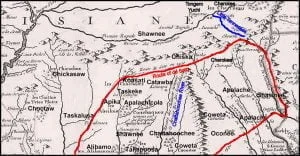
1718 French Map of North America - Detail

In his dissertation, archaeologist Bennie Keel confronted pressures from North Carolina to claim Cherokees had been in the region for 1,000 years, yet he found limited evidence before 1720, suggesting a gap in their historical record. Earlier towns identified in North Carolina and Tennessee often carried Creek or other Indigenous names, indicating possible cultural connections. The historical narrative of the Cherokees’ presence before the 18th century remains elusive, with European maps and archaeological findings contradicting claims of their long-standing habitation in the region.

Eyewitnesses who were never called to the witness stand

Between 1585 and 1600, a catastrophic event in the Southern Highlands led to the abandonment of major indigenous towns and the cessation of mound building, particularly in places like northwest Georgia and southeastern Tennessee. Archaeological evidence suggests a European invasion, possibly accompanied by deadly pathogens, decimated the native population. Following the 1976 adoption of a Cherokee-centric historical narrative, many archaeological interpretations misidentified other tribes, particularly failing to recognize the Shawnee and Muskogean presence in the region. Accurate identity verification remains essential in understanding the area’s complex past.

Chronology of European Occupancy in the Southern Highlands

The post outlines a detailed chronology of European activity in the Southern Appalachians, beginning with Captain René de Laundonnière’s exploration in 1564 and continuing through various events involving Spanish and French settlements, trade interactions, and conflicts with Native American tribes. It highlights the complex relationships between Europeans and indigenous populations, including intermarriage and the establishment of forts. The timeline also notes significant archaeological findings and discussions surrounding the ethnic identities of early settlers, leading to the eventual formation of various communities in the region.

Mysterious Cherokee Raiders

1591 Floridae Americae Provinciae Map

The Early History of Jackson County, GA outlines the existence of the Bohuron tribe, located northeast of modern Atlanta, and notes their Arabic-derived name meaning “Nobility.” In 1770, the Bohurons were defeated by the Talasee Creeks and, known for raiding Native American villages, were often mistakenly blamed for these attacks. Historical accounts highlight them as part of a broader pattern of predatory groups in the region. Additionally, Cherokee legends recall their role in sacking the capital of Apalache, revealing a turbulent history of conflict among tribes.

French Colonizing Expeditions

In 1562, Captain Jean Ribault established a temporary fort in Port Royal Sound, SC, leading French expeditions to claim territory and explore trade routes, including the Altamaha River. In 1564, Captain René Goulaine de Laudonniére sought to establish Fort Caroline and trade with the Apalache. These expeditions yielded valuable resources like gold and copper, despite ultimately leading to tragedy for the colonists. Pierre Gambie later created a trade network after the Fort Caroline massacre, hinting at continued French interest in the region.

The Migration Legend of the Kashita People

The Creek Indians, a diverse and assimilated group, faced significant decimation, particularly the Itsate-speaking Creeks, due to European diseases and slave raids. By the early 1700s, the Muskogee-speaking Creeks emerged dominant in west-central Georgia and east-central Alabama. The Migration Legend of the Kas’hita People, recorded in 1735, recounts their journey through northwest Georgia and encounters with various tribes. This narrative provides insight into the region’s history and cultural dynamics during a period when the Kas’hita integrated into the Creek Confederacy.

Apalachee Tribe

The Apalachee Indians, of Muskhogean ancestry, originally inhabited the Lake Jackson region around 1100-1511 before relocating to Florida. They were noted for their agricultural practices, strong societal organization, and notable resistance against Spanish colonization. Following a significant decline due to raids and the collapse of their political structure, many Apalachee relocated to Louisiana and other regions. The remaining bands, like the Talimali, signify the tribe’s enduring legacy, with their historical territory stretching from present-day Tallahassee to St. Marks.

Hitchiti Indian Tribe

The Hitchiti tribe, part of the southeastern Apalachian group, inhabited areas along the Chattahoochee River, known for their industriousness and honesty. They are believed to have originated from a canebrake near the coast, settling in various towns, including Hitchitúdshi and Tutalósi. Historically, they were members of the Creek confederacy, first noted in 1733. The Hitchiti language, distinct from Creek, once spread widely, and remnants of an ancient female dialect persist today. Their cultural heritage includes traditional songs, reflecting their linguistic history.

Apalachi Indian Tribe

The Apalachi, derived from the Apalachee Indians, spoke a distinct dialect linked to the Hitchiti and Mikasuki languages. Historically significant, the Apalachi province likely encompassed the upper Chattahoochee River basin. Notable towns included Apalachicola, known for its peaceable disposition and agricultural productivity. Throughout the 17th century, the Apalachi experienced conflicts with Spanish colonists, documenting their grievances to the Spanish crown. By the 19th century, the tribe’s remnants were primarily located in Louisiana, numbering just fourteen families by 1815.

Apalachee Indian Tribe

The Apalachee, a Muskhogean group, inhabited parts of western Florida and possibly extended into Georgia. Noted for their agricultural society, they centered around numerous towns and missions established by Spanish explorers in the 17th century. Their culture, blending influence from northern relatives and southern tribes, is reflected in their clothing and architectural styles. Historical accounts detail their encounters with Spanish expeditions, illustrating their resistance and eventual decline due to conflicts and external pressures, culminating in their near destruction in the early 18th century during colonial warfare.

Apalachee Indians

The Apalachee Indians, part of the Muskhogean linguistic family, were primarily located near present-day Tallahassee, Florida. Their history includes early encounters with Spanish explorers in the 16th century and significant resistance to colonization. By the 17th century, they experienced missionary efforts, rebellions, and conflicts with neighboring tribes. The Apalachee faced severe decline following attacks in the early 18th century, with most eventually migrating to Louisiana. Their population dwindled significantly, and today, few descendants remain, though their name persists in various geographic locations.