History of Amherst New Hampshire

Residence of Isaac Brooks in Amherst New Hampshire

The history of Amherst, New Hampshire, unfolds from its 1675 land grant to veterans of the Narraganset War, marking the impetus for settlement along the Souhegan River. From its early governance and incorporation in 1760 to territorial adjustments that birthed Mont Vernon and Milford, this narrative encompasses local geography, economy, and Indigenous presence. Key military engagements, civic institutions, and genealogical records are explored up to 1882, offering a comprehensive view of the town’s evolution and its prominent figures.
Essex County Massachusetts Probate Records 1635-1664

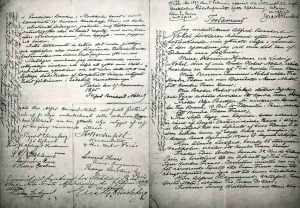
Sample Last Will and Testament

The “Governor and Company of Massachusetts Bay” established a judicial system in 1628, with a General Court in Boston and quarterly courts in major towns like Salem and Ipswich by 1635. These courts managed probate matters, and after Essex County’s formation in 1643, individual probate courts were later established in 1692. These are the probate records from 1635 to 1664, sourced from various original documents, including detailed wills and estate settlements.

The Amidon Family of Rehoboth, MA

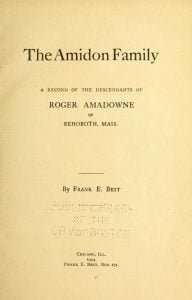
The Amidon Family

The Amidon Family genealogy book details the lineage of Roger Amadowne, a French Huguenot who fled to England and later to America after the revocation of the Edict of Nantes. Documented in Salem, Massachusetts in 1637, variations of his surname include Amadon, Amidown, and Ammidon. The work, organized with biographical sketches and two helpful indexes, presents the family’s history and is richly illustrated. Originally published in 1904, it serves as a valuable resource for descendants and historians alike.

History of Minneapolis and Hennepin County, Minnesota

History of Minneapolis and Hennepin County, Minnesota

The aim of this history was to present in a permanent form the key incidents in the history of Minneapolis, from its earliest settlement to its publication in 1895. The primary facts and events recounted were mostly obtained from living witnesses and participants. It was rare for a city with more than two hundred thousand inhabitants to have so many of its first settlers still alive. The city’s growth had been so extraordinary and unprecedented that many of its earliest settlers remained. Some information was also gleaned from the notes left by now-deceased writers who witnessed the events described. Great care was taken to verify the accuracy of all facts and incidents mentioned. While it might have been too much to hope that the work was entirely free from errors, it was confidently believed that any such errors were few and insignificant.

Richard Dexter Genealogy, 1642-1904

Arms of Dexter

Being a history of the descendants of Richard Dexter of Malden, Massachusetts, from the notes of John Haven Dexter and original researches. Richard Dexter, who was admitted an inhabitant of Boston (New England), Feb. 28, 1642, came from within ten miles of the town of Slane, Co. Meath, Ireland, and belonged to a branch of that family of Dexter who were descendants of Richard de Excester, the Lord Justice of Ireland. He, with his wife Bridget, and three or more children, fled to England from the great Irish Massacre of the Protestants which commenced Oct. 27, 1641. When Richard Dexter and family left England and by what vessel, we are unable to state, but he could not have remained there long, as we know he was living at Boston prior to Feb. 28, 1642.

Biography of Capt. John C. Rea

Capt. John C. Rea, born in 1837 in Franklin County, Illinois, developed expertise in farming and participated actively in the Civil War, where he rose to captain. After the war, he settled in Marion County, Arkansas, engaging in agriculture and advocating for education and law. Rea was an influential Democratic leader and served as justice of the peace. Married twice, he fathered several children, and his contributions to the community and commitment to farming earned him widespread respect as a public-spirited citizen.

Rea, George Whitefield – Obituary

George Whitefield Rea, born on October 7, 1839, in Pittsburgh, faced early hardships after his mother’s death. He served in the Civil War from 1864 until its end, later pursuing a legal career in Nebraska and Oregon. Rea held various judicial positions, including justice of the peace at his death. A devoted family man, he raised four children after his first wife’s passing and remarried Ella Garrett. Active in church and community, he passed away on October 18, 1911, leaving behind his wife, four children, and three sisters.

Rea, T. F.

T.F. Rea, a prominent figure in Baker County’s mining history, passed away at the age of 75 due to complications from two strokes, the first occurring in late February and the second in March. Originally from Fairfield, Iowa, he relocated to Auburn, Baker County with his family at the age of ten and dedicated his life to quartz mining in the region. His contributions to the local mining industry have been significant throughout his long residency.