
Descendants of Hon. Horatio Leonard Cushman of Taunton, MA

The Cushman family of Taunton, MA, traces its lineage back to Robert Cushman, a key figure in the Mayflower Pilgrims’ voyage. His son, Thomas, emerged as an important church elder in Plymouth. The family continued to thrive, with Horatio Leonard Cushman serving as mayor and a dedicated public servant. His son, Seth Leonard Cushman, succeeded him in local commerce, leading the Bristol County National Bank. The Cushman lineage reflects a rich heritage of civic duty and economic contribution in New England.
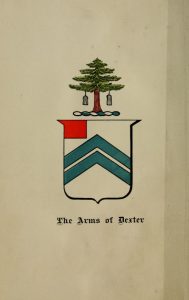
Richard Dexter Genealogy, 1642-1904

Arms of Dexter

Being a history of the descendants of Richard Dexter of Malden, Massachusetts, from the notes of John Haven Dexter and original researches. Richard Dexter, who was admitted an inhabitant of Boston (New England), Feb. 28, 1642, came from within ten miles of the town of Slane, Co. Meath, Ireland, and belonged to a branch of that family of Dexter who were descendants of Richard de Excester, the Lord Justice of Ireland. He, with his wife Bridget, and three or more children, fled to England from the great Irish Massacre of the Protestants which commenced Oct. 27, 1641. When Richard Dexter and family left England and by what vessel, we are unable to state, but he could not have remained there long, as we know he was living at Boston prior to Feb. 28, 1642.

Muster Roll of Captain Nathan Barker’s Company

Title page to the Aroostook War

Muster Roll of Captain Nathan Barker’s Company of Light Infantry in the Detachment of drafted Militia of Maine, called into actual service by the State, for the protection of its Northeastern Frontier, from the sixth day of March, 1839, the time of its rendezvous at Augusta Maine, to the twenty-sixth day of March, 1839, when discharged or mustered.

Appleton Family Genealogy of Saco Valley Maine

The Appleton family originated from Great and Little Waldingford, Suffolk, England, with John Appleton’s arrival in New England in 1635. Subsequent generations held significant roles in colonial governance, including resistance to oppressive taxation. Key figures include Samuel Appleton, a military leader in King Philip’s War, and Rev. Nathaniel Appleton, a Harvard graduate and minister. Many descendants eventually settled in Maine and contributed to local governance and community. Their legacy includes many distinguished individuals, cementing their influence in American history.

1923 Historical and Pictorial Directory of Angola Indiana

1923 Angola Indiana Directory Book Cover

Luedders’ historical and pictorial city directory of Angola, Indiana for the year 1923, containing an historical compilation of items of local interest, a complete canvass of names in the city, which includes every member of the family, college students, families on rural lines, directory of officers of county, city, lodges, churches, societies, a directory of streets, and a classified business directory.

Norwich Vermont in the Revolutionary War

Norwich, Vermont provided modest participation in the Revolutionary War, highlighted by its formation of a Committee of Safety in March 1777. Evidence suggests a militia was established as early as 1774. The town contributed to regiments under Colonels Warner and Bedell. Local militias organized for defense amid threats from British forces in 1776, further demonstrating Norwich’s involvement. Despite lacking comprehensive records, the enlistment of local soldiers was significant, along with efforts to protect the community from loyalist activities and contribute to the war effort.

Baldwin County Georgia Marriages 1806-1850

This index compiles 1,352 Baldwin County, Georgia marriage records from court documents covering 1806 to 1850. It lists groom, bride, and marriage date entries in chronological order, offering a valuable genealogical resource for tracing family history, local relationships, and early county residents across more than four decades.

Biography of William H. Paine

William H. Paine, born in 1820 in Warren County, Tennessee, became a prominent farmer and stockman in Lincoln Township, Missouri. He was the fourth of eleven children in a family descended from Georgia and South Carolina. Paine faced the challenges of pioneer life and had limited formal education, yet he developed strong mathematical skills through self-study. Married in 1848, he had thirteen children and lived primarily in Greene and Christian counties. An active participant in the Civil War, he served with the Missouri State Militia and was involved in significant battles.

Biographical Sketch of Charles Alfred Paine

Charles Alfred Paine, born in Cleveland on October 18, 1865, was a prominent banker and served in various roles throughout his career, including assistant cashier and later cashier of Central National Bank and president of National City Bank. He held vice presidential and director positions in several financial institutions and companies, contributing significantly to the banking sector. Paine married twice, first to Margaret Helen Martin and later to Ruth Elizabeth Kendig, with whom he had two children. He was also a member of multiple social clubs.

Biography of Prof. Charles Russell Paine

Prof. Charles Russell Paine, born in Barnstable, Massachusetts, in 1839, played a pivotal role in California’s educational landscape after moving there in 1870. He taught in several states before establishing a private school in San Bernardino and later serving as County Superintendent of Schools. Alongside his father-in-law, he ventured into fruit farming in Riverside, where they settled on previously barren land. His experiences as a pioneer, including amusing tales of early challenges, reflect his significant contributions to both education and agriculture in the region.

Biography of Willis S. Paine

Willis S. Paine, born in Rochester, N.Y., on January 1, 1848, is renowned for his significant contributions to banking oversight in New York. A valedictorian of his class at Rochester University, he practiced law under prominent attorneys and later became a bank examiner. His expertise led to his appointment as superintendent of the banking department by Governor Cleveland in 1883. Paine’s notable achievements include successful bank insolvencies and the revision of banking laws. He also authored influential works on banking and law, demonstrating a lifelong commitment to financial regulation and scholarship.

Biographical Sketch of Almond M. Paine

Benjamin Paine, a prosperous farmer in Glocester, R.I., had a significant family, including his son Ransom, a wheelwright and farmer. Ransom’s son, Judge Almond M. Paine, born in 1820, was educated and began teaching at fifteen. He settled in East Killingly, where he thrived as a merchant and held numerous public offices, including Justice of the Peace and Judge of Probate. Active in banking, he maintained a reputation for integrity. Almond married Phebe Salsbury, with whom he had two children.