History of Rindge New Hampshire

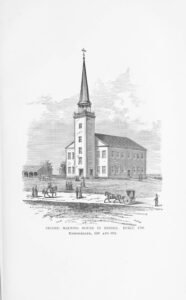
Second Meeting House in Rindge New Hampshire

The History of the Town of Rindge, New Hampshire by Ezra S. Stearns, was published in 1875, and covers the period from the original Rowley Canada grant or Massachusetts charter through the year 1874. Stearns traces the legal, territorial, and institutional development of Rindge, beginning with colonial land grants and boundary disputes and proceeding through settlement, incorporation into a town and development into a small manufacturing hub. More than half the volume is devoted to genealogical material. The genealogical register of Rindge families includes thousands of names compiled from a wide range of sources and assisted by contributions from residents and researchers beyond the town.

New Hampshire State Builders

Birthplace of George Franklyn Willey in the Summer

State Builders, published in 1903, serves as a historical and biographical account of New Hampshire at the turn of the twentieth century. Authored by local writers, it covers the state’s development across various sectors including politics, education, and industry, while documenting the lives of notable residents. The volume reflects both continuity and change in the state’s traditions, making it a valuable reference for understanding New Hampshire’s institutions and influential figures during this pivotal period.

Vital Records of Bellingham, Massachusetts

Vital Records of Bellingham Massachusetts to the year 1850

Alphabetical indexes to the vital records of Bellingham, Massachusetts, up to the year 1850, supplemented by information from bible records, church registers, cemetery inscriptions and other private sources to include the diary kept by Samuel Wight and his daughters.

Medway Massachusetts vital records

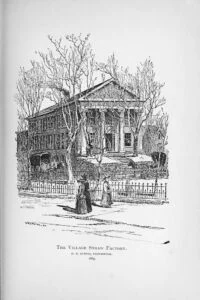
Medway Village Straw Factory

Alphabetical indexes to the vital records of Medway, Massachusetts, up to the year 1850, supplemented by information from church registers, cemetery inscriptions and other private sources to include Rev. Dr. Jacob Ide’s account of Marriages and Deaths, 1814-1849.

The Amidon Family of Rehoboth, MA

The Amidon Family

The Amidon Family genealogy book details the lineage of Roger Amadowne, a French Huguenot who fled to England and later to America after the revocation of the Edict of Nantes. Documented in Salem, Massachusetts in 1637, variations of his surname include Amadon, Amidown, and Ammidon. The work, organized with biographical sketches and two helpful indexes, presents the family’s history and is richly illustrated. Originally published in 1904, it serves as a valuable resource for descendants and historians alike.

History of Littleton New Hampshire

1895 Map of Littleton New Hampshire

The History of Littleton New Hampshire is comprised of three volumes, two volumes of history, and a final volume of genealogies. Considered one of the best examples of local history written in the early 20th century, is your ancestors resided in Littleton then you need these books. Read and download for free!

Weymouth ways and Weymouth people

Weymouth ways and Weymouth people

Edward Hunt’s “Weymouth ways and Weymouth people: Reminiscences” takes the reader back in Weymouth Massachusetts past to the 1830s through the 1880s as he provides glimpses into the people of the community. These reminiscences were mostly printed in the Weymouth Gazette and provide a fair example of early New England village life as it occurred in the mid 1800s. Of specific interest to the genealogist will be the Hunt material scattered throughout, but most specifically 286-295, and of course, those lucky enough to have had somebody “remembered” by Edward.

History of the township and village of Mazomanie, Wisconsin

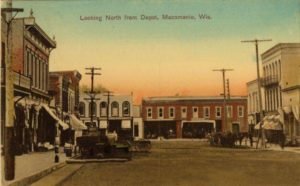
Looking North from Depot, Mazomanie, Wis.

The manuscript, History of the township and village of Mazomanie [Wisconsin] penned by William Kittle and published in 1900 collected information from a wide variety of sources, both documents, and living interviews. This book provides a general history of the township, and then presents a series of brief biographical sketches on the early settlers of Mazomanie. The links below will take you to the start of each historical section as detailed in the contents for the book, and then the specific pages of the book where each biographical sketch is contained. There is no index for the book, nor is there a list of biographical sketches contained within. We have taken the liberty of creating a biographical index for it.

The Original Grantees of Norwich Vermont

On July 5, 1761, a number of men received land grants for what would become Norwich, Vermont. Most were from Mansfield, Connecticut, though many never visited the town. The list includes individuals such as Eleazer Wales, Abner Barker, and Ebenezer Heath, among others. Notably, some opted not to accept their grants. The document serves as a historical record of the original grantees, highlighting their connections to Connecticut and their role in the early settlement of Norwich.

Biography of William L. Learned

William L. Learned, born July 24, 1821, in New London, Connecticut, became a distinguished jurist in Albany, New York. A Yale College graduate, he began his legal career after studying under notable lawyers. Elected to the Supreme Court in 1870, he served for eighteen years, known for his clear, analytical opinions and commitment to judicial integrity. Additionally, he contributed to legal education at Albany Law School and was involved in various civic projects, reflecting his dedication to both law and community welfare.

Biography of Hon. Alphonso Fowler Learned

Hon. Alphonso Fowler Learned, born in 1838 in Boston, Massachusetts, embarked on a diverse career spanning maritime service, commerce, and politics. After early schooling and a stint as a cabin boy, he settled in San Francisco, engaging in mercantile and newspaper ventures. He served as consul to Nicaragua and held various civic roles, including on the city council. Married to Isabelle McCurdy, he raised a family of six children while also contributing to Masonic leadership in China and Port Townsend.