
1923 Historical and Pictorial Directory of Angola Indiana

1923 Angola Indiana Directory Book Cover

Luedders’ historical and pictorial city directory of Angola, Indiana for the year 1923, containing an historical compilation of items of local interest, a complete canvass of names in the city, which includes every member of the family, college students, families on rural lines, directory of officers of county, city, lodges, churches, societies, a directory of streets, and a classified business directory.
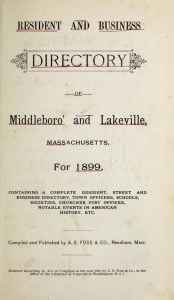
1899 Directory for Middleboro and Lakeville Massachusetts

1899 Middleboro and Lakeville Massachusetts Directory Cover

The 1899 Directory for Middleboro and Lakeville, Massachusetts, compiled by A. E. Foss & Co., provides a comprehensive list of residents and businesses, alongside town officers, schools, churches, and societies. It includes notable historical events and offers a detailed account of the local community, featuring numerous surnames from both towns. This directory serves as an essential resource for understanding the demographics and social structure of Middleboro and Lakeville during that period.

Hutchinson Family of Norwich Vermont

The Hutchinson family, one of the early settlers in Norwich, Vermont, traces its roots back to Massachusetts in the late 1620s. Abijah Hutchinson, a descendant, settled in Windham before moving to Norwich in 1765 with his son Samuel. They cleared land for farming and eventually made a permanent settlement. Samuel and his wife Jemina had several children, continuing the lineage. John Hutchinson, a soldier in the Continental Army, and his descendants include notable figures and various branches in New York and beyond.

Early Residents of Great Falls, Montana

The early residents of Great Falls, Montana, included Paris Gibson, a sheep rancher and land investor; Hon. H. P. Rolfe, a lawyer and former school superintendent; and George W. Taylor, the first lawyer in the city. E. G. Maclay, the first merchant, and Ira Myers, a lumber mill operator, also contributed to the community’s development. Other notable figures include H. W. Child, involved in mining and smelting, and J. H. Fairfield, a practicing surgeon and mayor. Each played a vital role in shaping Great Falls.

Old Norfolk County Massachusetts Records

The records detail various land transactions in Haverhill and Salisbury, Massachusetts, during the 1650s and 1660s. Notable transactions include the conveyance of house lots and land between individuals such as John Ward, Robert Swan, and Richard Currier, often with the presence of witnesses like Richard Littlehale. The documentation highlights the growth and development of property ownership in the region, with transactions often recorded in court. These records provide valuable insights into the lives of early settlers and the evolution of land use in Old Norfolk County.

Biography of William Martin Ladd

William Martin Ladd, a notable young official in Montgomery County, Kansas, serves as the postmaster of Dearing, having demonstrated his capabilities through a successful civil service examination. Born on October 4, 1891, in Vernon, he comes from a family of Scotch-Irish descent with strong ties to the region. Ladd’s professional background includes banking, and he has significantly enhanced local mail services. A member of the United Brethren Church and various fraternal organizations, he married Ethel M. Johnson in 1911, and they have one son.

Biography of W. Ladd

W. Ladd, born in Ontario in 1826, journeyed to California in 1851, initially mining in Virginia City. After a brief return to Michigan, he ventured west again in 1859, where he continued mining, worked as a millwright, and later became a contractor. In 1882, he settled in Redlands, cultivating a successful orange orchard. He was married twice, with three daughters from his second marriage to Mary Quillin. Ladd passed away in 1886, leaving behind a legacy of hard work and perseverance in California’s burgeoning landscape.

Surnames Kelly to Love

This document contains genealogical statements regarding various individuals and families of Creek, Choctaw, Chickasaw, and Mississippi Choctaw descent who sought recognition and enrollment in tribal rolls. The records, primarily from 1909 reports, detail claimants’ ancestry, enrollment issues, and tribal affiliations. Many individuals were denied enrollment due to factional disputes, legal technicalities, or failure to apply within deadlines. The document includes references to official reports and affidavits, offering insights into the complexities of Native American citizenship and land rights during the early 20th century.

Biography of John R. Ladd

John R. Ladd, born in 1838 in New York, moved to California in 1852 and later settled in Ladd’s Canyon, Oregon. He and his wife Rachel Knapp ran a successful hotel catering to miners. Ladd engaged in freighting, farming, and stock-raising, expanding his landholdings significantly. In 1877, he established a stage line and owned various properties. He passed away in 1887, leaving behind a legacy cherished by his family and community. His widow continues to manage his estate, while their children remain involved in agriculture in the area.

Biography of William Sargent Ladd

William Sargent Ladd, born in Vermont in 1826, emerged as a pivotal figure in Oregon’s development, fostering both economic and social progress. Initially drawn to the Pacific coast by its economic potential, he established a successful mercantile business in Portland and co-founded a significant bank. Ladd was known for his integrity, philanthropic efforts, and dedication to public education and welfare. His approach combined business acumen with a strong moral compass, earning him respect and admiration throughout Oregon. His legacy includes a commitment to community welfare and business responsibility.

Biography of W. S. Ladd

William Sargent Ladd, born in 1826 in Vermont, exemplified exceptional influence in Oregon’s development. Arriving in the nascent state in 1851, he built a successful mercantile and banking career, co-founding Ladd & Tilton Bank. A committed philanthropist, Ladd championed social and educational causes, consistently allocating a portion of his income to charity. Despite his wealth, he shunned political office but upheld moral integrity and fairness, earning respect as a community leader. His life reflected a profound dedication to the welfare of Oregon and its citizens, marking him as a pivotal figure in the state’s history.