Collections of the New Hampshire Historical Society

1892 Map of New Hampshire

The Collections of the New Hampshire Historical Society is a 15 publication series documenting the state’s history through various primary sources, including manuscripts, letters, and public records. It collates valuable narratives that were previously difficult to access, providing insight into events, individuals, and communities in New Hampshire. Each volume offers focused topics and historical analyses, and most volumes contain individual indexes.

History of Hampton New Hampshire vol 2

1892 Map of Hampton NH

The original version of this monumental work was published in 2 volumes. Volume 1 contains the history of the town of Hampton, New Hampshire from its settlement in 1638 to the autumn of 1892 and can be found here. Volume 2 featured the genealogical and biographical details of the early families of Hampton, NH up to the autumn of 1892 and this is the volume shown below. This manuscript was meticulously researched by Joseph Dow up until his death in 1889. Unfortunately his death preceded the final compilation of the genealogies and his daughter, Lucy Ellen Dow, took on the task after his decease. For genealogists this is an important fact. Lucy admits in her preface that she had difficulty bringing the genealogies down to date (1892) for lack of full understanding of Josiah Page’s notes and for the lack of accurate town records. As she laments about the town records “but whole decades are passed over with scarcely an entry of birth or marriage.” Indeed they are.

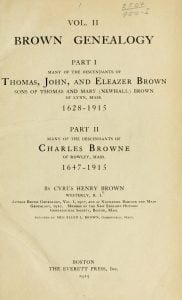
Brown Genealogy

Brown Genealogy

In 1895, Cyrus Henry Brown began collecting family records of the Brown family, initially with the intention of only going back to his great-grandfathers. As others became interested in the project, they decided to trace the family lineage back to Thomas Brown and his wife Mary Newhall, both born in the early 1600s in Lynn, Massachusetts. Thomas, John, and Eleazer, three of their sons, later moved to Stonington, Connecticut around 1688. When North Stonington was established in 1807, the three brothers were living in the southern part of the town. Wheeler’s “History of Stonington” contains 400 records of early descendants of the Brown family, taken from the town records of Stonington. However, many others remain unidentified, as they are not recorded in the Stonington town records. For around a century, the descendants of the three brothers lived in Stonington before eventually migrating to other towns in Connecticut and New York State, which was then mostly undeveloped. He would eventually write this second volume of his Brown Genealogy adding to and correcting the previous edition. This book is free to search, read, and/or download.

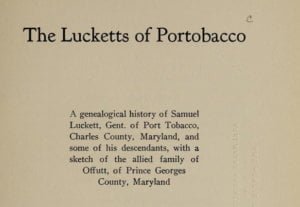
The Lucketts of Portobacco

The Lucketts of Portobacco

A genealogical history of Samuel Luckett, Gent, of Port Tobacco, Charles County, Maryland, and some of his descendants, with a sketch of the allied family of Ofifutt, of Prince Georges County, Maryland.

Adams, Adderton, Addison, Alexander, Applebaugh, Ashby, Atkisson, Baggett, Bainbridge, Baldwin, Barnes, Barney, Bartlett, Battle, Beale, Beall, Beatty, Beaven, Belt, Benson, Bethel, Blair, Borden, Bottrell, Bowie, Bradford, Brazier, Brengle, Briscoe, Brocke, Brogdon, Brown, Bryan, Burgess, Campbell, Cantwell, Carr, Carroll, Cave, Chiswell, Clapman, Clements, Clephane, Contee, Cooke, Cooper, Cope, Cox, Creek, Cumming, Dade, Davis, Delahay, Dent, Doling, Dorry, Dorsey, Douglas, Drone, Duval, Eagler, Earle, Edelen, Edmonston, Elms, Evans, Fendall, Ferguson, Field, Fink, Floyd, Fouch, Franklin, Galford, Gladden, Glahn, Glenn, Godfrey, Goodrick, Gracey, Graham, Gray, Green, Griffin, Gulick, Haddox, Hall, Hamill, Hamilton, Hanson, Harding, Harris, Harrison, Harrold, Hawkins, Haynie, Hobbs, Hobson, Holton, Hussey, Jamieson, Jenifer, Jenkins, Jett, Johnson, Jones, Jordan, Kalbfleisch, Keith, Kennedy, Kenner, Kerrick, Kybert, Langworth, Lawson, Lennarts, Lewis, Lilley, Lowe, Luckett, Lynn, Maddox, Magruder, Mantz, Manzy, Markham, Marlow, Martin, Marye, Mastin, Matthews, McCane, McCauley, Metcalf, Middleton, Miller, Minor, Mooney, Moore, Morehead, Morris, Mudd, Muir, Murray, Neale, Nelson, Nesbit, Nichnow, Nichollas, Odom, Offord, Offutt, Oldham, ORea, Orrell, Parker, Parnell, Patton, Payne, Perry, Peters, Peyton, Posey, Price, Ramsey, Rankin, Rasbury, Ratliff, Reed, Robey, Robinson, Roxborough, Sage, Sargeant, Sayles, Scott, Sewell, Seydel, Shaw, Shrive, Sidener, Skinner, Smith, Smoot, Sprigg, Spriplin, Steel, Stone, Sugar, Swansted, Swearingen, Taylor, Theobald, Thickpenny, Thompson, Tolson, Tongue, Trundle, Tyler, Venom, Wall, Wallace, Ware, Watkins, West, Westman, Wheadon, Wheeler, White, Whiting, Wickliff, Willcoxen, Williams, Withers, Witt, Wood, Woods, Woodward, Yates, Yost.

Allen Genealogy of New Bedford Massachusetts

In March 1635, George Allen and his family sailed from England to New England with Rev. Joseph Hull, settling initially in Weymouth before moving to Sandwich, Massachusetts. As a yeoman farmer, he became involved in local governance, serving as constable and deputy to the General Court. George’s descendants include prominent figures in Old Dartmouth, with familial branches spreading throughout Massachusetts and beyond. The Allen family navigated challenges of religious intolerance while establishing their legacy, and their story reflects the broader historical tapestry of early New England settlements.

Hussey and Morgan Families of New Bedford MA

The Hussey and Morgan families have a significant history in New Bedford, dating back nearly a century. Key figures include George Hussey and Charles Wain Morgan, both influential in the whaling and shipping industries during the early nineteenth century. Christopher Hussey, their ancestor, was among the early settlers in New England, while George Hussey and his son were prominent ship merchants. Charles Morgan, who also established a successful shipping business, contributed to community institutions and left an enduring legacy in New Bedford’s wealthy society.

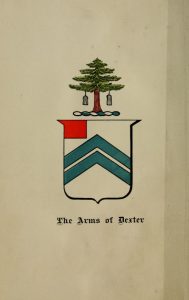
Richard Dexter Genealogy, 1642-1904

Arms of Dexter

Being a history of the descendants of Richard Dexter of Malden, Massachusetts, from the notes of John Haven Dexter and original researches. Richard Dexter, who was admitted an inhabitant of Boston (New England), Feb. 28, 1642, came from within ten miles of the town of Slane, Co. Meath, Ireland, and belonged to a branch of that family of Dexter who were descendants of Richard de Excester, the Lord Justice of Ireland. He, with his wife Bridget, and three or more children, fled to England from the great Irish Massacre of the Protestants which commenced Oct. 27, 1641. When Richard Dexter and family left England and by what vessel, we are unable to state, but he could not have remained there long, as we know he was living at Boston prior to Feb. 28, 1642.

Biography of Lewis T. Hussey

Lewis T. Hussey, born in 1866 in Ohio, moved to Kansas as a child and became a prominent figure in the insurance industry. He served as a deputy register of deeds and later established the Metropolitan Accident Association, which evolved into the Continental Casualty Company. His leadership as mayor of Lyndon led to significant public infrastructure improvements. Appointed state fire marshal in 1915, Hussey has dedicated himself to fire safety and community welfare, while also engaging in various civic and fraternal organizations. He is married with two sons.

Biography of Jerry Hussey

Jerry Hussey, a notable figure in Kansas history, was born in Vermont in 1845 and became an orphan at a young age. He enlisted in the Civil War at just 16 and endured captivity in Libby Prison. After the war, he moved to Kansas in 1868, transforming a wilderness into a thriving farm. A respected community member, he served as Osage County’s register of deeds and was active in local organizations. Hussey had three marriages and two children, living a life marked by resilience and dedication to his community.

John A. Hussey

Sergt. John A. Hussey, son of Eli and Mrs. W. A. Hussey from Randolph County, entered military service on December 24, 1916, in Greensboro, N.C. His career included postings in Columbus, Ohio, San Francisco, Honolulu, and Kerney, California. He served with the Second, 32nd, and 82nd Infantry, ultimately serving in the Construction Division until he was mustered into reserve on July 23, 1919.