History of Rindge New Hampshire

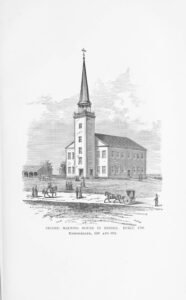
Second Meeting House in Rindge New Hampshire

The History of the Town of Rindge, New Hampshire by Ezra S. Stearns, was published in 1875, and covers the period from the original Rowley Canada grant or Massachusetts charter through the year 1874. Stearns traces the legal, territorial, and institutional development of Rindge, beginning with colonial land grants and boundary disputes and proceeding through settlement, incorporation into a town and development into a small manufacturing hub. More than half the volume is devoted to genealogical material. The genealogical register of Rindge families includes thousands of names compiled from a wide range of sources and assisted by contributions from residents and researchers beyond the town.

New Hampshire Men of Progress

1892 Map of New Hampshire

New Hampshire Men of Progress contains 289 biographical sketches and portraits of leaders in business and professional life in and of the state of New Hampshire. It was edited by the staff of the Manchester Union under the supervision of Richard Herndon.

History of Francestown New Hampshire

Map of Francestown New Hampshire

History of Francestown, New Hampshire is a historic and genealogical record of the town from its first settlement in 1758 through the beginning of 1891. It records Francestown’s settlement, civic growth, religious and educational institutions, military participation, industries, and social customs, followed by an extensive genealogical register of families associated with the town.

Vital Records of Bellingham, Massachusetts

Vital Records of Bellingham Massachusetts to the year 1850

Alphabetical indexes to the vital records of Bellingham, Massachusetts, up to the year 1850, supplemented by information from bible records, church registers, cemetery inscriptions and other private sources to include the diary kept by Samuel Wight and his daughters.

History of Amherst New Hampshire

Residence of Isaac Brooks in Amherst New Hampshire

The history of Amherst, New Hampshire, unfolds from its 1675 land grant to veterans of the Narraganset War, marking the impetus for settlement along the Souhegan River. From its early governance and incorporation in 1760 to territorial adjustments that birthed Mont Vernon and Milford, this narrative encompasses local geography, economy, and Indigenous presence. Key military engagements, civic institutions, and genealogical records are explored up to 1882, offering a comprehensive view of the town’s evolution and its prominent figures.

1910 Eastern Shawnee Census

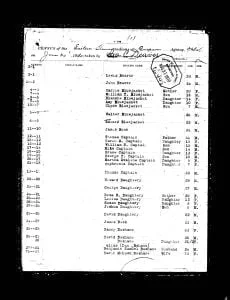
1910 Eastern Shawnee Census – page 1

Pages of the 1910 Eastern Shawnee Census. Contains table showing the previous roll number, current roll number, Indian name if given, English name if given, Relationship, Age, and Sex. Also contains the original images of the census.

1914 Eastern Shawnee Census

The 1914 census record of the Eastern Shawnee Tribe from the Quapaw Agency was taken on June 30, 1914, in Indian Territory, which is now Oklahoma. The Eastern Shawnee Tribe primarily resides in northeastern Oklahoma, having separated from other Shawnee groups in the 19th century to establish their community in this region. Recognized as a federally recognized tribe, the Eastern Shawnee have their own government and tribal structure. The purpose of the 1914 census was to maintain an official record of the Eastern Shawnee Tribe members as part of the U.S. government’s broader efforts to document Native American populations. This census provides detailed information about individual tribe members, including their names, ages, sex, family relationships, allotment numbers, and roll numbers.

Sevier County 1830 Tennessee Census

1830 Sevier County Census transcription

Published in Knoxville, Tennessee in 1956 and distributed by the Genealogical Publishing Company of Baltimore, Maryland, Sevier County, Tennessee: Population Schedule of the United States Census of 1830 (Fifth Census) provides a transcription of the often difficult to read, 1830 Sevier County Tennessee census. Authored by Blanche C. McMahon and Pollyanna Creekmore, this meticulous reproduction of the original census record sheds light on the people of Sevier County in 1830.

Wintergreen Cemetery, Port Gibson, Mississippi

Wintergreen Cemetery, Port Gibson, Mississippi

This survey of Wintergreen Cemetery, Port Gibson, Mississippi, was completed in 1956 by Mr. Gordon M. Wells and published by Joyce Bridges the same year. It contains the cemetery readings Mr. Wells was able to obtain at that date. It is highly likely that not all of the gravestones had survived up to that point, and it is even more likely that a large portion of interred individuals never had a gravestone.

Marriages of Orange County, Virginia, 1747-1810

Marriages of Orange County, Virginia, 1747-1810

Catherine Lindsay Knorr’s Marriages of Orange County, Virginia, 1747-1810 stands as a pivotal work for genealogists and historians delving into the rich tapestry of Virginia’s past. Published in 1959, this meticulously compiled volume sheds light on the matrimonial alliances formed within Orange County, Virginia, during a period that was crucial to the shaping of both local and national histories. The absence of a contemporary marriage register presented a formidable challenge, yet through exhaustive examination of marriage bonds, ministers’ returns, and ancillary records, Knorr has reconstructed a reliable record of these marriages.

Idaville Community, A Century of Unity, 1860-1960

Idaville community centennial, a century of unity, 1860-1960

The “Idaville Community, A Century of Unity, 1860-1960” is a seminal work that offers a comprehensive look into the first century of Idaville and its neighboring townships within White County and Adams Township of Carroll County. Published by the Idaville Centennial Committee in 1960, this volume was crafted to commemorate the centennial celebration of these communities, highlighting a century marked by unity and growth. Through the diligent efforts of the Idaville Centennial Committee, this book was designed to preserve the memory of the pivotal moments that have shaped these areas.

History of Ontario County, New York, part 1

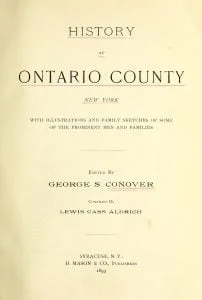
History of Ontario County, New York

“History of Ontario County, New York: With Illustrations and Family Sketches of Some of the Prominent Men and Families” is a comprehensive historical compilation, organized by Lewis Cass Aldrich and meticulously edited by George Stillwell Conover. Published in 1893 by D. Mason & Co., Syracuse, N.Y., this monumental work illuminates the rich tapestry of Ontario County’s past. Recognizing the voluminous nature of the original single volume, it has been thoughtfully divided into two parts for convenience and accessibility. Part 1 encompasses the historical and biographical narrative of Ontario County, laying the foundation for the genealogical treasures contained in Part 2.

History of Adair County Iowa and its People – vol 2

History of Adair County, Iowa, and its people vol 2 title page

Back in 1915, Lucian Moody Kilburn, was engaged to write a history of Adair County Iowa by the Pioneer Publishing Company of Chicago Illinois, he then being at that time a resident of the county for 50 years. The manuscript was divided into two volumes. This volume, numbered 2, provides biographical sketches of 348 leading men and women of the County of Adair including many of its founding families. You can read or download the free eBook from this website.

Journal of Rockingham County History and Genealogy 1976-1978

Journal of Rockingham County History and Genealogy vol I, Number 1, April 1976

The Rockingham County Historical Society in Wentworth, NC, publishes the Journal of Rockingham County History and Genealogy twice a year, in April and October. This journal includes articles about the history and genealogical resources of Rockingham County, North Carolina, and the surrounding areas. The historical articles are of high quality and extensively researched. This book covers the first three years of publication, 1976-1978. A full index can be found at the end of each individual volume.

Brown Genealogy

Brown Genealogy

In 1895, Cyrus Henry Brown began collecting family records of the Brown family, initially with the intention of only going back to his great-grandfathers. As others became interested in the project, they decided to trace the family lineage back to Thomas Brown and his wife Mary Newhall, both born in the early 1600s in Lynn, Massachusetts. Thomas, John, and Eleazer, three of their sons, later moved to Stonington, Connecticut around 1688. When North Stonington was established in 1807, the three brothers were living in the southern part of the town. Wheeler’s “History of Stonington” contains 400 records of early descendants of the Brown family, taken from the town records of Stonington. However, many others remain unidentified, as they are not recorded in the Stonington town records. For around a century, the descendants of the three brothers lived in Stonington before eventually migrating to other towns in Connecticut and New York State, which was then mostly undeveloped. He would eventually write this second volume of his Brown Genealogy adding to and correcting the previous edition. This book is free to search, read, and/or download.

St. Charles County’s Participation in the World War

St. Charles County's Participation in the World War

Soon after World War 1 localities across the country wished to honor the men and women who had served the Nation from their locality. St. Charles County, Missouri, is one of these counties. This manuscript isn’t limited to just the men who fought overseas, it also includes the women who had participated via Red Cross and the men who had actively served in the various campaigns backing the War here at home.

History of Bentleysville, Pennsylvania

Bentleysville title page

This book is a collection of stories, letters, and historical records detailing the brief history of Bentleysville, a rural community in southwestern Pennsylvania. Established around a mill operated by Sheshbazzar Bentley Sr. and Jr. on Pigeon Creek in 1816, the town grew to a population of 300 by 1868. The author traces the origins of Bentleysville back to the 1770s to document the earliest settlers, while also providing context through significant national events like the Whiskey Rebellion and the Civil War. Although Bentleysville’s history as a village ended before 1900, this work preserves its legacy for future generations.