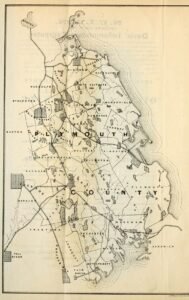
Genealogies of Pembroke New Hampshire

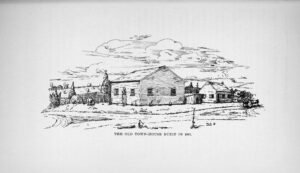
Old Pembroke NH Town House, built 1811

The “Genealogies of Pembroke, New Hampshire” is derived from the town’s second historical volume, and documents the connections of early settler families through the nineteenth century. It emphasizes families of the first settlers and families who resided in Pembroke over a long period of time. Organized alphabetically by surname, the genealogies use a consistent numbering system for easy reference. Carter draws from diverse sources, including town records and personal accounts of Pembroke’s citizens, while acknowledging possible inaccuracies in both their memory and the collection of information. However, by preserving these family lineages, Carter enhances the town’s historical narrative, complementing the first volume’s historical content. Supplementing this volume of genealogies is a compilation of marriage records which occurred in Pembroke, New Hampshire, from 1739 through 1895.

New Hampshire Men

1892 Map of New Hampshire

New Hampshire Men presents 407 biographical sketches, with portraits, of men who were active in commercial, professional, and political life in New Hampshire in 1893.

Abington Massachusetts Marriage and Death Records

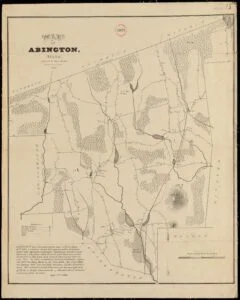
1830 Map of Abington, Massachusetts

Volume 2 of the Abington, Massachusetts vital records compiles marriage and death records up to 1850, complementing Volume 1, which contains birth records. Established in 1712, Abington’s boundaries have shifted, affecting historical jurisdiction. Extensive research from town records, cemeteries, and family Bibles ensured comprehensive documentation, including the identification of Black families recorded by given names. The volume is organized alphabetically by marriages and deaths.

History of Hampton New Hampshire vol 2

1892 Map of Hampton NH

The original version of this monumental work was published in 2 volumes. Volume 1 contains the history of the town of Hampton, New Hampshire from its settlement in 1638 to the autumn of 1892 and can be found here. Volume 2 featured the genealogical and biographical details of the early families of Hampton, NH up to the autumn of 1892 and this is the volume shown below. This manuscript was meticulously researched by Joseph Dow up until his death in 1889. Unfortunately his death preceded the final compilation of the genealogies and his daughter, Lucy Ellen Dow, took on the task after his decease. For genealogists this is an important fact. Lucy admits in her preface that she had difficulty bringing the genealogies down to date (1892) for lack of full understanding of Josiah Page’s notes and for the lack of accurate town records. As she laments about the town records “but whole decades are passed over with scarcely an entry of birth or marriage.” Indeed they are.

History of Littleton New Hampshire

1895 Map of Littleton New Hampshire

The History of Littleton New Hampshire is comprised of three volumes, two volumes of history, and a final volume of genealogies. Considered one of the best examples of local history written in the early 20th century, is your ancestors resided in Littleton then you need these books. Read and download for free!

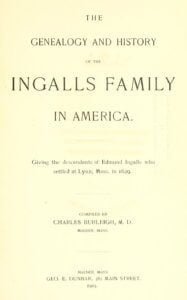
The genealogy and history of the Ingalls family in America

The genealogy and history of the Ingalls family in America

Edmund Ingalls, son of Robert, was born about 1598 in Skirbeck, Lincolnshire, England. He immigrated in 1628 to Salem, Massachusetts and with his brother, Francis, founded Lynn, Massachusetts in 1629. He married Ann, fathered nine children, and died in 1648.

1st Mississippi Light Artillery

The 1st Mississippi Light Artillery, also known as Withers’ Light Artillery, comprised several companies raised across Mississippi, participating in key battles during the Civil War. Initially assembled in May 1862, the regiment played a crucial role in the defense of Vicksburg against Union forces, with notable contributions at Chickasaw Bayou and the Vicksburg campaign. Throughout its service, the artillery faced significant casualties and challenges, ultimately surrendering at Vicksburg in July 1863. Afterward, surviving members regrouped as infantry before continuing their service in various capacities.

Descendants of Alexander Bisset Munro of Bristol, Maine

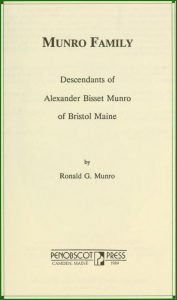
Munro Family

Alexander Bisset Munro was born 25 Dec. 1793 at Inverness, Scotland to Donald and Janet (Bisset) Munro. Alexander left Scotland at the age of 14, and lived in Dimecrana in the West Indies for 18 years. He owned a plantation, raising cotton, coffee and other produce. He brought produce to Boston Massachusetts on the ship of Solomon Dockendorff. To be sure he got his money, Solomon asked his to come home with him, where he met Solomon’s sister, Jane Dockendorff. Alexander went back to the West Indies, sold out, and moved to Round Pond, Maine, and married Jane. They had 14 children: Janet, Alexander, Margaret, Nancy, Jane, Mary, Solomon, Donald, John, William, Bettie, Edmund, Joseph and Lydia.

Bean and Bane Family Genealogy of Saco Valley Maine

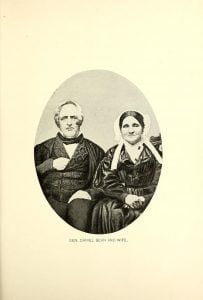
Gen. Daniel Bean and Wife

The Bean and Bane family genealogy traces origins to a supposed ancestor from the Isle of Jersey, though evidence suggests a Scottish lineage, with the surname derived from Gaelic meaning “fair.” Key figures include Lewis Bane, who settled in Boston around 1670, and his sons, who established roots in York, Maine. Captains Lewis and Joseph Bane played prominent roles in early settlements and conflicts with Native Americans. Generations of Beans and Banes contributed significantly to the region’s history, including military service and local governance.

Disbursements to Cherokees under the Treaty of May 6, 1828

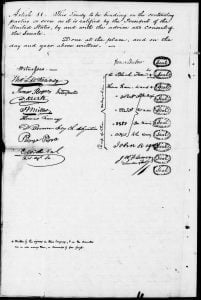
Treaty of May 6, 1828, page 9

An abstract of disbursements made by Cherokee agent George Vashon records payments to 390 Cherokee families, totaling 1,835 individuals, under the fifth article of the 1828 treaty. Between September 1830 and December 1833, Vashon distributed $47,251.75 of the $50,000 congressional grant by War Department drafts, with a slight discrepancy from the actual recorded amount.

1899 Directory for Middleboro and Lakeville Massachusetts

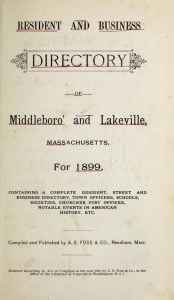
1899 Middleboro and Lakeville Massachusetts Directory Cover

The 1899 Directory for Middleboro and Lakeville, Massachusetts, compiled by A. E. Foss & Co., provides a comprehensive list of residents and businesses, alongside town officers, schools, churches, and societies. It includes notable historical events and offers a detailed account of the local community, featuring numerous surnames from both towns. This directory serves as an essential resource for understanding the demographics and social structure of Middleboro and Lakeville during that period.

Genealogical and Family History of Vermont

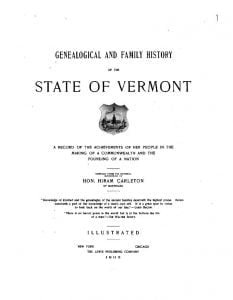
Genealogical and Family History of the State of Vermont vol 1

Hiram Charlton took on the publication of the Genealogical and Family History of the State of Vermont for Lewis Publishing. In it, he enlisted the assistance of living residents of the state in providing biographical and genealogical details about their family, and then he published all 1104 family histories in two distinct volumes.

Narrative of the Captivity of Mrs. Mary Rowlandson – Indian Captivities

In February 1676, during King Philip’s War, Mrs. Mary Rowlandson was captured by Native Americans after her home in Lancaster was attacked. She witnessed horrific violence and loss, including the deaths of family members and friends, as the assailants burned homes and killed indiscriminately. Throughout her captivity, she endured immense physical and emotional suffering, facing starvation and constant fear. Yet, she found strength in her faith, documenting her ordeal and reflecting on God’s providence. Ultimately, she was redeemed after many harrowing weeks, reuniting with her husband but mourning the loss of her child and other relatives.

The Micmac Indians At Bay d’Espoir

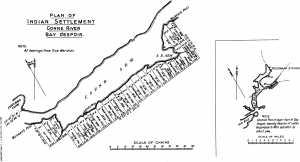
Plan of Indian Settlement Conne River Bay Despoir

A detailed report on the Micmac settlement at Bay d’Espoir in Newfoundland, describing the community’s land, housing, church, school, diet, trapping economy, and leadership. It also warns that declining game, encroaching Europeans, and lack of land titles threaten their future, while historical notes trace the Micmacs’ arrival in Newfoundland and their impact on the Beothuks.

Biographical Sketch of George E. Drew

George E. Drew was born on December 12, 1872, to Charles and Martha (Lee) Drew in Webber Hills. He received his education at the Orphan Asylum and married Susie Putnam, daughter of Zachariah and Eunice (Bledsoe) Putnam, on November 8, 1894. The couple had five children: Eugene H. (1896), Richard F. (1899), Eunice P. (1902), Paula E. (1910), and Howard L. Drew (1912).

Biographical Sketch of Frank M. Drew

Frank M. Drew, born in New York City on June 30, 1852, was a prominent theater manager and businessman. Educated in Philadelphia, he initially pursued acting before shifting to the circus and museum industries for sixteen years. Drew constructed the Cleveland Theater in 1883 and partnered with Mr. Campbell on various playhouses. A member of the Elks and Masonic bodies, he married Blanche C. Collard in 1885 and had six children, maintaining a summer residence in Girard, Pennsylvania.

Biographical Sketch of H. L. Drew

H. L. Drew, originally from Michigan, spent his early career in lumbering and merchandising before serving as a Captain in the Union army during the Civil War. After struggling with health issues linked to severe forest fires, he relocated to San Bernardino in 1875. Known for his public spirit, Drew has actively contributed to the city’s development, notably helping secure railroad construction in the valley. He also engages in agriculture, owning a significant ranch dedicated to citrus fruit cultivation.

Improvements to Annexed Cherokee Lands

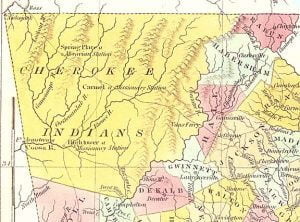
1830 Map of Cherokee Territory in Georgia

The Treaty of May 6, 1828, granted the Cherokee Nation 7 million acres as a permanent home, recognizing their sovereignty while mandating the cession of remaining lands to the United States. As a result, some Cherokee settlers were displaced from previously believed tribal lands. The treaty stipulated that land ceded would be appraised, and cash payments would be made for improvements made by proprietors. Numerous accounts detail the assessed value of various improvements, reflecting the complexities of land and ownership during this period.