Index to Articles found in the El Farol Newspaper 1905-1906

El Farol Masthead

The Lincoln County New Mexico online archives contains pdf’s of all remaining copies of the El Farol Newspaper of Capitan NM, but doesn’t have an index to the newspaper. C. W. Barnum, an active member of AHGP, and state coordinator for the New Mexico AHGP recently invested his time and energy into providing an every person index to the various extant issues. He has shared this wonderful index with AccessGenealogy in hopes that it will reach a wider audience. Enjoy!
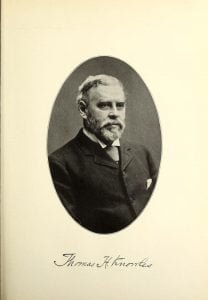
Knowles Family of New Bedford, MA

thomas knowles

The Knowles family, established in New Bedford for nearly a century, descends from the ancient lineage in Eastham, Massachusetts. Key figures include Thomas and James H. Knowles, whose firm was pivotal in the whaling industry. The family name was upheld by later generations engaged in diverse business and civic roles, greatly impacting local commerce and community welfare. Noteworthy individuals include Capt. John P. Knowles, a prominent whaling captain, and Joseph Knowles, influential in cotton manufacturing. The family’s legacy intertwines with New Bedford’s rich maritime history.

Progressive Men of Western Colorado

Early Life in Colorado

This manuscript, in its essence, is a collection of 948 biographies of prominent men and women, all leading citizens of Western Colorado. In this context, Western Colorado encompasses the counties of Archuleta, Chaffee, Delta, Eagle, Garfield, Gunnison, Hinsdale, La Plata, Lake, Mesa, Mineral, Moffat, Montezuma, Montrose, Ouray, Pitkin, Rio Blanco, Routt, San Juan, and San Miguel.

Wright Family of Boston, MA

The Wright family, an early Boston lineage, traces its origins to Richard Wright, who settled in Plymouth around 1644. Over generations, the family intermarried with prominent New England clans like the Adams and Wentworths. Notable descendants include Theodore Francis Wright, a significant figure in the New Jerusalem Church, and Augustus Hunt Wright, a Civil War veteran and community leader in Abington. Their legacy reflects the family’s deep roots in American history and its contributions to religion, education, and civic life in Massachusetts.

Captain McGehee, G. M. D. No. 673, Harrisonville District

The document lists individuals associated with Captain McGehee in the Harrisonville District, including various Allen, Bailey, and Johnston family members, as well as many others. Notable figures such as sheriff Bruster and esquire Glenn are mentioned among a significant number of residents, highlighting the community’s demographic during this period. This compilation of names serves as a historical record of local leadership and citizenry under McGehee’s command, reflecting the social structure and connections within the district.

Establishment of Fort Smith in 1817

Quapaw Cession Map

In 1817, a military post was established at Belle Point, now Fort Smith, Arkansas, to protect white settlers and the Cherokee from Osage hostilities. Major William Bradford led the detachment tasked with this, supported by Major Stephen H. Long, who surveyed the area. The post was strategically located at the junction of the Poteau and Arkansas rivers, facilitating navigation and trade. Subsequent treaties with the Osage and other tribes led to significant land cessions, shaping early relations and territorial boundaries in the region.

Richard Dexter Genealogy, 1642-1904

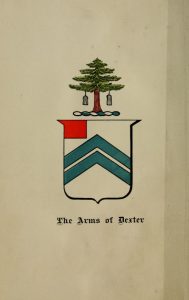
Arms of Dexter

Being a history of the descendants of Richard Dexter of Malden, Massachusetts, from the notes of John Haven Dexter and original researches. Richard Dexter, who was admitted an inhabitant of Boston (New England), Feb. 28, 1642, came from within ten miles of the town of Slane, Co. Meath, Ireland, and belonged to a branch of that family of Dexter who were descendants of Richard de Excester, the Lord Justice of Ireland. He, with his wife Bridget, and three or more children, fled to England from the great Irish Massacre of the Protestants which commenced Oct. 27, 1641. When Richard Dexter and family left England and by what vessel, we are unable to state, but he could not have remained there long, as we know he was living at Boston prior to Feb. 28, 1642.

Representative Men of Maine – Biographical Sketches and Portraits

Representative Men of Maine Title Page

A historical collection of portraits and biographical sketches of prominent Maine residents in business, industry, the professions, and politics, along with profiles of every governor since statehood in 1820. Published in 1893, it offers a rich snapshot of the people who shaped Maine’s public life and leadership.

History of Kossuth, Hancock, and Winnebago Counties, Iowa

History of Kossuth, Hancock, and Winnebago counties, Iowa

History of Kossuth, Hancock, and Winnebago Counties, Iowa together with sketches of their cities, villages and townships, educational, civil, military and political history; portraits of prominent persons, and 638 biographies of representative citizens. Also included is a history of Iowa embracing accounts of the pre-historic races, and a brief review of its civil and military history.

1899 Directory for Middleboro and Lakeville Massachusetts

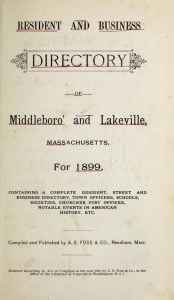
1899 Middleboro and Lakeville Massachusetts Directory Cover

The 1899 Directory for Middleboro and Lakeville, Massachusetts, compiled by A. E. Foss & Co., provides a comprehensive list of residents and businesses, alongside town officers, schools, churches, and societies. It includes notable historical events and offers a detailed account of the local community, featuring numerous surnames from both towns. This directory serves as an essential resource for understanding the demographics and social structure of Middleboro and Lakeville during that period.

Melungeons

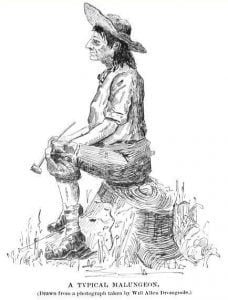
A cartoon mocking the typical Melungeon.

The term “Melungeon” has various interpretations and origins, possibly stemming from the French word “mélange” or the English “malengin.” Historically marginalized, Melungeons were often classified as white, Indian, or free people of color based on skin tone. Their ancestry is complex, with some scholars linking them to mixed-race unions in colonial times. Brent Kennedy’s research in the 1990s revived interest in Melungeon heritage, challenging stereotypes and advocating for further study. His findings stirred academic controversy regarding the Melungeons’ ethnic origins and identity.

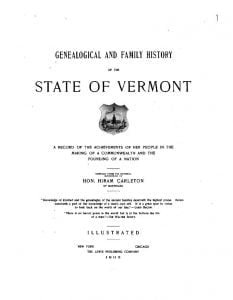
Genealogical and Family History of Vermont

Genealogical and Family History of the State of Vermont vol 1

Hiram Charlton took on the publication of the Genealogical and Family History of the State of Vermont for Lewis Publishing. In it, he enlisted the assistance of living residents of the state in providing biographical and genealogical details about their family, and then he published all 1104 family histories in two distinct volumes.

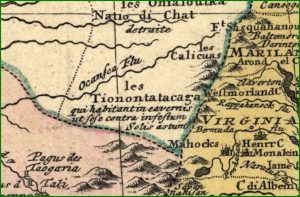
An Historical Sketch of the Tionontates or Dinondadies, now called Wyandots

les Tionontatacaga

The tribe which, from the time of Washington’s visit to the Ohio, in 1753, down to their removal to the West, played so important a part under the name of Wyandots, but who were previously known by a name which French write Tionontates; and Dutch, Dinondadies, have a history not uneventful, and worthy of being traced clearly to distinguish them from the Hurons or Wyandots proper, of whom they absorbed one remnant, leaving what were later only a few families near Quebec, to represent the more powerful nation.

Seneca County New York Biographies

Seneca County History Newsletter Drawing

In the 1980’s a series of newsletters were published four times a year by Seneca County NY featuring historical information concerning Seneca county and her past residents. The current historian for Seneca County placed these online using PDF files. One of the main features of each edition were biographical sketches of early settlers of Seneca County. This is a list of those biographical sketches linked to the pdf copy of the newsletter.

Narrative of Marie Le Roy and Barbara Leininger

The Narrative of Mary le Roy and Barbara Leininger. Who for four and a half years were captive among the Indians, and on the 6th May 1759 arrived happy in this city. From her own lips never written and promoted to the Press. This manuscript gives an account of the captivity and escape of these two girls, whose families lived on Penn’s Creek, in the present Union County, Pennsylvania. It also provides a lengthy list of names of other prisoners met by the two ladies in their captivity.

Narrative of the Captivity of Nehemiah How

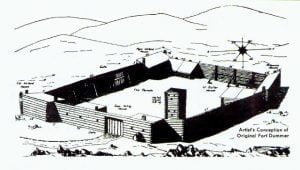
Fort Dummer

A Narrative of the captivity of Nehemiah How, who was taken by the Indians at the Great Meadow Fort above Fort Dummer, where he was an inhabitant, October 11th, 1745. Giving an account of what he met with in his traveling to Canada, and while he was in prison there. Together with an account of Mr. How’s death at Canada. Exceedingly valuable for the many items of exact intelligence therein recorded, relative to so many of the present inhabitants of New England, through those friends who endured the hardships of captivity in the mountain deserts and the damps of loathsome prisons. Had the author lived to have returned, and published his narrative himself, he doubtless would have made it far more valuable, but he was cut off while a prisoner, by the prison fever, in the fifty-fifth year of his age, after a captivity of one year, seven months, and fifteen days. He died May 25th, 1747, in the hospital at Quebec, after a sickness of about ten days. He was a husband and father, and greatly beloved by all who knew him.

Early Probate Records of Hampton, N.H.

1892 Map of Hampton NH

The early probate records of the Province of New Hampshire, from 1635 to 1771, have been published in nine volumes (vols. 31-39) of the set “New Hampshire State Papers” edited by Albert Stillman Batchellor, Henry Harrison Metcalf, and Otis G. Hammond. Originally published in the years 1907-1941 these books are available in many libraries throughout New Hampshire. The list included here contains transcriptions of some of the early probate records for Hampton, New Hampshire. It is not a complete list of the available probate records.