History of Rindge New Hampshire

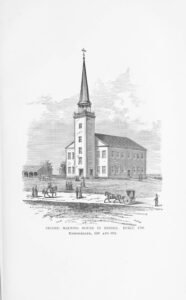
Second Meeting House in Rindge New Hampshire

The History of the Town of Rindge, New Hampshire by Ezra S. Stearns, was published in 1875, and covers the period from the original Rowley Canada grant or Massachusetts charter through the year 1874. Stearns traces the legal, territorial, and institutional development of Rindge, beginning with colonial land grants and boundary disputes and proceeding through settlement, incorporation into a town and development into a small manufacturing hub. More than half the volume is devoted to genealogical material. The genealogical register of Rindge families includes thousands of names compiled from a wide range of sources and assisted by contributions from residents and researchers beyond the town.
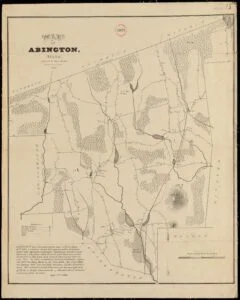
Abington Massachusetts Marriage and Death Records

1830 Map of Abington, Massachusetts

Volume 2 of the Abington, Massachusetts vital records compiles marriage and death records up to 1850, complementing Volume 1, which contains birth records. Established in 1712, Abington’s boundaries have shifted, affecting historical jurisdiction. Extensive research from town records, cemeteries, and family Bibles ensured comprehensive documentation, including the identification of Black families recorded by given names. The volume is organized alphabetically by marriages and deaths.

Abington Massachusetts Birth Records

1830 Map of Abington, Massachusetts

Volume 1 of the Abington, Massachusetts vital records details births recorded in the town up to 1850, featuring comprehensive research from town records, cemeteries, and church documents. Established in 1712, Abington’s jurisdictional changes may affect genealogical searches. The records also include separate listings for Black families, primarily by given names. Additionally, various surnames are cataloged, emphasizing the need to consider alternate spellings. For marriages and deaths, researchers should consult Volume 2.

History of Derby Connecticut, 1642-1880

Edmund Leavenworth of Derby, Connecticut

The book titled “History of the Old Town of Derby, Connecticut, 1642-1880” presents a comprehensive account of Derby’s development, including the town’s Indian history, early settlers, and significant events like the Revolutionary War. It emphasizes education, commerce, and church influences, while offering an extensive collection of biographies and genealogies.

Essex County Massachusetts Probate Records 1675-1681

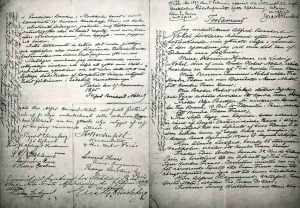
Sample Last Will and Testament

The “Governor and Company of Massachusetts Bay” established a judicial system in 1628, with a General Court in Boston and quarterly courts in major towns like Salem and Ipswich by 1635. These courts managed probate matters, and after Essex County’s formation in 1643, individual probate courts were later established in 1692. These are the probate records from 1675 to 1681, sourced from various original documents, including detailed wills and estate settlements.

Essex County Massachusetts Probate Records 1665-1674

Sample Last Will and Testament

The “Governor and Company of Massachusetts Bay” established a judicial system in 1628, with a General Court in Boston and quarterly courts in major towns like Salem and Ipswich by 1635. These courts managed probate matters, and after Essex County’s formation in 1643, individual probate courts were later established in 1692. These are the probate records from 1665 to 1674, sourced from various original documents, including detailed wills and estate settlements.

Essex County Massachusetts Probate Records 1635-1664

Sample Last Will and Testament

The “Governor and Company of Massachusetts Bay” established a judicial system in 1628, with a General Court in Boston and quarterly courts in major towns like Salem and Ipswich by 1635. These courts managed probate matters, and after Essex County’s formation in 1643, individual probate courts were later established in 1692. These are the probate records from 1635 to 1664, sourced from various original documents, including detailed wills and estate settlements.

Descendants of Thomas, John and Eleazor Brown

The Brown Family Reunion at Brownstown Pennsylvania

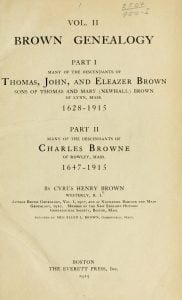
Cyrus Henry Brown’s Brown Genealogy, first published in 1907, is an essential resource for genealogists tracing the Brown family lineage. This volume, published in 1915 and labeled as “Volume II,” should be understood as a complete replacement of the original volume rather than a supplementary addition. Brown’s new research and updates make this work a standalone resource for those exploring the Brown family’s extensive history. It is fully indexed, and the content spans nearly 250 years, offering valuable insight into numerous branches of the family.

Spokane Story

Spokane Story

“Spokane Story: A Colorful Early History of the Capital City of the Inland Empire” by Lucile Foster Fargo offers readers an evocative journey through the formative years of Spokane, Washington. Published in 1957 by Northwestern Press in Minneapolis, this work seeks to straddle the realms of history and storytelling, presenting a narrative that is neither entirely factual history nor pure fiction. Fargo accepts the challenging task of depicting Spokane’s cultural and developmental evolution from its fur trade beginnings to its emergence as a municipal entity in the early twentieth century.

Brown Genealogy

Brown Genealogy

In 1895, Cyrus Henry Brown began collecting family records of the Brown family, initially with the intention of only going back to his great-grandfathers. As others became interested in the project, they decided to trace the family lineage back to Thomas Brown and his wife Mary Newhall, both born in the early 1600s in Lynn, Massachusetts. Thomas, John, and Eleazer, three of their sons, later moved to Stonington, Connecticut around 1688. When North Stonington was established in 1807, the three brothers were living in the southern part of the town. Wheeler’s “History of Stonington” contains 400 records of early descendants of the Brown family, taken from the town records of Stonington. However, many others remain unidentified, as they are not recorded in the Stonington town records. For around a century, the descendants of the three brothers lived in Stonington before eventually migrating to other towns in Connecticut and New York State, which was then mostly undeveloped. He would eventually write this second volume of his Brown Genealogy adding to and correcting the previous edition. This book is free to search, read, and/or download.

Biography of Lawrence Pembroke Browne

Lawrence Pembroke Browne, originally from Pennsylvania, established his career in Kansas City, Missouri, where he became a prominent businessman in general merchandise through his partnership with W. H. Chick. As the head of the Browne family business until his death in 1893, he significantly contributed to the Mexican trade and was influential in the expansion of commerce along the railroads. His son, Evan H. Browne, pursued a varied career in banking and manufacturing, demonstrating strong business acumen and community involvement, including founding the Mercantile Club.

Biographical Sketch of Abraham Browne

Abraham Browne and his sons, Abraham Jr., Nathaniel, and Oliver, settled near Warren Pond around 1775 after moving from Grafton, Massachusetts. They established homes in different locations, with Abraham Sr. passing away in 1808. Abraham Jr. married Lucy Golding and had ten children, while Nathaniel served in town government and married Molly Gee. Oliver later moved to Surry. Abijah, son of Abraham Jr., became a justice of the peace and had a notable descendant, Gardner Shepard Browne, who had a diverse career in ministry and medicine before his death in Chicago in 1876.

Biography of Thomas F. Browne

Thomas F. Browne, born in Memphis, Tennessee, in 1870, has been the manager and resident vice president of the United States Fidelity Guaranty Company in St. Louis since 1911. He began his career with the Louisville Nashville Railroad Company, rising from a clerical role to manage the office at Stanton, Tennessee. In 1918, he was promoted to his current position. Browne is recognized for his integrity and energy, contributing significantly to the corporation’s success. He is politically active, a community leader, and a dedicated member of the Westminster Presbyterian church.

Slave Narrative of Dave Taylor

The interview with Dave Taylor offers a glimpse into his life as an ex-slave and soldier of fortune. Born on a Virginia plantation, his journey took him through perilous territories and naval adventures, ultimately landing him in Key West. Taylor recounts tales of survival, family, and resilience amidst the tumult of war and Reconstruction. Despite hardships, he remained loyal to his roots and his beloved wife, illustrating the complexities of life for former slaves in post-war America. His anecdotes reflect a unique blend of humor and hardship shaped by his experiences.

Biography of Charles H. Browne

Charles H. Browne, born in 1881 in St. Joseph, Missouri, is the proprietor and editor of the Horton Headlight-Commercial, Brown County’s sole newspaper, following the consolidation of several local journals. A veteran of the Kansas National Guard, he played an active role in military service during significant conflicts. Browne is also involved in various fraternal organizations and has served on the Horton school board. Married in 1903, he and his wife have three children and are integral members of their community.

Biography of Herbert Andrew Browne, M. D.

Herbert Andrew Browne, M.D., a prominent physician and surgeon in Galena since 1899, gained acclaim for his professional expertise. Born on March 11, 1878, in Brooklyn, New York, he graduated from the Homeopathic Medical College in Kansas City in 1898. He actively participates in various medical societies and fraternal organizations, reflecting his community involvement. Browne has two children from his first marriage and later married Henrietta Powell in 1914. His family has a rich history in the U.S., with roots tracing back to Ireland.

Biography of Hon. J. J. Browne

Hon. J. J. Browne, born in Greenville, Ohio in 1843, was educated in law at Michigan University and practiced in Portland before moving to Spokane Falls in 1878. He became a prominent advocate for the city’s growth, making significant contributions through various ventures, including the Spokane Mills Company and the Cracker Factory. Browne’s efforts included lobbying for local legislative initiatives and investments in infrastructure, such as the street railway. He also participated in Washington’s constitutional convention, reflecting his commitment to the region’s development.