1819 Cherokee Reservation List
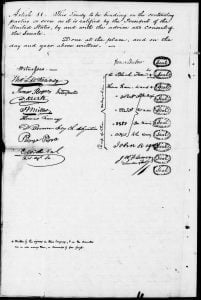
This specific roll is of a list of 146 heads of families entitled to reservations under the Treaty with the Cherokee of the 27th February, 1819.

This specific roll is of a list of 146 heads of families entitled to reservations under the Treaty with the Cherokee of the 27th February, 1819.
“The Story of Wise County, Virginia” by Luther F. Addington, published in 1956 by the Centennial Committee and School Board of Wise County, Virginia, serves as a historical record of the county from its inception through its first hundred years. Wise County, established in 1856 from sections of Russell, Lee, and Scott counties, carries the name of Governor Henry Alexander Wise, highlighting its significance in the state’s political and social life. This text outlines the county’s formation, development, and the various elements that have shaped its identity, including geography, notable events, and significant figures.

Free: Genealogy of the Lewis family in America, from the middle of the seventeenth century down to the present time. Download the full manuscript. About the middle of the seventeenth century four brothers of the Lewis family left Wales, viz.: Samuel, went to Portugal; nothing more is known of him; William, married a Miss McClelland, and died in Ireland, leaving only one son, Andrew; General Robert, died in Gloucester county, Va. ; and John, died in Hanover county, Va. It is Andrews descendants who are featured in the manuscript.
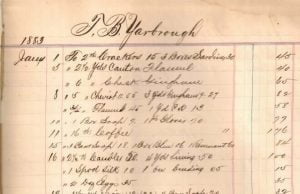
Original images, and index, of Thomas B. Yarbrough’s store ledger which he kept while conducting business in Honey Grove, Texas. Volume 1 covers the years of 1 Jan 1883-Jul 1884.
An abstract of disbursements made by Cherokee agent George Vashon records payments to 390 Cherokee families, totaling 1,835 individuals, under the fifth article of the 1828 treaty. Between September 1830 and December 1833, Vashon distributed $47,251.75 of the $50,000 congressional grant by War Department drafts, with a slight discrepancy from the actual recorded amount.
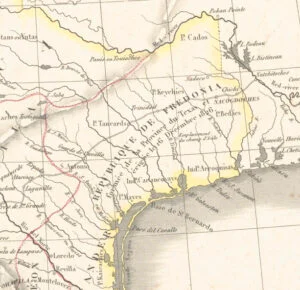
Between 1812 and 1836, the Texas Cherokee Nation faced significant challenges as they settled in Texas after migrating from Arkansas. Led by Chief John Bowles, they sought peace, gaining recognition as Mexican citizens. However, rising tensions with the Republic of Texas culminated in their expulsion in 1839. Despite earlier treaties affirming their land rights, the government adopted destructive policies against them, ultimately leading to conflict. This tragic history underscores the complexities of their struggle for land and sovereignty, mirroring broader themes of displacement and conflict in American history.
Samuel Houston Benge, born in 1832, was a prominent political figure and a soldier, participating in the Indian Home Guards and contributing to the 1866 treaty. He served multiple terms as a senator and as a delegate to Washington. In 1866, he married Nannie Brewster, and they had a son, Samuel Houston Benge Jr., who later married Josephine J. Walker. The family has roots in Fort Gibson, where Samuel Houston Jr. was born in 1898 and became a farmer.
Samuel Houston Benge Jr. was born in Fort Gibson in 1898, the son of Samuel Houston and Josephine J. (Walker) Benge. He married Margaret Hildebrand in 1918 and became a farmer near Fort Gibson, with one son, Samuel Houston Benge. The lineage traces back to Samuel Houston Benge, born in 1832, who held various political positions, including Councilor and senator, and notably signed the treaty of 1866. He married Nannie Brewster in 1866, and they had a significant family legacy.
Oce Benge, born September 9, 1851, in the Tahlequah District, married Martha Adair on February 18, 1883. They had five children, including Georgia and Eleanor, who married into prominent families. Benge served as Sheriff of Saline District and was also a Council member. His lineage ties to notable Cherokee figures, including Richard Fields, a chief, and his brother George Fields, a captain in the Creek War. Benge’s life reflects a blend of family legacy and public service within the Cherokee community.
Mrs. DeLora Benge passed away on May 26, 1927, in Union, Oregon, at the age of 66. Born in London, Kentucky, on March 3, 1861, she relocated to the Grande Ronde Valley in 1907. She is survived by her husband, David Benge, six children, and ten grandchildren. Known for her compassion towards others, she faced her final illness with courage. Her funeral was held at the Methodist Church in Union, drawing a large turnout of friends and family. She is interred in the Union cemetery.
Mary Benge, aged 92, passed away on June 21 in La Grande, Oregon. Born on April 9, 1915, in Coffey, Missouri, she had a varied life, including running a restaurant in Denver and ranching in Heppner after marrying Terrell Benge in 1943. A passionate member of the Ladies Elks and Eastern Star, she was known for her cooking and love of gardening. She is survived by her son, stepdaughter, grandchildren, and several great-grandchildren. A memorial service will occur at Heppner Masonic Cemetery on Saturday.
This document contains genealogical statements regarding various individuals and families of Creek, Choctaw, Chickasaw, and Mississippi Choctaw descent who sought recognition and enrollment in tribal rolls. The records, primarily from 1909 reports, detail claimants’ ancestry, enrollment issues, and tribal affiliations. Many individuals were denied enrollment due to factional disputes, legal technicalities, or failure to apply within deadlines. The document includes references to official reports and affidavits, offering insights into the complexities of Native American citizenship and land rights during the early 20th century.
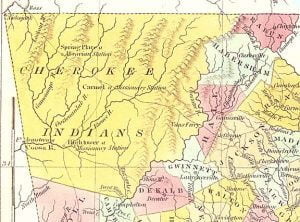
The Cherokee Indians, primarily from the Southeastern U.S., have a rich history marked by their early adoption of a written language and a government structure similar to that of the United States. Despite their forced relocation to Oklahoma in the 1830s, they maintained significant genealogical ties, often intermarrying with Whites. Emmet Starr’s “History of the Cherokee Indians and Their Legends and Folklore” emphasizes personal biographies and genealogies, providing insights into the lives and connections of many Cherokee families across generations, thereby enriching their cultural narrative.