
Records of the Governor and Company of the Massachusetts Bay in New England is a five-volume printed edition of the original manuscript records of the Massachusetts Bay Company and early colonial government. The first volume covers corporate proceedings in England before the transfer of the charter in 1630, and the records of the General Court and Court of Assistants in Massachusetts through 1641. The second volume continues the General Court records from 1642 to 1649, portions of which survive only in damaged form and were restored using earlier transcripts and duplicate leaves.
The remaining volumes extend through 1686, when the colonial government was superseded under President Dudley.
See Massachusetts Bay Records 1628-1686 for the other volumes in this set of records.
Volume 1, 1628-1641
Contents of Volume I
- The Colony Charter, 1
- The Company's Records, 1628— 1630, 21
- The Colony Records, 1630—1641, 71
- Miscellaneous Records, 347
- Oaths, John Pratt's Answer to the Court, 358
- Court Order, 30 Apr, 1629, 361
- Court Order, 21 May, 1629, 363
- Freemen of the Colony, 1631—1641, 366
- Appendix, Letter from Matthew Cradock, 383
- First General Letter of Instructions from
- The Governor and Company, 386
- Second General Letter of Instructions from
- The Governor and Company, 398
- Company's Letter to the Ministers, 407
- Company's Letter to John Endicott, 408
- General Index, 411
- Index of Freemen, 469
Introduction
There is within this historical manuscript many items of local and family interest for the genealogist. With names at the ready in the back of each volume, you may find tidbits like the following for your ancestor:
“Ordered, that Willm Shepheard, servt to Willm Sumer, shalbe whipt for stealeing victualls from his mr & beanes from the Indians./”
“Ordered, that Willm Perkins shall (for drunkenes & other misdemeanrs by him comitted) stand att the nexte Genall Court one houre in publique vewe, with a white sheete of pap on his brest, haveing a greate D made vpon it, & shall attend the pleasure of the Court till hee be dismissed./”
“Ordered, that George Ropps shalbe seuerely whipt here this Psent Court, & againe after some convenient tyme att Salem, att some publique meeteing there, for strickeing his maistr, Mr Garford, throweing him downe, & spurneing him with his feete, being downe; & the Court hath intreated John Endicott, Esq, to see his correccon gyven./”
“Ordered, that Willm Barker shalbe whipt for stealeing bacon, cheese, &c, from Ralfe Tompkins./”
In the performance of his duty, the editor has studiously avoided making comments upon the subject matter of the records, confining his notes entirely to a description of the written volumes, with such explanations only as were deemed necessary to make known the writers of the various portions.
Marginal dates have been introduced throughout the volumes; and that no doubt should arise as to what year each month belonged, double dating has been used in all instances from the first of January to the twenty-fourth of March, inclusive.
It is necessary that the reader should bear in mind that as the colony records were written at a period when the Julian method of computing time was in use, the legal year commenced on Conception Day, the 25th of March. Therefore, when double dating occurs, the first figure indicates the legal year, and the last the historical year, which commenced on the first of January. By the same calendar the months were numbered, as well as named, and were often expressed by these numbers only; as, —
- March
- April
- May
- June
- July
- August
- September
- October
- November
- December
- January
- February
The days of the week were likewise numbered, and sometimes expressed by peculiar symbols; as, —

The paging of the manuscript volumes has been retained in the printed copy by placing in the margin the number of the original page, enclosed in brackets, and by denoting the place where each page commences in the text by a star.
All intended obliterations have been omitted in the printed copy, and all interlineations caused by clerical error have been printed in their proper places.
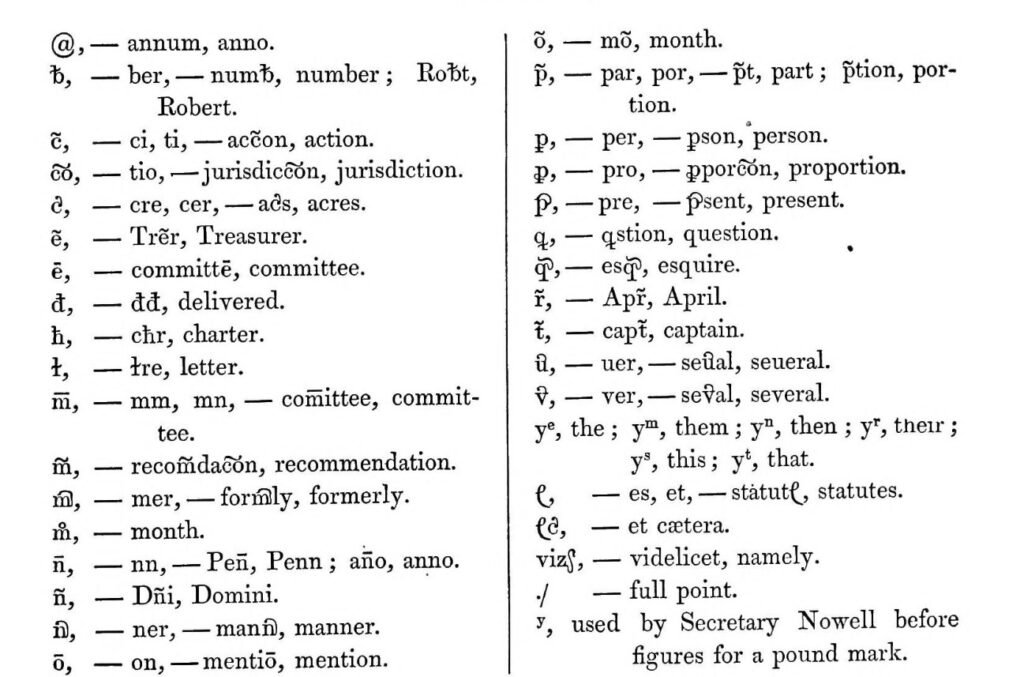
In order to preserve the character of the ancient record, various typographical symbols, representing the contractions used in ancient chirography, have been employed wherever such contractions occur in the manuscript. A list of these will be found in its proper place.
The indexes were carefully prepared by Francis H. Underwood, Esq.; and it is believed they will prove to be as accurate as they are minute. The names of such persons as took the oath of freemen have been entered in separate indexes, in order to simplify in a considerable degree the general indexes.
Marks and Contractions
A Dash — (or straight line) over a letter indicates the omission of the letter following the one marked.
A Curved Line ~ indicates the omission of one or more letters next following the one marked.
A Superior Letter indicates the omission of contiguous letters, either preceding or following it.
A Caret ^ indicates an omission in the original record.
A Cross x indicates a lost or unintelligible word.
All doubtful words supplied by the editor are included between brackets, [ ].
Some redundancies in the original record are printed in Italics.
Some interlineations, that occur in the original record, are put between parallels, || ||.
Several characters have special significations, namely: —
Source
Shurtleff, Nathaniel Bradstreet, editor, Records of the governor and company of the Massachusetts bay in New England, vol. I, Boston : W. White, printer to the commonwealth, 1853.
See Massachusetts Bay Records 1628-1686 for the other volumes in this set of records.