
Narratives of Rogers, Goodwin, Toogood – Indian Captivities

Three Narratives of Excessive Distress of Persons Taken at the Destruction of Salmon Falls, in the State of New Hampshire, on the Twenty-Seventh of March, 1690; Viz., The Cruel Torture of Robert Rogers, the Five Years’ Captivity of Mehetable Goodwin, and the Fortunate Escape of Thomas Toogood. From the Magnalia Christi Americana, of Doctor Cotton Mather.
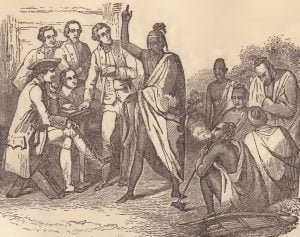
The Wars of the Five Nations – Indian Wars

Treaty with Five Nations

The Five Nations, a confederacy of five Indian tribes, were significant allies of the English against the French during the Indian Wars. Their sophisticated governance and military strategies set them apart, allowing them to maintain supremacy over other tribes and engage effectively in war. Despite their initial defeats by the French and the Adirondacks, they rallied with Dutch support and eventually reclaimed power. Their engagements with the French exemplified both their valor and the complexities of colonial rivalries, culminating in fluctuating alliances and treaties that shaped their future interactions.

Biography of William Henry Seward

William H. Seward, born on May 16, 1801, in New York, was a prominent lawyer, politician, and Secretary of State. He graduated from Union College in 1820 and quickly gained recognition for his political acumen, serving in the New York State Senate and as Governor. Elected to the U.S. Senate in 1849, he became a key figure in the Republican Party and was a strong supporter of abolitionism. As Secretary of State under Lincoln, he negotiated significant treaties, including the purchase of Alaska. He survived an assassination attempt in 1865 and died in 1872.

Biography of A. P. Fonda

A. P. Fonda was born on March 30, 1878, in Leavenworth, Kansas. A dedicated citizen, he excelled as a farmer and lawyer, focusing on land and real estate following his admission to the bar in 1903. Fonda was actively involved during World War I, capturing a German spy and leading a successful Liberty loan drive. He served as food commissioner for Jackson County, where he advocated for the public against exploitation. Married in 1910, he is committed to community welfare, youth development, and his faith.

Biography of Solon O.Thachek

Solon O. Thachek, born on August 31, 1830, in New York, was a prominent lawyer and judge in Kansas, recognized for his efforts in fostering relations with South America. After graduating from Union College and Albany Law School, he moved to Lawrence in 1858, co-owning the local newspaper. Active in state politics, he served in the Wyandotte constitutional convention, as a judge, and held various positions in the State Senate. His notable international mission involved a journey to South America advocating for reciprocity, culminating in influential reports to Congress. He died in 1895 while serving as president of the State Historical Society.

Biography of Lucius Cozzens Rice

Lucius Cozzens Rice, born on June 30, 1867, in Riceville, New York, became a prominent businessman and Idaho’s state treasurer. He prepared for college at Clinton Seminary and attended Union College, where he excelled in leadership. After moving to Idaho in 1891, he established a successful general merchandise store in St. Anthony. Rice was instrumental in founding the First Bank of Fremont County and the Snake River Valley Telephone Company. Elected state treasurer in 1898, he was noted for his prudent management of public funds and was deeply involved in Democratic politics.

Biography of Andrey Abraham Potter

Andrey Abraham Potter, born in Vilna, Russia, in 1882, emigrated to the U.S. at fifteen and pursued a distinguished career in engineering education. After completing his degree at MIT, he gained experience with General Electric before joining Kansas State Agricultural College. As dean of the engineering division, he authored numerous articles and bulletins on engineering topics, reflecting his expertise and commitment to the field. Married to Eva Burtner, they have two children. Potter’s contributions have greatly advanced engineering knowledge and education.

Biographical Sketch of Thomas Winston Burnham

Thomas Winston Burnham, born January 22, 1844, in Cleveland, was a prominent manufacturer and banker. He received his education from Cleveland public schools and Union University, earning an A.B. degree. Burnham married Mary Kate Coll on October 6, 1869, and had two daughters. He held leadership positions as president of The Star Elevator Co., The Kilby Mfg. Co., and served as a director at several financial institutions. A member of various clubs, he enjoyed golfing and motoring in his leisure time.

Biographical Sketch of Melvin Daniel Kilmer

Melvin Daniel Kilmer, born on July 29, 1858, in New York State, was the son of Augustus and Vianna Barner Kilmer. He received his education at Eastmans Business College and married Mary T. Hoag in 1886. Kilmer served as president and manager of The Kilmer Spring Support Co., which produced wire-forming machines and bale ties. He was also involved with M. D. Kilmer Co. and A. H. Kilmer & Son. A Mason, he held memberships in various Masonic organizations.

Biographical Sketch of Arthur Silas Wright

Arthur Silas Wright, born on March 7, 1858, in Decatur, N.Y., was an influential educator. He earned his A.B. from Union College in 1882 and advanced degrees from Princeton Theological Seminary and the University of Leipzig. Married to Julia B. Barbyte in 1890, he served as junior professor and later full professor of modern languages at Union College and Case School of Applied Science. He was actively involved in professional associations and made significant contributions as an editor of various scholarly works.

Biographical Sketch of Arthur Bishop Shepherd

Arthur Bishop Shepherd was born on November 29, 1871, in Troy, New York. He pursued his education at St. Paul School, Columbian University, and the Massachusetts Institute of Technology. In September 1900, he married Gertrude Robins and had three children. Shepherd worked as a designing engineer at General Electric for fourteen years, later managing their Cleveland office. He held various managerial positions across several companies and served as a director for the Toledo-Chicago Interurban Railroad Company. He was also active in the Electric League and the Theta Phi Fraternity.

Biography of Abram A. Post

Abram A. Post, born July 26, 1876, is the owner of a historic 500-acre farm in Seneca, New York, which has been in his family since 1809. Educated in Geneva, Penn Yan, and the New York Military Academy, he worked for General Electric before spending five years in Cuba. Returning to the homestead, he embraced scientific farming, focusing on fruit cultivation. He married Margaret Barnes in 1904 and has three children. Active in his community, he is affiliated with the Masons, the Republican Party, and the Episcopal Church.

Biographical Sketch of Edward Graham Hayes

Edward Graham Hayes, born July 12, 1862, attended Canandaigua Academy, the Pennsylvania Military Academy, and Union College, graduating in 1886. After several years in the cattle business in Colorado and time spent abroad, he married Elizabeth McGill in 1900 and returned to Canandaigua in 1903. Hayes later became involved in banking, rising to president of the McKechnie Bank by 1909. He engaged in local politics as an independent Republican and contributed to various civic organizations, including a decade as police commissioner. He had two children, George and Elizabeth.

Biography of Edward Wemple

Edward Wemple, born on October 23, 1843, in Fultonville, New York, is a prominent political figure known for his democratic principles and service as state comptroller. Hailing from a lineage that championed liberty and education, he initially pursued law but shifted to manage his father’s foundry business. Wemple’s political career began in local offices, rising to the state legislature and then to Congress, where he supported veteran rights and canal maintenance. Elected comptroller in 1887, he is recognized for his integrity, executive ability, and popularity in public service.

Biography of Samuel M. Van Santvoord

Samuel M. Van Santvoord, born on October 2, 1819, in Schenectady, emerged from humble beginnings to become a renowned merchant in Albany over twenty-seven years. Orphaned at five, he supported his widowed mother and began his career as a clerk in a local dry goods store. After gaining experience in New York City, he returned to Albany, significantly contributing to the prosperity of W. M. Whitney’s firm. A dedicated businessman and community figure, he retired in 1889, leaving a legacy of honor and friendship.

Biography of James Wesley Hutt

James Wesley Hutt, born on August 16, 1846, in Schoharie County, New York, boasts a legacy rooted in pioneering and public service. His great-grandfather, John Hutt, was a Revolutionary War soldier, while his father, William Hutt, was a prominent expressman. After gaining experience in the express business, Hutt became general superintendent of the National Express Company. He is also involved with multiple express ventures and has contributed significantly to the Adirondack region. A dedicated public servant, Hutt remains a respected figure in his field and community.

Biography of Charles H. Peck

Charles H. Peck, born March 30, 1833, in Sandlake, New York, exhibited a profound interest in botany from a young age. Educated at the state normal school and later Union College, he became a dedicated botanist and eventually the botanist at the New York State Museum of Natural History. His significant contributions, especially in mycology, expanded the museum’s herbarium, identifying many new fungi species. A devoted family man and member of the Fourth Presbyterian Church, Peck’s career reflects his deep passion for nature and science.

Biography of Frederick Townsend

General Frederick Townsend, born on September 21, 1825, in Albany, played a significant role in the military development of New York, demonstrating exceptional gallantry during the Civil War. A graduate of Union College, he initially practiced law before turning his focus to military affairs. Appointed adjutant-general in 1857, he enhanced the state’s military preparedness, leading New York troops effectively at various battles. Post-war, he held multiple leadership roles and actively contributed to various civic organizations. Townsend’s legacy is marked by dedication to service and community.