Descendants of Frederick Packard of Brockton, MA
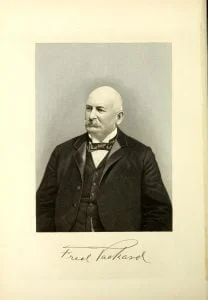
Fred. Packard

Frederick Packard, born in 1836 in Brockton, MA, emerged as a prominent figure in the local shoe manufacturing industry. His success stemmed from hard work and business acumen. He began his career making boots and shoes, eventually founding firms such as Burt & Packard, which gained a reputation for quality. A respected community member, Packard was active in local organizations and politics but shunned public office. He married Mary Eliza Ramsdell, and after a long and prosperous life, he passed away in 1910, leaving a lasting legacy.
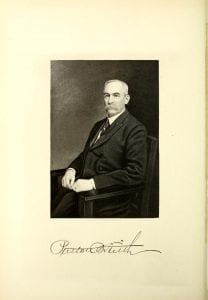
Descendants of Charles Keith of Bridgewater, Massachusetts

Rev. James Keith

Charles Keith, born in 1794, married Mehitable Perkins in 1817, and they had several children, including Charles Perkins Keith, who became a prominent shoe manufacturer in Brockton, Massachusetts. Charles Perkins Keith’s business thrived from the mid-19th century, establishing a legacy in the shoe industry. His sons, Preston Bond and Rufus Perkins Keith, continued this tradition, holding significant roles in local manufacturing and banks while actively contributing to the community and the South Congregational Church. The Keith family remains a notable presence in Bridgewater’s history.

Establishment of Fort Gibson in 1824

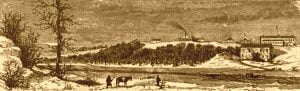
Fort Gibson in 1875

The Arkansas Territory was established by Congress in 1819, encompassing parts of present-day Arkansas and Oklahoma, with governance limited to the eastern section. James Miller became its first governor in 1819, tasked with overseeing relations with Native tribes. Efforts to broker peace between the Osage and Cherokee tribes were largely unsuccessful, leading to military reinforcements at Fort Smith. In 1824, troops were moved to a new post, Cantonment Gibson, established to enhance security and regulate tensions, which would eventually evolve into Fort Gibson, founded in 1824.

Dedham Massachusetts Historical Society Register 1890-1903

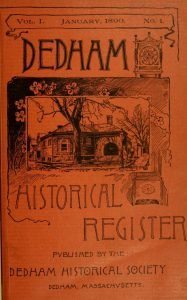
Dedham Historical Register vol 1

From 1890-1903, the Dedham Historical Society in Dedham Massachusetts printed a quarterly pamphlet for it’s historical society called the “Dedham Historical Register.” In this pamphlet a variety of genealogical data was published on families of Dedham and the villages emanating from the early residents of Dedham, such as Dorchester, Franklin, Medfield, Medway, Needham, and Sharon, etc.

Free Massachusetts Vital Records

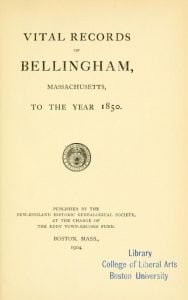
Vital Records of Bellingham Massachusetts to 1850

This is a collection of free vital records books for Massachusetts towns, most of them known as “Tan Books.” Generally, these records go up to 1850 at which, the genealogist can use the census records to assist in identifying the family connections further. They’re called “tan books” because they were bound by tan cloth. Included with this article is an account of why and how these manuscripts were published along with links to all 274 Massachusetts vital record books which can be freely read.

Descendants of Mark Lothrop of Bridgewater MA

The Lothrop family, tracing its origins to Mark Lothrop, who settled in Salem, Massachusetts in 1643, has a rich history in New England. Mark was a key figure in Bridgewater, serving in various civic roles until his death in 1685. His descendants, including Samuel and Edmund Lothrop, contributed significantly to local governance and community affairs. Notable family members included Howard Lothrop, an influential town clerk and state legislator, and several who served during the Revolutionary War, showcasing the family’s enduring legacy in Massachusetts history.

Genealogy of Richard Bishop

Richard Bishop, a husbandman in Salem, married Dulzebella before 1635, who died in 1658. He later wed Mary Gould in 1660 and passed away in 1674. His children included Mary, Edward, and several others, with descendants residing in Salem, Rehoboth, Ipswich, and Newbury. Notable family branches emerged through marriages, leading to various professions, including yeomen and tradesmen. The family maintained connections across New England, with records tracing multiple generations through significant events and relationships, including marriages and migrations.

The History of Miscellaneous Salem House Lots

The post details the conveyance of several lots by Colonel John Hathorne in Salem during the late 17th century. Key transactions include the Henry West Lot, which passed to Samuel West; the John Higginson Lot, where a house was built; and the Nathaniel Hathorne Lot, which was subdivided and later transferred to various individuals. Other lots, such as those belonging to John Harvey and Stephen Sewall, also changed hands during this period, reflecting the area’s evolving property landscape.

Estate of George Corwin House

The estate of George Corwin encompassed a four-acre pasture formerly owned by Rev. Hugh Peter. After Peter’s return to England, he sold it to Capt. George Corwin in 1659. Following George’s death in 1684-5, the estate was divided between his sons Jonathan and John. Jonathan, a judge during the witch trials, later resided in the house linked to the estate. The property changed hands multiple times, ultimately falling to Joshua Ward, who replaced the original house with a brick residence by 1789, hosting George Washington during his visit.

Elizabeth Tawley House

The Elizabeth Tawley House was originally owned by Dr. George Emery, an early Salem surgeon. In 1677, he transferred it to his kinswoman Elizabeth Tawley, who lived there with her family until her death in 1714. Ownership passed through several generations, with the property being modified over time. By the 19th century, following various transactions, the Gardners purchased the estate and transformed it into the Railway House hotel, which opened in 1848, becoming a notorious establishment known for accommodating railroad travelers.

Genealogy of the Adams Family

Jonas Adams, a mariner from Salem, married Sarah Jefferds in 1729. His will was proved in 1757, after which Sarah ran an inn until her death in 1786. They had several children, including Elizabeth, Sarah, Samuel, and William. Daniel Adams, also a mariner, married Hepzibah Batchelder and had numerous descendants. Other Adams family records from Marblehead and Ipswich detail multiple marriages and births, highlighting the family’s extensive lineage and connections within the region.

Genealogy of Edward D. Baker of Salem Massachusetts

The genealogy of Edward D. Baker from Salem, Massachusetts, reveals a lineage tracing back to Alfred the Great, King of England. Through a succession of notable ancestors, including Princess Ethelwida and various earls and barons, the lineage includes key historical figures like Hubert de Burgh, a Chief Justice of England. The family line continues to Edward D. Baker and his descendants, including Mary Fitch Baker and her relatives in Massachusetts and Chicago, providing a rich historical context to Baker’s heritage.

Rev. George Phillips Genealogy

Rev. George Phillips, the first minister of Watertown, arrived in New England aboard the Arbella in 1630. He was educated at Cambridge and served in Watertown for fourteen years until his death in 1644. His descendants include notable figures such as Samuel Phillips, a minister in Rowley, and Rev. Samuel Phillips, who served at Andover’s Old South Church for sixty years. The lineage continued through Lydia Phillips, who married Dr. Parker Clarke, and their daughter Elizabeth, who married Simon Davis.

Descendants of John Abbe

John Abbe settled in Salem, Massachusetts, in 1636. He married Mary Loring, who died in 1662, and later wed Mary Goldsmith in 1674. John made provisions for his family in a trust before his death in 1698, which was settled by his son Thomas in 1702. His descendants include notable figures, such as Lieutenant Thomas Abbe, a soldier in King Philip’s War, and several generations who contributed to military efforts and community development in New England. The line continues through his grandsons and their families.

Biography of Joseph K. Vincent

Judge Joseph K. Vincent, a prominent figure in Idaho for over thirty-seven years, has significantly contributed to the state’s business, political, and social life. Born in Salem, Massachusetts, in 1822, Vincent’s early life involved earning his living from a young age. His ventures included mining in California and Oregon, military service during the Civil War, and various roles in local government. A self-made man, he successfully engaged in mining and stock raising and served as probate judge of Idaho County. He married Elizabeth Leland and has nine children, maintaining an esteemed position in his community.

Biography of Alfred Damas

Alfred Damas, born in Brussels, Belgium, on July 18, 1835, has had a distinguished career in the mercantile sector of Lewiston, Idaho, for twenty-six years. After an early naval apprenticeship, he migrated to the U.S., engaging in mining and trading. He settled in Lewiston in 1872, successfully running a general merchandise store. Damas also held several public offices and became a prominent member of the Masonic fraternity, attaining high ranks. Married to Maria Frances Sperling, he has one daughter and enjoys a reputation as a respected pioneer in Idaho.

Biographical Sketch of Christopher Avery

Christopher Avery, born in England around 1590, emigrated to New England in the early 1630s, possibly accompanying Governor Winthrop. His early years were spent in Gloucester, Massachusetts, where he held several public offices. In 1658, he moved to Boston before eventually settling in New London, Connecticut, in 1665. Although there are varying accounts of his origins, it is noted that his wife and most of his children remained in England, leaving him to establish his family line in America. Avery died on March 12, 1679.

Biography of Hon. Frederick W. Lander

Hon. Frederick W. Lander, born December 17, 1822, in Salem, Massachusetts, was a prominent civil engineer, the first chief justice of the Washington Territory Supreme Court, and a brigadier-general during the Civil War. An influential figure in the Northern Pacific Railroad survey, he proposed innovative transcontinental railway routes. In the military, he participated in key battles but tragically died on March 2, 1862, due to a brain congestion. Lander is also remembered for his role in the Pryor-Potter duel, which ended humorously.