Essex County Massachusetts Probate Records 1675-1681
Sample Last Will and Testament

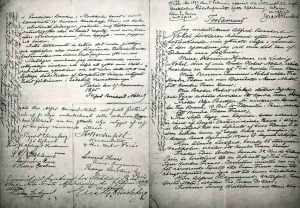
The “Governor and Company of Massachusetts Bay” established a judicial system in 1628, with a General Court in Boston and quarterly courts in major towns like Salem and Ipswich by 1635. These courts managed probate matters, and after Essex County’s formation in 1643, individual probate courts were later established in 1692. These are the probate records from 1675 to 1681, sourced from various original documents, including detailed wills and estate settlements.

Essex County Massachusetts Probate Records 1665-1674

Sample Last Will and Testament

The “Governor and Company of Massachusetts Bay” established a judicial system in 1628, with a General Court in Boston and quarterly courts in major towns like Salem and Ipswich by 1635. These courts managed probate matters, and after Essex County’s formation in 1643, individual probate courts were later established in 1692. These are the probate records from 1665 to 1674, sourced from various original documents, including detailed wills and estate settlements.
Essex County Massachusetts Probate Records 1635-1664

Sample Last Will and Testament

The “Governor and Company of Massachusetts Bay” established a judicial system in 1628, with a General Court in Boston and quarterly courts in major towns like Salem and Ipswich by 1635. These courts managed probate matters, and after Essex County’s formation in 1643, individual probate courts were later established in 1692. These are the probate records from 1635 to 1664, sourced from various original documents, including detailed wills and estate settlements.
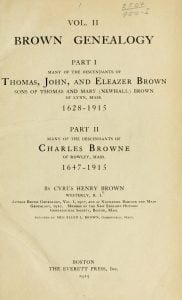
Descendants of Thomas, John and Eleazor Brown

The Brown Family Reunion at Brownstown Pennsylvania

Cyrus Henry Brown’s Brown Genealogy, first published in 1907, is an essential resource for genealogists tracing the Brown family lineage. This volume, published in 1915 and labeled as “Volume II,” should be understood as a complete replacement of the original volume rather than a supplementary addition. Brown’s new research and updates make this work a standalone resource for those exploring the Brown family’s extensive history. It is fully indexed, and the content spans nearly 250 years, offering valuable insight into numerous branches of the family.

Rowley Massachusetts vital records

Vital Records of Rowley Massachusetts

The following records of births, marriages and deaths include all entries to be found in the books of record kept by the town clerks; in the church records; in the returns made to the Essex County Quarterly Court; in the cemetery inscriptions; and in the private records found in family Bibles, etc. These records are printed in a condensed form in which every essential particular has been preserved. All duplication of the town clerks’ record has been eliminated, but differences in entry and other explanatory matter appear in brackets. Parentheses are used when they occur in the original record; also to indicate the maiden name of a married woman, and to show variations in the spelling of a name in the same entry.

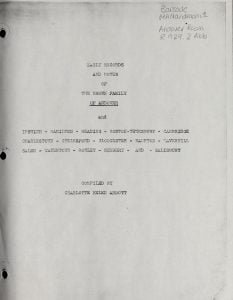
Early Records and Notes of the Brown Family

Early Records and Notes of the Brown Family

This is not a compiled genealogy, but rather, a compilation of notes, facts, and genealogies concerning the various early Brown families of the towns of Andover, Ipswich, Hamilton, Reading, Boston-Tewksbury, Cambridge, Charlestown, Chelmsford, Gloucester, Hampton NH, Haverhill, Salem, Watertown, Rowley, Sudbury, and Salisbury. Charlotte Helen Abbott compiled a series of volumes on early families of New England called the “Abbott Genealogies.” This is volume 7 of the series.

Brown Genealogy

Brown Genealogy

In 1895, Cyrus Henry Brown began collecting family records of the Brown family, initially with the intention of only going back to his great-grandfathers. As others became interested in the project, they decided to trace the family lineage back to Thomas Brown and his wife Mary Newhall, both born in the early 1600s in Lynn, Massachusetts. Thomas, John, and Eleazer, three of their sons, later moved to Stonington, Connecticut around 1688. When North Stonington was established in 1807, the three brothers were living in the southern part of the town. Wheeler’s “History of Stonington” contains 400 records of early descendants of the Brown family, taken from the town records of Stonington. However, many others remain unidentified, as they are not recorded in the Stonington town records. For around a century, the descendants of the three brothers lived in Stonington before eventually migrating to other towns in Connecticut and New York State, which was then mostly undeveloped. He would eventually write this second volume of his Brown Genealogy adding to and correcting the previous edition. This book is free to search, read, and/or download.

Abbot Family of New England

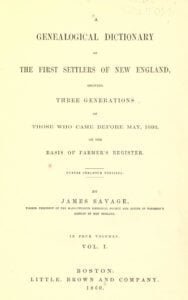
A genealogical dictionary of the first settlers of New England vol 1

The Abbot family of New England, traced in James Savage’s genealogical work, includes notable figures such as Arthur Abbot, who settled in Marblehead around 1634 and had a son, Philip. Several generations followed, with families established in towns such as Ipswich, Andover, and Cambridge. Many Abbots contributed to early colonial life, engaging in various trades and civic duties. The family’s legacy persists, with descendants continuing to thrive across New England into the 19th century.

Abbott Genealogical Register

Abbott Genealogical Register

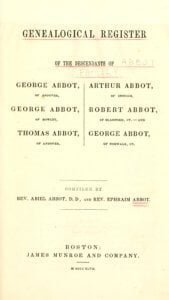
In 1847, Abiel Abbot and Ephraim Abbot compiled a comprehensive genealogical record titled “Abbott Genealogical Register,” detailing the lineage of several Abbott families originating from early New England settlers. Initially aimed to document the descendants of George Abbot, Sr. of Andover, the scope expanded to include numerous branches such as George Abbot, Jr., Thomas Abbot of Andover, Arthur Abbot of Ipswich, Robert Abbot of Branford, Ct., and George Abbot of Norwalk, Ct., among others. This volume, published by J. Munroe and Company in Boston, Massachusetts, integrates meticulously gathered data, revealing the expansive and intertwined genealogies of the Abbott families. The authors’ painstaking research and dedication to accuracy, despite challenges in data completeness, provide a valuable resource for anyone tracing the Abbott lineage or studying early American familial structures.

The Ancestry of Sarah Stone

Ancestry Chart for Sarah Stone

The ancestry of Sarah Stone, wife of James Patten of Arundel (Kennebunkport) Maine
Contains also the Dixey, Hart, Norman, Neale, Lawes, Curtis, Kilbourne, Bracy, Bisby, Pearce, Marston, Estow and Brown families.

Descendants of Richard Kimball of Ipswich MA

Richard Kimball, originally from Rattlesden, Suffolk, England, arrived in New England in 1634 and settled in Ipswich, Massachusetts. A notable figure, he served as a wheelwright and became a freeman in 1635. He married Ursula Scott and later Margaret Dow, fathering nine children. His son, Richard Kimball (2), who moved to Wenham, continued the family’s prominence, holding various civic roles. The family lineage extended through several generations, notable for their involvement in local governance and the Revolutionary War, leading to descendants like John Kimball, a respected Easton merchant and postmaster.

Descendants of Rev. George Shove of Fall River, MA

Rev. George Shove, ordained in 1665, served as the third minister of Taunton and contributed significantly to local secular matters, particularly as a landowner. He married Hopestill Newman, followed by two additional marriages, and fathered several children, including Edward, who continued the family legacy. The Shove family became influential in Fall River, with descendants like Charles O. Shove excelling in the textile industry and community service. Charles O. was known for his leadership at the Granite Mills, while his brother Edward pursued a successful career as a cotton broker.

Free Massachusetts Vital Records

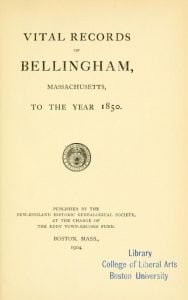
Vital Records of Bellingham Massachusetts to 1850

This is a collection of free vital records books for Massachusetts towns, most of them known as “Tan Books.” Generally, these records go up to 1850 at which, the genealogist can use the census records to assist in identifying the family connections further. They’re called “tan books” because they were bound by tan cloth. Included with this article is an account of why and how these manuscripts were published along with links to all 274 Massachusetts vital record books which can be freely read.

Early New England People

Early New England People

Sarah Titcomb over her years of study of various New England families had collected quite a bit of material of several early New England families. At the bequest of some of her friends, she prepared and published them in book form. When reading through the material I was impressed with the amount of material collected on each individual, and rather then a brief genealogical sketch, readers are provided an in-depth study of each early family: Ayer, Bartlett, Bradley, Chase, Dean, Dow, Dunster, Ellis, Fuller, Hope, Kilby, Martine, Les Dernier, Maverick, Mills, Montague, Pemberton, Pepperrell, Poore, Precott, Sewall, Longfellow, Spofford, Titcomb, Watmough, and Willard.

King William’s War – Indian Wars

King Williams War Map

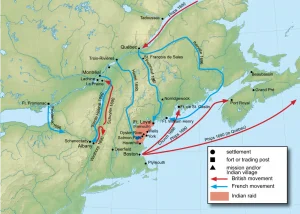
King William’s War (1688-1697) stemmed from territorial conflicts among the English, Spanish, and French, with Native American tribes often allying with the highest bidder. While the French aimed to expel the English from northern territories, the English targeted Canada. Initial hostilities began in Maine, escalating with brutal attacks, including the massacre at Schenectady. Despite military efforts, both sides suffered heavy losses, leading to a temporary peace in 1693. The war officially ended with the Treaty of Ryswick in 1697, restoring prior territorial claims and initiating a fragile peace.

Byfield Massachusetts Parish Records

Byfield Parish

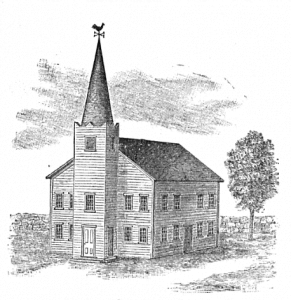
736 Byfield Massachusetts parish records recorded by a Rev. Hale from 1709-1743. These baptisms may include residents from Newbury, Rowley and Georgetown. The first pastor of the church in the parish was Rev. Moses Hale, who died Jan.16, 1743-4. The following are all the records of baptisms in the parish from the founding of the church to the time of Mr. Hale’s decease.