The Frawley Family of Prairie du Rocher Illinois
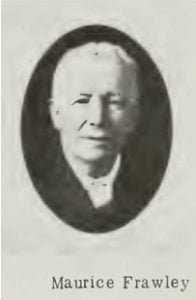
Maurice Frawley

Mr. Maurice Frawley, a cherished resident of Prairie du Rocher, was born in County Limerick, Ireland, in 1833. He married Mary Crimmins in 1859, and after immigrating to America in 1862, they settled in St. Louis before moving to Kidd, Illinois, in 1872. There, he farmed until his retirement in 1913, ultimately residing in Prairie du Rocher. Mr. Frawley’s life reflects hard work and integrity, with only one of his children surviving him.

The Siegfried Family of Prairie du Rocher Illinois

Anton Siegfried, born in Germany in 1852, immigrated to Red Bud, Illinois, in 1872. After working on a farm, he became involved in the cattle and hog trade and opened a meat market in Ruma in 1891, subsequently adding a general merchandise store. Married to Mary Melly in 1878, they had eight children. A Democrat, Siegfried served on the school board and as president of Ruma. He also owned a 120-acre farm, illustrating his commitment to both business and community.

The Eichenseer Family of Prairie du Rocher Illinois

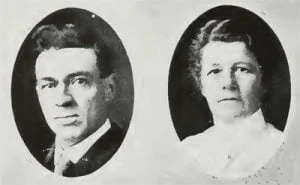
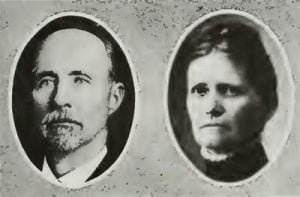
Mr. and Mrs. Joseph Eichenseer

The Eichenseer family, originally from Madonnaville, Monroe County, Illinois, has deep roots in agriculture. John Eichenseer, born in 1863, married Mary Wierschem in 1890 and raised ten children on their 80-acre farm. His brother, Joseph, born in 1870, married Mary Vogt, having three sons on a 100-acre farm. Meanwhile, George Eichenseer, born in 1878, also managed a farm and married Mary Anna Hoef, with one son. The family is recognized for their contributions to local farming and community life.

The Seitz Family of Prairie du Rocher Illinois

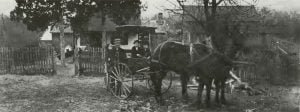
Residence of George J. Seitz, Prairie du Rocher

George J. Seitz, born on August 11, 1870, in Ste. Genevieve, Missouri, became a recognized liquor dealer in Prairie du Rocher, Illinois. After gaining experience as a butcher, he opened a saloon in 1912 following various roles, including hotelier and school board president. An active member of the community, he also contributed through local government and music. Married to Mary E. Menard, they had five children. His wife, a descendant of notable local figures, was previously married to John Brickey.

The Ellner Family of Prairie du Rocher Illinois

Mr. and Mrs. John P. Ellner

John Peter Ellner, a prominent farmer of Prairie du Rocher, was born in Herman, Missouri, in 1872. His family moved to Illinois in 1876, where he received his education. After working on his parents’ farm, he managed a 120-acre farm he rented in 1900 and later purchased in 1916. Married to Joseph Myerscough, they have two children. Ellner attributes his success to hard work, and he is affiliated with the Republican Party, while his wife is a member of the Altar Society.

The Brickey House of Prairie du Rocher Illinois

John Brickey

The Brickey House in Prairie du Rocher, Illinois, was an impressive three-story residence with a rich history originating from an 1860s lottery win associated with an opera house in Chicago. Abraham Hagerman Lee, the winner, sold his claim for $200,000 and used the money to construct the house. Later owned by F. W. Brickey, the mansion became a local cultural center. Tragically, it was abandoned and ultimately burned down in April 1970, marking the end of a storied legacy that began with a simple lottery ticket.

History of St. Joseph Church Prairie du Rocher Illinois

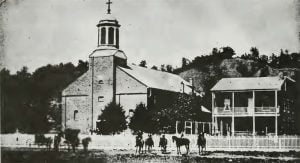
St. Joseph's Church and Rectory as originally built in 1858 and 1868 respectively

St. Joseph Church in Prairie du Rocher, Illinois, was established in 1722 as a chapel linked to the church of Ste. Anne at Fort Chartres. Following the founding of Fort Chartres in 1718 by Pierre Duque Boisbriant, the local community built a log chapel for the French settlers. Over time, the church gained prominence as Ste. Anne fell into disrepair, becoming a key parish for the French in the region. The current Romanesque church structure dates from 1858, embodying the parish’s rich history and cultural heritage.

The Palmier Family of Prairie du Rocher Illinois

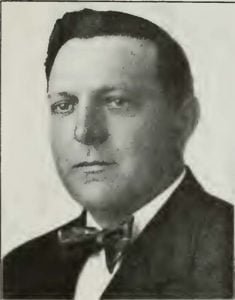
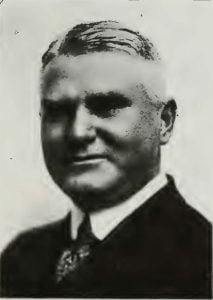
M. H. Palmier

M. H. Palmier, born on June 5, 1877, near Prairie du Rocher, Illinois, worked in various roles before marrying Dillie Miller on January 28, 1901. The couple had four children. After a brief stint in the liquor business in St. Louis, Palmier returned to Prairie du Rocher, where he purchased property in 1908 and built a modern establishment featuring a hall, salon, and other amenities. A devoted Democrat, he served multiple terms as village treasurer and was instrumental in local development efforts.

The Brickey Family of Prairie du Rocher Illinois

F. M. Brickey

Franklin W. Brickey was born in Potosi, Missouri, in 1819 and moved to Illinois at 19. He established a business in Fort Chartres before building a mill in Prairie du Rocher in 1858. His son, F. M. Brickey, born in 1860, succeeded him and expanded their ventures, including grain buying and land drainage. F. M. Brickey was involved in local politics and education, and his family residence is noted for its modern amenities. He was married to Emily J. Glad and had three children, emphasizing their community engagement and musical pursuits.

Early Migration to Fort de Chartres

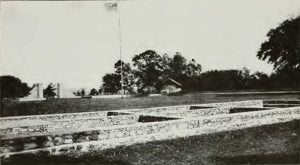
The ruins of Fort de Chartres with powder magazine intact

The history of Prairie du Rocher is intricately linked to Fort de Chartres and the Catholic Church, dating back to 1682 when La Salle claimed the territory for France. In 1717, the Illinois Country transitioned from Quebec to Louisiana’s jurisdiction. Commandant Pierre Duque Boisbriant established Fort de Chartres in 1720 to protect settlers and maintain French control. Despite its strategic location and role in French colonial governance, the fort faced neglect and flooding, leading to its eventual abandonment post-1763. Restoration efforts continue at the site today.

The O’Hara Family of Prairie du Rocher Illinois

Mr. and Mrs. Charles O'Hara

Henry O’Hara and his family, including his wife Margaret and ten children, relocated from Frederick County, Maryland, to Nelson County, Kentucky, in late 1811. After six years, they journeyed to Illinois, settling near Prairie du Rocher by 1818. Henry established the O’Hara Settlement and constructed a reliable clock, which passed through the family for generations. His son James, a pioneer in Southern Illinois, ran a successful farm and store. The family expanded, with notable members Charles and James R. O’Hara contributing to the community’s development.

Gov. Perier and Bienville

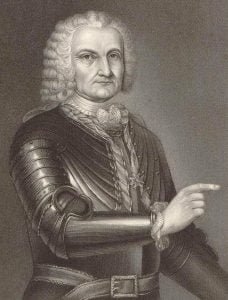
Bienville

The English colonists, wary of French expansion along the Mississippi, fostered conflicts between French and Native American tribes, particularly igniting animosity with the Chickasaws after a failed French escort led to their warriors’ deaths. Bienville, the French governor, attempted to use the Choctaws against the Chickasaws but faced significant resistance. Subsequent military expeditions by both Bienville and d’Artaguette ended in disastrous defeats against Chickasaw defenses. Ultimately, the Chickasaws showcased their resilience, marking critical victories that hindered French ambitions in the region.

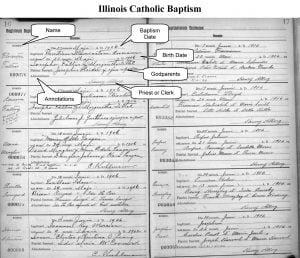
Illinois, Diocese of Belleville, Catholic Parish Records, 1695-1956

Illinois Bellville Church Records

A help guide for accessing the images of parish registers recording the events of baptism, first communion, confirmation (to 1907), marriage (to 1930) or death (to 1956) in the Diocese of Belleville (Illinois), Roman Catholic Church. The index to some volumes may reference pages within a given volume beyond current publication dates. As such, these images are not currently available. In addition to traditional parish registers, this collection includes a small number of census, church history, family and financial records. To assist the researcher I have broken down the available registers by county and name of parish, including the years covered by those parish records.

Early Exploration and Native Americans

Ferdinand de Soto’s interactions with Native American tribes, specifically the Choctaws and Chickasaws, exemplify early European attempts to impose their ideologies of civilization and Christianity upon Indigenous populations. This approach set a precedent for further exploitation and oppression of Native Americans, as European settlers sought to acquire land and resources. Throughout history, tribes like the Chickasaws, known for their valor, remained steadfast allies rather than adversaries. This enduring alliance contrasts sharply with the overarching narrative of dispossession and extermination faced by Indigenous nations in North America.

The Discovery Of This Continent: It’s Results To The Natives

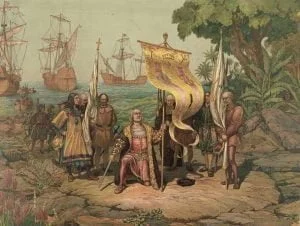
Columbus Landing on Hispaniola

In 1470, Christopher Columbus married Dona Felipa, daughter of a renowned navigator, and settled in Porto Santo, where they shared dreams of discovering lands to the West. Their ambitions fueled Columbus’s determination, leading to his 1492 voyage that resulted in the European discovery of the Americas. However, this event marked the beginning of devastation for native peoples, introducing warfare, disease, and colonization that would decimate their populations and cultures, ultimately transforming their rich, diverse societies into shadows of their former selves.

Escape From The Robber Band

On November 8, 1819, the author and companions faced a night of dread while staying with strangers who displayed suspicious behavior. Armed and apprehensive, they prepared for a possible attack, realizing the danger posed by their hosts. After surviving the night, they departed the premises, eventually joining other travelers on the road to safety. Their journey continued through Illinois, revealing a landscape of both fertile land and dangerous inhabitants, leading the author to reflect on the challenges and characters of this new frontier.

Biography of William A. Phillips

William A. Phillips, born in Scotland on January 14, 1824, was a key figure in Kansas history, advocating for abolition and supporting the Union during the Civil War. After moving to Illinois and gaining legal expertise, he became an influential journalist with the New York Tribune. During the war, he rose to command significant military units, distinguishing himself in battle. Post-war, Phillips represented the Cherokee Indians and served multiple terms in Congress, where he authored the notable book “Labor, Land and Law.” He passed away on November 30, 1893.

Biography of Benjamin H. Charles

Benjamin H. Charles, born on April 26, 1866, in Chester, Illinois, is a distinguished municipal bond lawyer based in St. Louis. He graduated from Westminster College and Yale Law School, and established his legal career amid the challenges of competition in 1892. His work as second and first associate city counselor saw him handle significant municipal cases. In 1917, he partnered with W. T. Rutherford, further cementing his reputation in municipal law. Charles is also active in various educational and social organizations. He is married with three sons.

Biography of Charles E. Hyndman, M. D.

Dr. Charles E. Hyndman, born June 29, 1881, in Sparta, Illinois, is a notable surgeon in St. Louis with extensive training both domestically and abroad. After earning his medical degree from Washington University in 1906, he built a distinguished career, particularly in surgery, and served in various hospitals. During World War I, he joined the Medical Corps, providing surgical aid overseas. A dedicated professional and lifelong learner, he is also active in numerous medical organizations and enjoys various recreational activities. He is married with one son.

Biography of Arthur Valentine Lashly

Arthur Valentine Lashly, born on February 14, 1880, in Randolph County, Illinois, was a distinguished lawyer in St. Louis, having earned his LL.B. from St. Louis University in 1910. He served as the prosecuting attorney from 1913 to 1915, notably combating illegal saloons and gambling. Lashly’s rigorous dedication to law enforcement earned him commendation for his integrity and effectiveness in office. A member of the Methodist Church and active in civic affairs, he has been a staunch supporter of the Democratic Party and various reform initiatives throughout his life.