Pennsylvania Digital Archives

Pennsylvania State Archives

These 45 genealogy databases comprise part of the Pennsylvania Digital Archives from the state government. We’ve only included those databases and documents which are most relevant to genealogists. All of them are free for you to use.

Wistar Family: A Genealogy of the Descendants of Caspar Wistar, Emigrant in 1717

Wistar Family title page

The book “Wistar Family: A Genealogy of the Descendants of Caspar Wistar, Emigrant in 1717” delves into the fascinating history of the Wistar family, tracing its roots back to Caspar Wistar, who was born on February 3, 1696, to Hans Caspar and Anna Catharina Wüster in Hilspach, near Heidelberg in the Electorate of the Rhenish Palatinate. Caspar’s father served as a huntsman or forester for the Prince Palatine, a position that was hereditary in their family.

Pennsylvania German Pioneers

Pennsylvania German pioneers vol 1 title page

This set of manuscripts was compiled in the 1930s by Strassburger and Hinke in order to provide the descendants of Pennsylvania German pioneers a publication of the most accurate of original lists of arrivals. In order to do this they transcribed the hard-to-read German and American script of the passenger lists, oaths of allegiance to the Crown, and oaths of abjuration and fidelity to the proprietors. These three types of records form the basis for the Pennsylvania German Pioneers.

The William Wade Hinshaw index to Pennsylvania Quaker meeting records

Stroudsburg Pennsylvania Monthly Meeting Book

The William Wade Hinshaw index includes transcriptions of Pennsylvania Quaker Monthly Meeting records, originally abstracted in the 1930s. This collection contains vital records (births, deaths, marriages), meeting minutes, and removals, archived at the Friends Historical Library post-Hinshaw’s death. Key Meetings like Concord, Exeter, and Frankford are detailed, alongside their established dates and record spans. Although the transcriptions may vary in clarity, they serve as a valuable resource for Quaker history and genealogical research, with original records available for verification.

The Turner Family Magazine

The Turner family magazine

In 1916 and 1917, William Montgomery Clemens edited a series of pamphlets called the Turner Family Magazine. It was meant to be a genealogical, historical and biographical magazine about the Turner family across the United States. That series of magazines was later published in 1920 as a complete bound volume. This is what this book is.

Record of the Smith family descended from John Smith

Record of the Smith family descended from John Smith

This book contains the history of the descendants of John Smith, born in Ireland in 1686, died in Uwchlan, Chester County, Pennsylvania, December 19, 1765; and his wife, Susanna, born in Ireland in 1691, died in Uwchlan, Chester County, Pennsylvania, December 24, 1767.

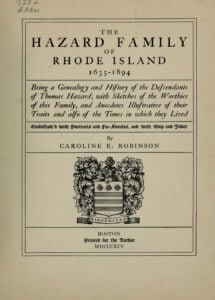
The Hazard family of Rhode Island 1635-1894

The Hazard family of Rhode Island 1635-1894

The Hazard family of Rhode Island 1635-1894 – Being a genealogy and history of the descendants of Thomas Hazard, with sketches of the worthies of this family, and anecdotes illustrative of their traits and also of the times in which they lived.

Washburn Genealogy of Bridgewater Massachusetts

Old Families of Southeastern Massachusetts

The Washburn family, among the earliest settlers of Bridgewater, Massachusetts, traces its roots to John Washburn, who arrived in New England by 1632. His lineage includes notable descendants such as Capt. Abraham Washburne, a Revolutionary War soldier, and his son Seth, who became a successful entrepreneur in cotton gins. The family continued to thrive, with later generations like George and Lucy Eaton, who contributed to the community’s legacy. The Washburns remain a significant part of Bridgewater’s history, exemplifying the town’s early growth and development.

Baxendale Family of Brockton, Massachusetts

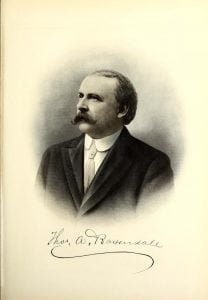
thos a baxendale

Thomas Albert Baxendale, born in 1840 in England, became a prominent figure in Brockton, Massachusetts, establishing a successful business in box toes for shoes. As a pioneer in shoe manufacturing, his inventions greatly influenced the industry. He was also a dedicated real estate developer, known for constructing elegant homes and improving Amrita Island, where he and his wife, Esther, planned a legacy for education and humane treatment of animals. Baxendale passed away in 1910, leaving behind a significant impact on his community and the shoe industry.

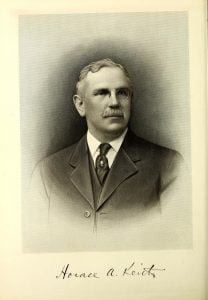
Ancestors of Horace Alden Keith of Brockton, MA

Horace Alden Keith

Horace Alden Keith, born May 25, 1862, in West Bridgewater, MA, founded the Brockton Webbing Company, becoming a prominent figure in local industry. He hailed from a distinguished lineage, tracing back to Rev. James Keith, an early minister in Bridgewater. His father, Henry Snell Keith, and mother, Thalia Alden, also contributed to the family’s historical significance. Horace’s early career included roles at Spalding Brothers before establishing his own successful business, reflecting both his entrepreneurial spirit and New England heritage.

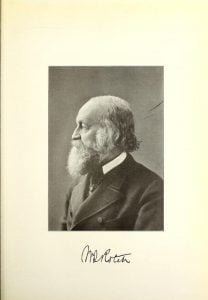
Ancestors of William J. Rotch of New Bedford, MA

William J. Rotch

The Rotch family has played a significant role in New Bedford’s history since the 18th century, greatly impacting its whaling and cotton industries. William Rotch, the first American ancestor, settled in Provincetown around 1700, later moving to New Bedford and pioneering the whale fishery there. His descendants continued to shape the city’s commercial landscape, including William J. Rotch, who became a notable businessman and public figure, serving as mayor and supporting various local enterprises and educational initiatives. The family’s legacy endures in New Bedford’s character and prosperity.

Descendants of Philip Taber of New Bedford, MA

Philip Taber, born in 1605 and passed in 1672, was an early settler of New Bedford, MA, with a distinguished public service record, including roles as a deputy and representative. He had two wives, Lydia Masters and Jane, and fathered several children, including Thomas Taber, who continued the family legacy through civic duties in Dartmouth. The Taber lineage expanded with Joseph and Benjamin Taber, leading to notable descendants like Edward Smith Taber, who achieved success in various industries, including the Morse Twist Drill Company.

Hussey and Morgan Families of New Bedford MA

The Hussey and Morgan families have a significant history in New Bedford, dating back nearly a century. Key figures include George Hussey and Charles Wain Morgan, both influential in the whaling and shipping industries during the early nineteenth century. Christopher Hussey, their ancestor, was among the early settlers in New England, while George Hussey and his son were prominent ship merchants. Charles Morgan, who also established a successful shipping business, contributed to community institutions and left an enduring legacy in New Bedford’s wealthy society.

Establishment of Fort Smith in 1817

Quapaw Cession Map

In 1817, a military post was established at Belle Point, now Fort Smith, Arkansas, to protect white settlers and the Cherokee from Osage hostilities. Major William Bradford led the detachment tasked with this, supported by Major Stephen H. Long, who surveyed the area. The post was strategically located at the junction of the Poteau and Arkansas rivers, facilitating navigation and trade. Subsequent treaties with the Osage and other tribes led to significant land cessions, shaping early relations and territorial boundaries in the region.

Choctaw Nation and the Greer County Dispute

1818 Melish Map of the United States

The dispute over Greer County involves the Attorney General of the United States challenging Texas’s claims based on the 1819 Adams-Onís Treaty, which established boundaries between the U.S. and Spain. Despite the treaty, Texas has asserted jurisdiction over the territory in violation of U.S. treaty rights. The case seeks judicial clarification of whether the disputed land falls under U.S. or Texas authority, emphasizing historical claims stemming from significant early treaties and ongoing tensions regarding territorial rights and ownership.

Natchez Trace

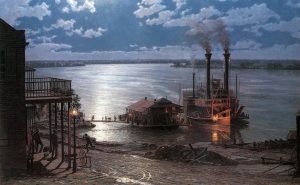
Natchez Under the Hill

In 1792, a treaty with the Chickasaw at Chickasaw Bluffs established the Natchez Trace, a significant route connecting Nashville to Natchez. Initially a thoroughfare for emigrants, it soon became infamous for outlaws like Mason and Murrell, who preyed on travelers. Despite efforts to capture these bandits, they eluded authorities until betrayal led to Mason’s demise. The Trace witnessed both lawlessness and camaraderie among its diverse users, ultimately fading from memory as it transformed into farmland, overshadowed by the bustling growth of nearby settlements.

Narrative of Marie Le Roy and Barbara Leininger

The Narrative of Mary le Roy and Barbara Leininger. Who for four and a half years were captive among the Indians, and on the 6th May 1759 arrived happy in this city. From her own lips never written and promoted to the Press. This manuscript gives an account of the captivity and escape of these two girls, whose families lived on Penn’s Creek, in the present Union County, Pennsylvania. It also provides a lengthy list of names of other prisoners met by the two ladies in their captivity.