The William Wade Hinshaw index to Pennsylvania Quaker meeting records
Stroudsburg Pennsylvania Monthly Meeting Book

The William Wade Hinshaw index includes transcriptions of Pennsylvania Quaker Monthly Meeting records, originally abstracted in the 1930s. This collection contains vital records (births, deaths, marriages), meeting minutes, and removals, archived at the Friends Historical Library post-Hinshaw’s death. Key Meetings like Concord, Exeter, and Frankford are detailed, alongside their established dates and record spans. Although the transcriptions may vary in clarity, they serve as a valuable resource for Quaker history and genealogical research, with original records available for verification.
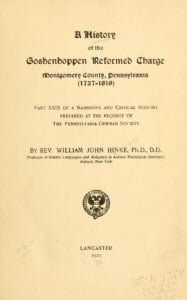
A history of the Goshenhoppen Reformed charge, Montgomery County, Pennsylvania (1727-1819)

A history of the Goshenhoppen Reformed charge, Montgomery County, Pennsylvania

In “A History of the Goshenhoppen Reformed Charge, Montgomery County, Pennsylvania (1727-1819),” William John Hinke delves into the rich history of one of Pennsylvania’s earliest Reformed congregations. Published in 1920, this detailed account traces the evolution of the Goshenhoppen Reformed Charge, focusing on its foundational years and the pivotal role it played in the religious life of early American settlers. Drawing from an extensive collection of church records and other historical documents, Hinke’s work not only highlights the religious activities but also sheds light on the community’s social dynamics from its establishment in 1727 through the early 19th century. This book serves as an invaluable resource for historians and genealogists alike, offering insights into the development of Reformed Church communities in colonial America.

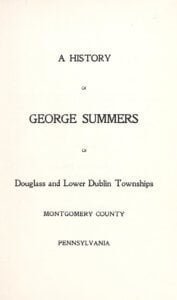
A history of George Summers of Douglass and Lower Dublin townships, Montgomery County, Pennsylvania

A history of George Summers of Douglass and Lower Dublin townships, Montgomery County, Pennsylvania

George Summers, progenitor of one of the Summers Families in America, was born in Germany shortly after the year 1690, and arrived in this country on the 22nd ot September in the year of 1752, landing at Philadelphia on the ship “Brothers, in charge of Captain Wm. Muir. He was married to Elizabeth . They had six sons and one daughter, namely Philip, Henry, John, Martin, George, Peter and Margaretha Elizabeth. Two of them, Philip and Henry, however, did not come over with their father but arrived two years later, September 30th, 1754 on the ship “Edinburg also landing at Philadelphia.

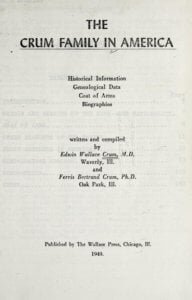
The Crum family in America

The Crum family in America

“The Crum Family in America” by Edwin Wallace Crum and Ferris Bertrand Crum is a comprehensive exploration of the Crum lineage, focusing primarily on two branches that emigrated from the Lower Rhineland, Germany, and settled in Pennsylvania and Virginia. Published in 1949 by Wallace Press, this book meticulously compiles historical and genealogical data about the Crum family without claiming to encompass all bearers of the Crum name. Delving into the lives and legacies of key figures such as Anthony Crum, Sr., and Matthias Crum, Sr., the text presents a detailed account of their migration to America around 1770, their subsequent settlements, and their family developments in Virginia. By combining archival records and the first U.S. Census data, this work aims to piece together the family’s early American history, while acknowledging gaps and unresolved connections in the family’s lineage.

Biography of Andrew H. Reeder, Governor

Andrew H. Reeder, born in 1807 in Easton, Pennsylvania, emerged as a prominent lawyer and politician during a critical era leading to the Civil War. He gained national attention as Governor of Kansas Territory, where his firm stance against pro-slavery measures led to significant conflict and threats against his life. Despite his Southern connections, Reeder became a strong advocate for anti-slavery forces, which led to his removal from office under dubious pretenses. After returning to Pennsylvania, he resumed legal practice and remained an influential figure until his death in 1864.

Biography of William Clinton Bardo

William Clinton Bardo was a notable figure in Arkansas City’s banking sector, serving as vice president of the Security National Bank. A descendant of a pioneering Pennsylvania family, he began his career in education before moving west during the Cherokee Strip land rush, where he homesteaded for twelve years. Following his success as a farmer, he transitioned to business and became integral to local civic and church activities. Bardo’s life reflects the spirit of exploration and community service, aligning with the progressive development of Kansas.

Biographical Sketch of A. W. King

A. W. King, a skilled marble and granite cutter, co-founded the Concordia Monumental Works in Cloud County, Kansas, in 1915 with D. F. Perkins. With over thirty-five years of experience, King played a key role in the firm’s rapid success, achieving nearly $16,000 in business within its first year. Born in Scotland in 1863, King emigrated to the U.S. in 1871 and honed his craft in Philadelphia before moving to Kansas in 1902. He is married to Onah Adams.

Biographical Sketch of George Godfrey Moore

George Godfrey Moore, born in Philadelphia on November 20, 1872, became a prominent figure in Kansas’s insurance sector after relocating in 1900. Initially a newspaper man, he transitioned into life insurance, ultimately serving as the general agent for the Germania Life Insurance Company. A notable community leader, he founded the Rotary Club of Topeka and actively participated in various local organizations. Moore, a devoted Mason and church member, married Georgie Major and has significantly contributed to Topeka’s welfare through his business and civic engagements.

Biography of William Stephen McDonald

William Stephen McDonald, born March 21, 1853, in Prince Edward Island, practiced medicine in Fort Scott for 25 years, driven by a profound spirit of service rather than financial gain. Educated at Wesleyan University and Jefferson Medical College, he combined athleticism with a dedication to patient care, often responding to calls in challenging conditions. A respected figure in the medical community, he also engaged in local organizations and served as a local surgeon for the Frisco Railroad. He married Flora Rice in 1892 and is an active member of the Methodist Church.

Biography of Samuel Bowman

Samuel Bowman, born May 18, 1846, in Virginia’s Shenandoah Valley, is a notable Kansas figure with a diverse background. A descendant of German settlers, he migrated to Ohio in 1864 before establishing a farm in Illinois. In 1882, he moved to Kansas, where he engaged in farming and later served two terms as probate judge in Labette County. Since 1910, he has been in Coffeyville with his sons in the real estate, insurance, and loan business, contributing significantly to the community through various civic roles.

Biography of John Quincy Smith

John Quincy Smith, born on September 20, 1848, in Lebanon, Ohio, exemplified a life of diverse success in both medicine and business. After earning his medical degree, he practiced in several states before transitioning to the wholesale produce sector and later establishing a successful piano business in Fredonia. A community leader and active Republican, he contributed significantly to local development, including the Fredonia Development Company. Smith married Minerva C. Van Harlingen in 1872, and they had two children, continuing his legacy in Fredonia.

Biography of John Quincy Smith

John Quincy Smith, born in Lebanon, Ohio, in 1848, was a prominent figure in Fredonia, where his diverse career spanned medicine and business. After earning his medical degree, he practiced in Indiana and Idaho before transitioning to commercial endeavors. Smith established a successful wholesale produce business and later a piano company, influencing the local economy significantly. A dedicated community member and Methodist church trustee, he contributed to various enterprises, including the Fredonia Development Company. He married Minerva Van Harlingen and had two children, continuing to shape the region’s growth and prosperity.

Biography of Andrew C. Jobes

Andrew C. Jobes, born on April 21, 1857, in Damascus, Ohio, emerged from a modest background to become a prominent banker. After gaining experience in Mississippi, he relocated to Kansas, where he played a crucial role in establishing significant banking institutions, including the National Bank of Commerce in Wichita. He served as vice president of the First National Bank in Kansas City and held various directorships, including with the Santa Fe Railway Company. Jobes was also involved in agriculture and community service, while remaining steadfastly Republican throughout his life.

Biographical Sketch of J. D. Cassell

J. D. Cassell, born in 1827 in Montgomery County, Pennsylvania, initially worked on a farm before moving westward in 1854. He spent brief periods as a student and in merchant tailoring before teaching in New Carlisle and Rolling Prairie, where he also served as Postmaster for eight years. In 1874, Cassell settled in Mattoon and opened Cassells Restaurant. He experienced personal loss twice through marriage, first to Elizabeth France and later to Nancy J. Bolster, and had four children: Annie, Lydia, Mary, and Benjamin.