
Sketch of the Town of Huntington, Long Island
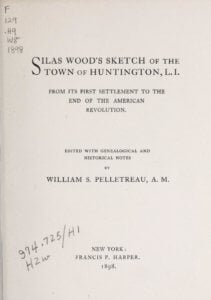
Silas Wood's sketch of the town of Huntington

Silas Wood’s sketch of the town of Huntington, L.I. is a small manuscript of 63 pages which provides an authoritative look at the early history of Huntington New York, from its first settlement to the end of the American revolution. Particularly fascinating to our Native American researchers is the history of the early interaction with the Matinecoes, the Massapeags, and the Secataugs.

Will of Thomas Jones, – 1669

The will of Thomas Jones, dated February 16, 1669, outlines his bequests to his family, including 20 shillings each for his three youngest sons and the same amount for his eldest sons. He bequeaths £10 to his daughter Martha, his best cloak to his eldest son Thomas, and a watch to his son John. His wife, Katharine Jones, is appointed executrix. The will was witnessed by Samuel Titus and Thomas Powell, and it was proved on March 2, 1669, with an inventory valuing his estate at £195.

Will of Thomas Wicks, – 1670

In his 1670 will, Thomas Wicks of Huntington bequeaths his property and assets primarily to his wife and children. His wife receives one-third of their accommodations for life, after which it passes to their son John. Son Thomas is granted land that belonged to John Lewis and additional meadow land. Wicks also bestows legacies upon daughters Rebecca and Martha, while the remainder of his estate is divided among his wife and four children: John, Elizabeth, Mary, and Sarah. Executors are named as Isaac Platt and Thomas Powell.

Will of James Naybor – 1671

In his will dated January 27, 1671, James Naybor of Huntington bequeaths his Great Trunk and best chest, filled with linens and woolen clothes, to his youngest daughter, Martha. He allocates £10 to his grandchild, Mercy, to be funded by the sale of his house in Boston, which he leaves to his five daughters: Mary, Sarah, Elizabeth, Rachel, and Martha. Martha is named executrix, with Mr. Wm. Bartholemew and Goodman Sundall serving as executors. The will was witnessed by Matthew Owen, Peter Floyd, and Joseph Bayley, and was proved on March 19, 1671.

Will of Thomas Brush – 1675

Thomas Brush of Huntington, Long Island, passed away without a will, prompting his son Thomas to be appointed as the estate administrator on September 10, 1675. The inventory of Brush’s estate was valued at £306 12s., as documented in the Court of Sessions records.

Will of William Ludlum – 1655

William Ludlam of Southampton bequeathed his properties to his sons, leaving housing and lands to Anthony, while Joseph received a new dwelling-house and adjacent lands. He made provisions for his daughters and grandchildren, specified a covenant with Samuel Davis, and appointed his son Henry as executor. Henry is tasked with managing the mill and received significant land holdings. The will was dated April 27, 1655, witnessed by John Howell and John Cooper, and proved at the Court of Assizes on November 2, 1667.

Bay, Bernice – Obituary

Bernice Wilson Bay, 87, passed away on March 19 in Huntington, New York. Born on October 5, 1911, in La Grande, she married Lawrence Bay in 1935. They lived in Seattle during World War II and later returned to Oregon before moving to California in 1961. After her husband’s death in 1964, she worked as a medical secretary. She is survived by two sons, a sister, three grandchildren, and a great-grandson. Donations are requested for the Alzheimer’s Foundation or the American Heart Association.

Matinecoc Tribe

The Matinecoc Indians were an Algonquian tribe that originally occupied the northwest coast of Long Island, New York, from Newtown to Smithtown. They established villages in areas like Flushing and Huntington. However, their population had significantly diminished prior to European contact, likely due to conflicts with the Iroquois, leading to tribute payments. By 1650, only about 50 families remained. Historian Ruttenber associates them with the Montauk group, although the exact relationships among western Long Island tribes remain unclear.