
Letter from Frederick Follet to Henry R. Schoolcraft

Frederick Follet’s letter to Henry R. Schoolcraft details his observations of Fort Hill, located near Le Roy, New York. He describes the Hill’s geological features and suggests it was naturally formed yet utilized as a fortification by ancient peoples. Follet notes remnants of entrenchments and various artifacts found in the area, indicating its historical significance. He also mentions the discovery of larger-than-average skeletons, hinting at a robust race of former inhabitants. Additionally, he includes a list of artifacts he sends for Schoolcraft’s review.
Letter from C. Dewey to Henry R. Schoolcraft

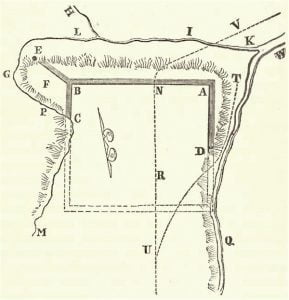
C. Dewey’s letter to Henry R. Schoolcraft describes the ancient entrenchments at Fort Hill in Genesee County, suggesting it may have been a fortified site predating European colonization. The quadrangular space is outlined by deep trenches and natural ravines, with artifacts such as clay pipes indicating varied cultural influences. Dewey dismisses the notion of French origin for the fort, instead pointing to a pre-Indian civilization. He offers his observations and speculations for Schoolcraft’s consideration, highlighting the historical significance of Fort Hill.

Ancient Entrenchments on Fort Hill, near Le Roy, Genesee County

Sketch of the Ancient entrenchments on Fort Hill, near Le Roy, Genesee County

The ancient entrenchments on Fort Hill, located near Le Roy, Genesee County, showcase a significant defensive structure shaped by natural geological features. Positioned at the confluence of Fordhams Brook and Allens Creek, the site includes remains of walls and ditches, which likely served as fortifications. Artifacts such as stone pipes, tools, and human bones of considerable size suggest occupation by a prehistoric culture predating the Native Americans. Despite alterations over time, evidence indicates the site’s enduring historical significance and mystery surrounding its original builders and functions.

Tonawanda Reservation Map and Occupants, 1890

The Tonawanda Reservation, established by a treaty in 1859, spans 7,549.73 acres across Erie, Genesee, and Niagara counties, New York. Originally surveyed in 1799, it includes various roads and churches, with many parcels cultivated by both Seneca Indians and white lessees. Notably, the 1890 map provides a detailed record of the reservation’s occupants, listing names associated with multiple sections, as well as infrastructure like schools and churches. The area shows signs of improvement, with ongoing cultivation and community development.

Reservations of the Six Nations in New York and Pennsylvania, 1723-1890

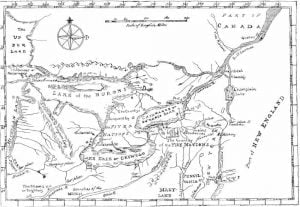
Map of the Country of the Five Nations

In 1771, Governor William Tryon prepared a map delineating the recognized boundaries of the Six Nations, later referenced by Lewis H. Morgan in 1851 to depict the villages and trails of the Five Nations. By 1890, the Oneida and Cayuga tribes had lost their ancestral lands in New York, retaining only small remnants. Various treaties led to significant land reductions for the Oneidas. The Six Nations’ reservations were organized under New York law, reflecting both traditional customs and modern governance challenges faced by their communities.

Biography of Hon. George Peabody Little

Hon. George Peabody Little, born on June 20, 1834, in Pembroke, N.Y., descends from notable New England families, notably the Littles of Newbury and the Peabodys of Danvers. His lineage traces back to George Little, a 1640 settler in Newbury, Massachusetts. Mr. Little’s family history includes prominent ancestors engaged in community leadership and public service, reflecting a rich heritage. He is the eighth generation of Littles in America, illustrating a deep-rooted connection to the region’s history and governance.

Biographical Sketch of Benjamin G. Kimball

Benjamin G. Kimball, born on November 17, 1814, in Bradford, Massachusetts, pursued his education at Bradford College. Following his father’s early death, he began his career at age fourteen in a dry goods store, eventually transitioning to shoemaking. In 1837, he moved to Missouri, where he engaged in various businesses, including farming and lumber trading in Jameson. A respected community leader, Kimball married Serilda A. Burton in 1843, and they had eight children, six of whom survived.

Five Nations Burial Customs

In the early 18th century, the Iroquois, or Five Nations, practiced distinctive burial customs reflective of a belief in an afterlife. They often placed bodies in upright positions within mounds, covering them with timber and earth, and adorned the graves with fine clothing and goods like wampum. Regular visits to the graves by relatives were customary, and mounds varied in size across regions. Significant burial sites have been discovered, including prominent graves of figures like Red Jacket, showcasing the spiritual importance of these rituals among the Iroquois.

Stone Bill, or Tomahawk

The pointed mace, discovered in ancient North American graves, features a semi-lunar design, functioning as a weapon for early warriors. Unlike the slicing methods of the agakwut and tomahawk, this mace was designed to pierce the skull through its sharp points and the warrior’s force. Various specimens, including one from Tonawanda, New York, exhibit impressive craftsmanship in siliceous slate. These early weapons signify a primitive society’s combat techniques prior to more sophisticated arms, highlighting a critical phase in pre-Columbian warfare.

Agreement of September 3, 1823

On September 3, 1823, a treaty was conducted in Moscow, New York, between the Seneca nation and representatives John Greig and Henry B. Gibson. For $4,286, the Seneca sachems, chiefs, and warriors sold the Gordeau reservation, comprising about 17,927 acres, while reserving 1,280 acres for their own use. The treaty was witnessed by officials from the United States and Massachusetts, ensuring the agreement was understood and executed to the satisfaction of the Seneca leaders.

Treaty of November 5, 1857

On November 5, 1857, articles of agreement were established between the U.S. commissioner Charles E. Mix and representatives of the Tonawanda band of Seneca Indians. The agreement involved the surrender of claims to lands west of Missouri and the allocation of $256,000 for the Tonawanda band. They could purchase their Tonawanda reservation from Ogden and Fellows, with conditions set for the purchase price. The treaty aimed to resolve unexecuted agreements from previous treaties and support the Seneca people amid challenges they faced.

Biography of Channing John Brown

Channing John Brown, born in Genesee County, New York, in 1847, played a pivotal role in founding Blue Rapids, Kansas, as secretary of a colony that settled there in 1869. A Hamilton College graduate, he became a prominent figure in local governance, serving as a state legislator and as clerk of the Kansas Supreme Court for 18 years. Returning to Blue Rapids in 1900, he ventured into the hardware business and developed a significant orchard. Married in 1881, he remains active in the community as a Republican and church member.

Biography of Seth Ingalsbee

Seth Ingalsbee, now retired in Wheaton, Kansas, has lived a remarkable life spanning over eighty-eight years. Born in 1829 in New York, he served in the Civil War with the Tenth Illinois Cavalry and later homesteaded in Kansas. A descendant of Revolutionary War veterans, he held significant roles in local governance, including postmaster and school board director. Ingalsbee witnessed transformative advancements in American society and built a legacy through his seven children. He remains a respected figure among fellow veterans and the community.

Biography of Carlton M. Lounsbury

Carlton M. Lounsbury, born in 1846 in New York, moved to Kansas in 1870, where he established a successful farming career and developed a homestead into 720 acres. A Republican and active community member, he also served as president of the Farmers State Bank and ran a country store for thirty years. Lounsbury married Mary C. Yarnell in 1884 and has two children, one of whom is pursuing higher education. Now retired in Lincoln, he remains a respected figure in Kansas affairs.

Biographical Sketch of Frank Mason Comstock

Frank Mason Comstock, born May 20, 1855, in LeRoy, New York, was a prominent college professor. He earned an A.B. and C.E. from Union College in 1876, followed by an A.M. in 1879 and a Ph.D. in 1891. Comstock worked on the New York Adirondack survey in 1876 and served as principal of the LeRoy Academic Institution until 1891. Since then, he has been a professor at the Case School of Applied Science, contributing to various technical publications and associations in forestry and geology.

Biographical Sketch of Adrian Dwight Joyce

Adrian Dwight Joyce, born on November 18, 1872, in Sumner, Iowa, was educated at Olivet College and the University of Michigan. He began his career in education before entering the wholesale hay and grain business in 1898. Joyce joined The Sherwin-Williams Company in 1902, progressing through various managerial roles to become general manager by 1910. He also held several vice-presidential positions in related companies and was active in clubs, enjoying motoring, golf, and fishing. He married Anna Page in 1879 and had four children.

Biography of George W. Vaughn

George W. Vaughn, known as Major Vaughn, was a prominent figure in American railroad engineering, with a career spanning from the early days of railroads in the U.S. until his death in 1916. Born in New York in 1829, he displayed remarkable mechanical talent despite limited formal education. He significantly contributed to various railroads across the country, including the Atchison, Topeka and Santa Fe Railway. His legacy includes innovative engineering feats and a lasting impact on the railroad industry in Kansas and beyond.

Biography of Otis T. Dyer

Otis T. Dyer, born in 1844 in New York, played a pivotal role in Riverside’s development before 1890. After serving in the Civil War, he established a successful banking career in Illinois. In 1880, he moved to Riverside, founding Dyer Bros. Bank. His banking acumen led to the formation of the Riverside Banking Company, and he was crucial in the city’s incorporation and water supply management. A prominent community figure, Dyer was also involved in various enterprises and held strong ties to local fraternal organizations and churches. He resided in a beautifully landscaped home with his wife, Mary Weed, and their four children.

Biographical Sketch of David Meacham

David Meacham, born on May 3, 1835, in Genesee County, New York, learned carpentry before moving to California in 1858. He traveled with General Harney, assisting in the aftermath of the Mountain Meadow Massacre and contributing to the memorial for the victims. After settling in Bloomfield and later San Bernardino, he made significant contributions to local construction, including building Riverside’s first house. Aside from a year spent in Virginia City, Nevada, Meacham has lived in California, known for his integrity and character.