New Hampshire Men

New Hampshire Men presents 407 biographical sketches, with portraits, of men who were active in commercial, professional, and political life in New Hampshire in 1893.

New Hampshire Men presents 407 biographical sketches, with portraits, of men who were active in commercial, professional, and political life in New Hampshire in 1893.

Volume II of History of the Town of Cornish, New Hampshire, with Genealogical Record, 1763–1910, compiled by William Henry Child and published in 1911, presents a detailed genealogical account of the families who settled in Cornish from its founding through the early 20th century.

Genealogy of the descendants of John Walker of Wigton, Scotland, with records of a few allied families : also war records and some fragmentary notes pertaining to the history of Virginia, 1600-1902
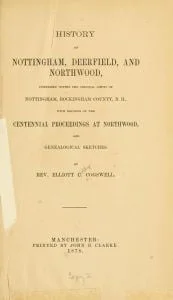
History of Nottingham, Deerfield, and Northwood, comprised within the original limits of Nottingham, Rockingham County, N.H., with records of the centennial proceedings at Northwood, and genealogical sketches.

Luedders’ historical and pictorial city directory of Angola, Indiana for the year 1923, containing an historical compilation of items of local interest, a complete canvass of names in the city, which includes every member of the family, college students, families on rural lines, directory of officers of county, city, lodges, churches, societies, a directory of streets, and a classified business directory.
William Tasker, born August 21, 1852, in Pittsfield, New Hampshire, was a key figure in Contoocook’s development. A descendant of early settlers, he worked in various local businesses before serving as a Selectman and Chairman of the Board in Pittsfield, where he notably oversaw a sewerage system project. In 1887, he became the superintendent of the Merrimack County Farm, improving its management significantly. Tasker married Bertha L. Osgood, and they had three children, becoming active community members and Grange participants.
This tract details the harrowing accounts of victims of the Fugitive Slave Law, illustrating the brutal realities faced by those escaping slavery and the systemic injustices they encountered. By chronicling individual cases, such as James Hamlet, who was seized and later purchased back to freedom, the document emphasizes the relentless pursuit of fugitives and the complicity of both law enforcement and the judiciary in enforcing slavery. It also highlights instances of resistance, such as the violent confrontation at Christiana, reflecting the moral and societal turmoil surrounding the law.