History of Rindge New Hampshire

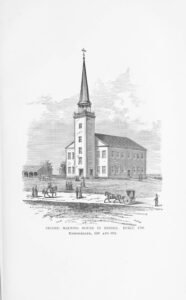
Second Meeting House in Rindge New Hampshire

The History of the Town of Rindge, New Hampshire by Ezra S. Stearns, was published in 1875, and covers the period from the original Rowley Canada grant or Massachusetts charter through the year 1874. Stearns traces the legal, territorial, and institutional development of Rindge, beginning with colonial land grants and boundary disputes and proceeding through settlement, incorporation into a town and development into a small manufacturing hub. More than half the volume is devoted to genealogical material. The genealogical register of Rindge families includes thousands of names compiled from a wide range of sources and assisted by contributions from residents and researchers beyond the town.

History of Francestown New Hampshire

Map of Francestown New Hampshire

History of Francestown, New Hampshire is a historic and genealogical record of the town from its first settlement in 1758 through the beginning of 1891. It records Francestown’s settlement, civic growth, religious and educational institutions, military participation, industries, and social customs, followed by an extensive genealogical register of families associated with the town.

History of Amherst New Hampshire

Residence of Isaac Brooks in Amherst New Hampshire

The history of Amherst, New Hampshire, unfolds from its 1675 land grant to veterans of the Narraganset War, marking the impetus for settlement along the Souhegan River. From its early governance and incorporation in 1760 to territorial adjustments that birthed Mont Vernon and Milford, this narrative encompasses local geography, economy, and Indigenous presence. Key military engagements, civic institutions, and genealogical records are explored up to 1882, offering a comprehensive view of the town’s evolution and its prominent figures.

Spokane Story

Spokane Story

“Spokane Story: A Colorful Early History of the Capital City of the Inland Empire” by Lucile Foster Fargo offers readers an evocative journey through the formative years of Spokane, Washington. Published in 1957 by Northwestern Press in Minneapolis, this work seeks to straddle the realms of history and storytelling, presenting a narrative that is neither entirely factual history nor pure fiction. Fargo accepts the challenging task of depicting Spokane’s cultural and developmental evolution from its fur trade beginnings to its emergence as a municipal entity in the early twentieth century.

Southborough Massachusetts vital records

Vital records of Southborough, Massachusetts, to the end of the year 1849 title page

The list of vital records of Southborough, Massachusetts, comprised in this volume includes all which were entered in the Town Books during the period from the earliest date there found to the end of the year 1849. Some additions and corrections of names and dates have been made from the records of the First Church, these being indicated in each instance by proper reference. There are a total of 6,267 births, marriages, and deaths recorded. This book is free to read or download.

History of Littleton New Hampshire

1895 Map of Littleton New Hampshire

The History of Littleton New Hampshire is comprised of three volumes, two volumes of history, and a final volume of genealogies. Considered one of the best examples of local history written in the early 20th century, is your ancestors resided in Littleton then you need these books. Read and download for free!

The genealogy and history of the Ingalls family in America

The genealogy and history of the Ingalls family in America

Edmund Ingalls, son of Robert, was born about 1598 in Skirbeck, Lincolnshire, England. He immigrated in 1628 to Salem, Massachusetts and with his brother, Francis, founded Lynn, Massachusetts in 1629. He married Ann, fathered nine children, and died in 1648.

Six Nations Names, Traditions, And Reminiscences

Indian nomenclature possesses distinct meanings, particularly in geographical contexts, revealing cultural significance. Many locations, like Tonawanda Creek and the Allegany River, have names derived from natural features or activities. Personal names often reflect individual traits or events, with traditional names fading amidst English influences. The St. Regis Indians’ heritage showcases a mixture of ancestries, with remnants of their past diminishing as modern customs take precedence. This evolution signifies a broader social transition, where the connection to traditional names and tribal identities weakens over time.

1896 St. Regis Indians Census

A June 1896 census of the St. Regis Tribe of Indians of New York Agency, taken by Alexander Solomon for U.S. Indian Agent J. R. Jewell, records 1,161 family members. The document lists households by surname, given name, and number in household, offering a detailed snapshot of the tribe’s community at the time.