History of Rindge New Hampshire

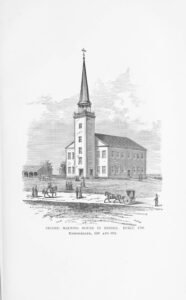
Second Meeting House in Rindge New Hampshire

The History of the Town of Rindge, New Hampshire by Ezra S. Stearns, was published in 1875, and covers the period from the original Rowley Canada grant or Massachusetts charter through the year 1874. Stearns traces the legal, territorial, and institutional development of Rindge, beginning with colonial land grants and boundary disputes and proceeding through settlement, incorporation into a town and development into a small manufacturing hub. More than half the volume is devoted to genealogical material. The genealogical register of Rindge families includes thousands of names compiled from a wide range of sources and assisted by contributions from residents and researchers beyond the town.
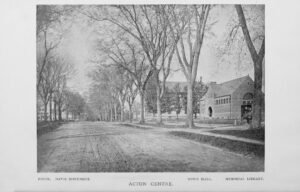
Acton Massachusetts History

Acton Center,Acton Massachusetts

Acton in History traces the town’s development from its beginnings as Concord Village in the seventeenth century through its emergence as a modest industrial community. It gives particular attention to the religious life of the town, including the building of early meetinghouses and the long ministries of figures such as the Rev. John Swift and the Rev. James T. Woodbury. The work devotes substantial space to Acton’s role in the Revolution, especially the events at the North Bridge in 1775 and the loss of Captain Isaac Davis and his company of minute-men. It also follows the growth of local industries, from blacksmithing and cooperage to the far-reaching effects of the Fitchburg Railroad after its arrival in 1844. Later chapters include brief sketches of notable residents in the 1880s. Throughout, the narrative weaves in discussions of Acton’s everyday life, civic engagement, and social values.

Abington Massachusetts Marriage and Death Records

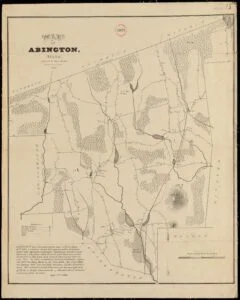
1830 Map of Abington, Massachusetts

Volume 2 of the Abington, Massachusetts vital records compiles marriage and death records up to 1850, complementing Volume 1, which contains birth records. Established in 1712, Abington’s boundaries have shifted, affecting historical jurisdiction. Extensive research from town records, cemeteries, and family Bibles ensured comprehensive documentation, including the identification of Black families recorded by given names. The volume is organized alphabetically by marriages and deaths.

Abington Massachusetts Birth Records

1830 Map of Abington, Massachusetts

Volume 1 of the Abington, Massachusetts vital records details births recorded in the town up to 1850, featuring comprehensive research from town records, cemeteries, and church documents. Established in 1712, Abington’s jurisdictional changes may affect genealogical searches. The records also include separate listings for Black families, primarily by given names. Additionally, various surnames are cataloged, emphasizing the need to consider alternate spellings. For marriages and deaths, researchers should consult Volume 2.

History of Windham New Hampshire

Residence of William H Anderson of Windham, New Hampshire

Leonard A. Morrison’s *The History of Windham, New Hampshire*, published in 1883, chronicles the town’s evolution from early settlements in the 18th century to the late 19th century. It highlights Windham’s roots in the Scotch-Irish Londonderry community and examines various aspects of local life, including land grants, education, and political developments. The work also documents significant historical events and includes extensive genealogies of the area’s early settlers and their descendants, drawing from comprehensive local records and archives.

History of Francestown New Hampshire

Map of Francestown New Hampshire

History of Francestown, New Hampshire is a historic and genealogical record of the town from its first settlement in 1758 through the beginning of 1891. It records Francestown’s settlement, civic growth, religious and educational institutions, military participation, industries, and social customs, followed by an extensive genealogical register of families associated with the town.

Lower Chinook, Kathlamet, Tillamook, and Clatsop Indians, Alive in 1906

In 1906, Charles E. McChesney compiled a list of the Lower Chinook, Kathlamet, Tillamook, and Clatsop Indians, along with their heirs, who had treaty agreements with the U.S. government since 1851. The document includes numerous names and corresponding addresses across various locations, such as Oregon, Washington, and California. This registration underscores the ongoing recognition of these tribes and serves as an important historical record of their existence and relocations during that period.

Early Records and Notes of the Brown Family

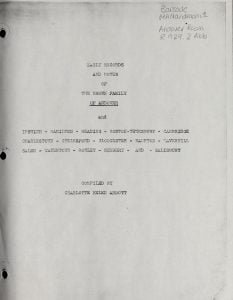
Early Records and Notes of the Brown Family

This is not a compiled genealogy, but rather, a compilation of notes, facts, and genealogies concerning the various early Brown families of the towns of Andover, Ipswich, Hamilton, Reading, Boston-Tewksbury, Cambridge, Charlestown, Chelmsford, Gloucester, Hampton NH, Haverhill, Salem, Watertown, Rowley, Sudbury, and Salisbury. Charlotte Helen Abbott compiled a series of volumes on early families of New England called the “Abbott Genealogies.” This is volume 7 of the series.

The genealogy and history of the Ingalls family in America

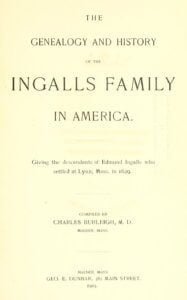
The genealogy and history of the Ingalls family in America

Edmund Ingalls, son of Robert, was born about 1598 in Skirbeck, Lincolnshire, England. He immigrated in 1628 to Salem, Massachusetts and with his brother, Francis, founded Lynn, Massachusetts in 1629. He married Ann, fathered nine children, and died in 1648.

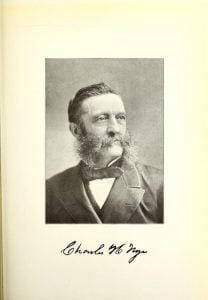
Ancestry of Charles Henry Nye of Hyannis, MA

Charles Henry Nye of Hyannis, MA

Charles Henry Nye of Hyannis, a direct descendant of Benjamin Nye from Sandwich, MA, represents a storied lineage beginning with early settlers. Benjamin Nye arrived in Lynn, Massachusetts, in 1635 and was active in community affairs, eventually establishing mills and serving in various public roles. Charles Henry, born in 1821, was an accomplished machinist and influential in the Cape Cod railroad. He married three times, last to Rose Berry, and contributed to local society while remaining engaged in community and fraternal organizations throughout his life.

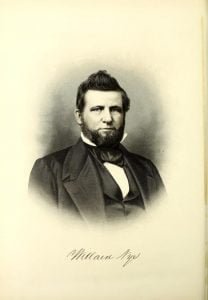
Ancestry of Hon. Willard Nye of New Bedford, Massachusetts

william nye

The Hon. Willard Nye, a significant figure in New Bedford, Massachusetts, was born into the prominent Nye family, tracing lineage back to Benjamin Nye, an early settler from England. Benjamin and his descendants played vital roles in their community, engaging in public service and building mills in Sandwich, Massachusetts. Willard Nye, a successful merchant and mayor, was known for his integrity and civic involvement during the tumultuous times leading up to the Civil War. He died in 1865, leaving a legacy of public service and dedication to his community.

Biography of Hon. George Washington Shedd

Hon. George Washington Shedd, born on April 17, 1847, in Shannon County, Missouri, is a prominent lawyer and successful farmer. He grew up in a family dedicated to public service and education. After working in various occupations, he was licensed to practice law in 1882, building a strong clientele. Shedd has been active in local politics, serving as associate justice of the Shannon County Court. A lifelong Republican, he is well-respected in his community and involved in the Masonic Lodge.