Genealogies of Pembroke New Hampshire

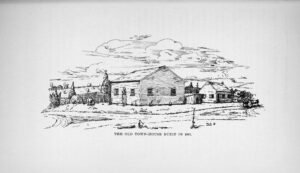
Old Pembroke NH Town House, built 1811

The “Genealogies of Pembroke, New Hampshire” is derived from the town’s second historical volume, and documents the connections of early settler families through the nineteenth century. It emphasizes families of the first settlers and families who resided in Pembroke over a long period of time. Organized alphabetically by surname, the genealogies use a consistent numbering system for easy reference. Carter draws from diverse sources, including town records and personal accounts of Pembroke’s citizens, while acknowledging possible inaccuracies in both their memory and the collection of information. However, by preserving these family lineages, Carter enhances the town’s historical narrative, complementing the first volume’s historical content. Supplementing this volume of genealogies is a compilation of marriage records which occurred in Pembroke, New Hampshire, from 1739 through 1895.

1932 New Hampshire Notables

1892 Map of New Hampshire

New Hampshire Notables,” published by the Concord Press in 1932, is a biographical compilation that follows a previous work by Henry H. Metcalf. It contains 474 brief sketches of notable individuals, both natives and residents of New Hampshire, recognized for their contributions across various fields such as public life, business, and education. This edition focuses on living subjects as of 1932, with an alphabetical index for easy reference. While not exhaustive, it serves as a valuable resource for researchers and libraries, preserving important biographical data.

History of Chester, New Hampshire, including Auburn

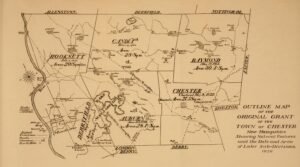
Outline map of the Original Grant of the town of Chester New Hampshire

The *History of Chester, New Hampshire, Including Auburn* by John Carroll Chase, published in 1926, serves as a supplement to the original 1869 *History of Old Chester*. This work was produced in response to a desire to document events that had occurred in the town since the previous publication, as well as to cover topics that were initially omitted. While Chester had seen a decline in population and industrial activity, the book highlights notable historical and social developments. It incorporates additions to military history, church records, and gravestone inscriptions, providing a comprehensive overview of Chester and Auburn’s past.

History of old Chester from 1719 to 1869

History of Old Chester title page

The *History of Old Chester from 1719 to 1869* by Benjamin Chase, published in 1869, offers a detailed account of the early settlement and development of Chester, New Hampshire. Compiled with the assistance of local historian Judge Samuel D. Bell, the book explores the town’s founding, genealogies, and significant events, using primary sources such as deeds, probate records, and personal diaries. Chase aimed to preserve the history and traditions of Chester’s early settlers while providing a comprehensive record for future generations. The work covers a broad range of topics, including religious, military, industrial, and genealogical history.

Descendants of Elder Nutter of Dover, MA

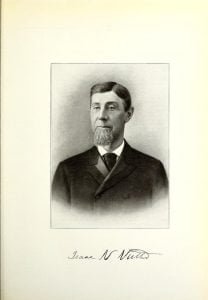
Isaac Newton Nutter

The Nutter family of East Bridgewater, descended from Elder Hatevil Nutter, who emigrated from England in 1633, played a significant role in early New Hampshire history. Elder Nutter was a prominent figure, serving as a ruling elder and holding various land grants. His lineage includes notable descendants such as Isaac Newton Nutter, who contributed to local development and banking, and his sons, Richard Winslow and Charles Latham Nutter, who continued the family legacy in public service and business.

The Original Grantees of Norwich Vermont

On July 5, 1761, a number of men received land grants for what would become Norwich, Vermont. Most were from Mansfield, Connecticut, though many never visited the town. The list includes individuals such as Eleazer Wales, Abner Barker, and Ebenezer Heath, among others. Notably, some opted not to accept their grants. The document serves as a historical record of the original grantees, highlighting their connections to Connecticut and their role in the early settlement of Norwich.