History of Carbondale, Illinois, 1852-1905
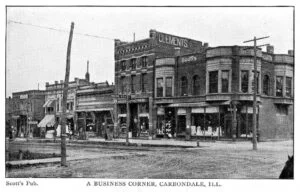
A Business Corner, Carbondale

Carbondale, Illinois, spans about 6,000 acres, primarily in the southwest quarter of Carbondale Township, established following congressional guidelines. Early settlers settled near Little Crab Orchard and Piles Fork creeks. The city’s growth is intertwined with the contributions of its founders, highlighted through 330 biographical sketches in the book, which offer details into their lives during challenging times. Carbondale’s history reflects the influence of individual leadership on municipal progress, celebrated here in the context of the nation’s bicentennial.
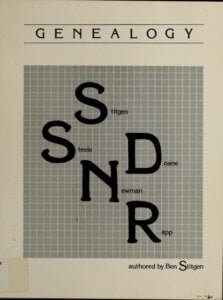
Genealogy: Stitgen, Steele, Doane, Newman, Rapp

Genealogy: Stitgen, Steele, Doane, Newman, Rapp

The Stitgen family comprises most of the book, and starts with Theodor and Barbare (Wollgrafs) Stutgen (the family would variously spell their name as Stutgen, Stuttgen, Stuettgen, and Stitgen.) Theodore Stitgen, grandson of Theodor Stutgen would immigrate to Richfield, Wisconsin about 1850 and eventually settled in Hillsboro, Oregon.

The Doane family starts with Christina Barnet from Annandale Scotland, who’s husband _____ Doane, died while in Scotland. She settled in Waunakee Wisconsin in 1853, with her twin sons, Andrew and Peter. The progenitor of the Rapp family, Peter and Susan (Marsh) Rapp, started in Pennsylvania and moved their family to Dane Township, Wisconsin in 1848. The Steele family starts with Robert and Nancy (Dunshee) Steele of Armagh County, Northern Ireland, who met on the voyage to America in 1801. They settled near Bovina, Delaware County, New York. The Newman family starts with John and Mary Newman of Polajewo Poland. They immigrated to America together in 1853 and settled in Madison, Wisconsin.

Family of Robert Cook of Brockton, Massachusetts

Robert Cook, born in Scotland in 1857, is the president of Brockton’s B. E. Jones Company, a prominent dry goods business. His career began in Scotland, where he gained extensive experience before moving to Boston and eventually partnering with Bradford E. Jones in 1888. Under Cook’s leadership, the company flourished into a major department store in southeastern Massachusetts. He is also noted for his active involvement in community and religious affairs and has a rich family life, having married twice and fathered seven children.

Biographical and Portrait Cyclopedia of Chester County, PA

Title Page for Biographical and Portrait Cyclopedia of Chester County Pennsylvania

An introductory page for the Biographical and Portrait Cyclopedia of Chester County, Pennsylvania, this volume includes a historical sketch of the county by Samuel T. Wiley and more than 500 biographical sketches of prominent local men and leading citizens. It also outlines Chester County’s colonial origins, early boundaries, and its role in the formation of neighboring counties.

Biographical Sketch of Francis T. Rapp

Francis T. Rapp, a prominent figure in San Mateo County, is both an insurance broker and the chief probation officer, a role he assumed last year, becoming the youngest individual to hold this position in California. Born and raised in San Mateo, he excelled in athletics at Santa Clara University. Since entering the insurance business three years ago, he has established a strong client base across the peninsula. Rapp is also involved in various civic organizations, demonstrating his commitment to the community.

Louisiana Land Patents – Choctaw Tribe

A detailed listing of Louisiana land patents for the Choctaw Tribe, organized by patentee name, date, document number, and accession number. The record includes many Native and non-Native grantees and spans patents issued from the 1840s through the early 1900s, offering a valuable reference for historical land and genealogy research.

Rough Riders

Rough Riders

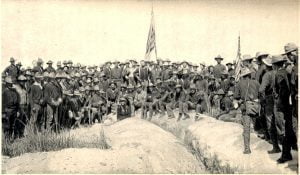
The compiled military service records of 1,235 Rough Riders, including Theodore Roosevelt, have been digitized. Each record features individual jackets detailing the soldier’s name, organization, rank, and medical records. The records also contain personal information and documentation descriptions. Discharges occurred for various reasons, such as age, ability, discipline issues, or hardship. This initiative provides significant insights into the personnel of the 1st U.S. Volunteer Cavalry during the Spanish-American War.