My Recollection of the 1920 Peggs Tornado
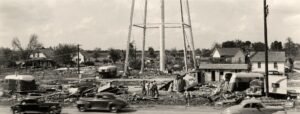
Tornado damage in Peggs, Oklahoma, May 1920

Walter Neel’s firsthand recollection of the 1920 Peggs cyclone describes the storm’s deadly impact on Peggs, Oklahoma, and nearby families. He recounts the warning signs, the destruction of homes and businesses, the loss of friends and relatives, and the grim work of helping identify bodies and dig graves in the aftermath.
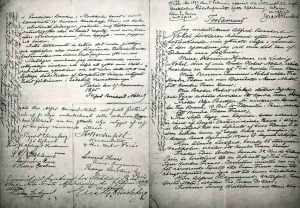
Vanderburgh County Indiana Will Abstracts, 1821-1873

Sample Last Will and Testament

Abstracts of over 600 wills for Vanderburgh County, Indiana, extracted by Mrs. Arthur C. Bitterman. Book A was typed by Mrs. James A. Gentry, book B typed by Mrs. Marvin J. Huff, and published as one by the Vanderburgh Chapter of the DAR. Book A primarily covers wills written or filed within the time period of 1823-1849 and book B includes the years of 1849-1873. In both cases there are wills that fall outside those dates.

Idaville Community, A Century of Unity, 1860-1960

Idaville community centennial, a century of unity, 1860-1960

The “Idaville Community, A Century of Unity, 1860-1960” is a seminal work that offers a comprehensive look into the first century of Idaville and its neighboring townships within White County and Adams Township of Carroll County. Published by the Idaville Centennial Committee in 1960, this volume was crafted to commemorate the centennial celebration of these communities, highlighting a century marked by unity and growth. Through the diligent efforts of the Idaville Centennial Committee, this book was designed to preserve the memory of the pivotal moments that have shaped these areas.

History of Bentleysville, Pennsylvania

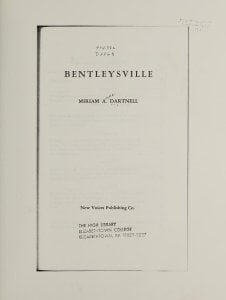
Bentleysville title page

This book is a collection of stories, letters, and historical records detailing the brief history of Bentleysville, a rural community in southwestern Pennsylvania. Established around a mill operated by Sheshbazzar Bentley Sr. and Jr. on Pigeon Creek in 1816, the town grew to a population of 300 by 1868. The author traces the origins of Bentleysville back to the 1770s to document the earliest settlers, while also providing context through significant national events like the Whiskey Rebellion and the Civil War. Although Bentleysville’s history as a village ended before 1900, this work preserves its legacy for future generations.

Marriage to Velma Yarborough

In September 1920, the author married Velma Yarborough after a period of dating. They faced agricultural challenges, including low cotton prices and a significant illness that nearly claimed the author’s life. The couple moved to California with family, where they both sought work while managing various personal and financial struggles. Throughout the years, they experienced agricultural successes and setbacks, and the author continually adapted to changing circumstances, including renting land and dealing with health issues, all while raising their family.

Move to Neosho Missouri

In the early years of life in Neosho, Missouri, the author recounts working on the Soakman fruit farm with family and later moving back to Flint, where they lived near the Beck family and attended school with Ava Potts. Experiences included encounters with venomous snakes and local snakebite remedies from Cherokee medicine men. The family then relocates to various properties, highlighting their agricultural lifestyle with hogs and horses, schools attended, and community interactions, painting a vivid portrait of rural life during that era.

Swimming at the Lower Falls

The author recounts childhood experiences at Shady Grove, particularly at the swimming hole known as the Lower Falls on 14 Mile Creek. He shares memories of swimming there with horses and a frightening incident where he nearly drowned. The area also held cultural significance for the Indigenous people, who hosted stomp dances. Additionally, the narrative details various encounters with horses, highlighting the author’s struggles with riding and the dangers associated with it, reflecting a life intertwined with water and animals.

Trading Horses

The narrator recounts their travel from Flint to Gentry, Arkansas, where they worked on a farm, milking cows and tending to stock. After a few days, they returned home, reflecting on their experiences with horse trading. They traded a yellow mare for a colt, engaged in horse racing, and eventually shared a tale of their beloved horse, Bullet. After serving in the Army, they faced family hardships that led to selling horses. Despite the challenges, their passion for horses and nostalgia for home remained strong.

Walter Alexander Neel

Walter Neel, born on January 18, 1934, in Mountain Home, Arkansas, recalls his family’s journey and life experiences through Missouri and Oklahoma. He reminisces about his early childhood, including notable family events, such as his grandfather’s funeral and their move to Indian Territory. Neel describes the modest beginnings of Tahlequah, detailing aspects of community life, local governance, and personal anecdotes, including the interactions with law enforcement. His narrative offers a glimpse into rural life in the early 20th century.

Move to the Davis Nursing Home

The author recounts a significant four-month stay at Davis Nursing Home, marked by a brief illness that led to a near-death experience. During this time, he encountered deceased friends and visions of heaven. Following recovery, he returned home for a few years before re-entering the nursing home. He reflects on a long life filled with both sorrow and gratitude, detailing family connections, tragic losses, and a desire for reunion with loved ones in the afterlife. He concludes by expressing his views against alcohol, attributing it to much heartache.

A Little Family Genealogy

Walter A. Neel reflects on his family’s genealogy, detailing the lives of his ancestors and siblings, including his parents, Alex Neel and Haney, and their significant connections. He recounts his childhood in various schools and experiences of conflict, friendship, and community activities. Neel recalls family dynamics, marriages within the family, and important life lessons learned. Despite physical challenges and the solitude of a nursing home, he expresses faith in Jesus and a hope for reunion with loved ones in Heaven.

Recollections of My Life

Walter A. Neel

Walter Neel, my great uncle and brother of my grandfather, resided predominantly in Oklahoma and was affectionately referred to as the unofficial mayor of Peggs. He penned a hand-written memoir in his final year, consisting of 90 pages lacking punctuation, which I have since edited for clarity. Despite his limited education and poor handwriting, his life experiences—including family moves and local events—offer a glimpse into my mother’s lineage, the Neel family. I hope readers appreciate his story as much as I did.

Brush Harbor Revival Meeting

The post recounts personal experiences surrounding a Brush Harbor revival meeting led by Henry Watkins. The narrator shares a frightening incident involving a mysterious figure at their home, leading to the illness and subsequent death of his wife. He details his life of marriage, separations, and the management of farms and businesses, including livestock and property sales. Eventually, due to health issues, he considers relocating to live with family, reflecting on both past relationships and changes in his living situation over the years.

Move from California to Texas

The narrative recounts a family’s journey from California to Texas in search of safety and stability amid fears of hunting firefighters. Settling into farming life, the narrator details challenging years, marked by the Great Depression, fruit farming, and struggles with livestock. Significant personal losses, including the deaths of family members due to illness, are poignant themes. The narrator’s son faced a severe accident yet turned his life around, only to succumb tragically to cancer much later, underscoring the cyclical nature of hardship and resilience in their lives.

Biographical Sketch of Neel, Adam S.

Adam Sylvester Neel was born on August 25, 1844, in Fort Bend County, Texas, to William T. Neel and Mary Stafford. The family faced hardships during the Mexican conflict, including property loss. After relocating to Richmond, they endured the yellow fever epidemic, which claimed the life of Adam’s sister, Sarah. Adam married Ellen Stafford, and they had three children: Cain, Aletha, and Sylvester. The Neel family settled near Richmond, along the Brazos River, where they continued to reside.