History and Genealogy of Baltimore Vermont
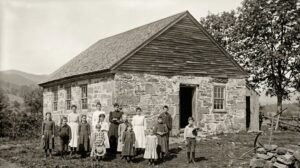
Old Stone Schoolhouse, Baltimore, Vermont

Annie M. Pollard’s 1954 work provides a detailed examination of Baltimore, Vermont’s history, tracing its origins as a part of Cavendish until its independence in 1793 due to geographic challenges. The book explores the town’s early years, highlighting the development of industry, education, infrastructure, and social welfare through town records and personal narratives. Pollard’s dedication as a public servant and her interest in local genealogy enrich the account, painting a picture of a resilient rural community with a unique identity shaped by its small size and self-reliance.
History of Rindge New Hampshire

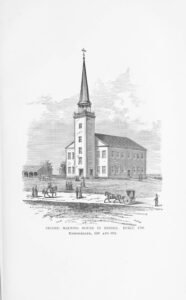
Second Meeting House in Rindge New Hampshire

The History of the Town of Rindge, New Hampshire by Ezra S. Stearns, was published in 1875, and covers the period from the original Rowley Canada grant or Massachusetts charter through the year 1874. Stearns traces the legal, territorial, and institutional development of Rindge, beginning with colonial land grants and boundary disputes and proceeding through settlement, incorporation into a town and development into a small manufacturing hub. More than half the volume is devoted to genealogical material. The genealogical register of Rindge families includes thousands of names compiled from a wide range of sources and assisted by contributions from residents and researchers beyond the town.

History of Newport New Hampshire

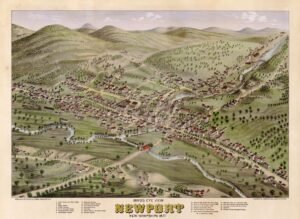
Bird's Eye View of Newport New Hampshire 1877

The History of Newport, New Hampshire, from 1766 to 1878 is a record of Newport’s growth from its early settlement through the close of the nineteenth century. It opens with the original charter and proprietary arrangements and follows the development of Newport’s physical setting, transportation routes, and economy. Particular attention is given to mills, banks, hotels, manufacturing, and the coming of the railroad, all of which shaped the town’s commercial life. The concluding genealogical section identifies families connected with Newport and other chapters provide biographical details that might otherwise be lost.

Abington Massachusetts Marriage and Death Records

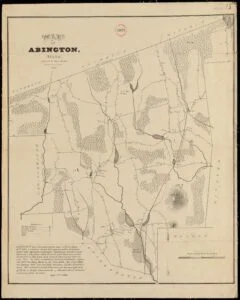
1830 Map of Abington, Massachusetts

Volume 2 of the Abington, Massachusetts vital records compiles marriage and death records up to 1850, complementing Volume 1, which contains birth records. Established in 1712, Abington’s boundaries have shifted, affecting historical jurisdiction. Extensive research from town records, cemeteries, and family Bibles ensured comprehensive documentation, including the identification of Black families recorded by given names. The volume is organized alphabetically by marriages and deaths.

1932 New Hampshire Notables

1892 Map of New Hampshire

New Hampshire Notables,” published by the Concord Press in 1932, is a biographical compilation that follows a previous work by Henry H. Metcalf. It contains 474 brief sketches of notable individuals, both natives and residents of New Hampshire, recognized for their contributions across various fields such as public life, business, and education. This edition focuses on living subjects as of 1932, with an alphabetical index for easy reference. While not exhaustive, it serves as a valuable resource for researchers and libraries, preserving important biographical data.

History of Amherst New Hampshire

Residence of Isaac Brooks in Amherst New Hampshire

The history of Amherst, New Hampshire, unfolds from its 1675 land grant to veterans of the Narraganset War, marking the impetus for settlement along the Souhegan River. From its early governance and incorporation in 1760 to territorial adjustments that birthed Mont Vernon and Milford, this narrative encompasses local geography, economy, and Indigenous presence. Key military engagements, civic institutions, and genealogical records are explored up to 1882, offering a comprehensive view of the town’s evolution and its prominent figures.

Ashfield Massachusetts Vital Records

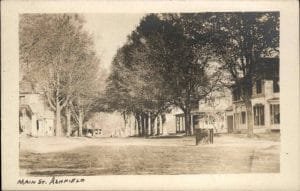
Main Street, Ashfield, Massachusetts

Alphabetical indexes to the vital records of Ashfield, Massachusetts, up to the year 1850, supplemented by information from bible records, church registers, cemetery inscriptions and other sources. PDF file is free to read and download.

Abbe-Abbey Genealogy

A genealogical dictionary of the first settlers of New England vol 1

The “Abbe-Abbey Genealogy” serves as a comprehensive and meticulously compiled homage to the heritage of the Abbe and Abbey families, tracing its roots back to John Abbe and his descendants. Initiated by the life-long passion of Professor Cleveland Abbe, this genealogical exploration began in his youth and expanded throughout his illustrious career, despite numerous challenges. It encapsulates the collaborative efforts of numerous family members and researchers, including significant contributions from individuals such as Charles E. Abbe, Norah D. Abbe, and many others, each bringing invaluable insights and data to enrich the family’s narrative.

Garrisons, Block-Houses, and Forts in the Saco Valley

Saco Fort in 1699

During the Indian wars, settlers along the Saco River constructed various fortifications for protection. Some were built individually, while others were financed by the Provincial Government. Notable structures included Saco Fort, established in 1693, and Fort Mary, built in 1708. These fortifications served as refuges during Indian threats, housing troops and local inhabitants. The construction of blockhouses and stockades ensured safety, although residents faced hardships during sieges. Many forts were later abandoned as peace returned, marking the challenging experiences of early settlers in the Saco Valley.

Gleanings from English Records about New England Families

Gleanings from English Records about New England Families

The classic work often cited by more contemporaneous authors on early New England families and the records of them found within the Principal Probate Registry, Somerset House, Strand, the Public Record Office, Fetter Lane, and the British Museum, Bloomsbury, while on a visit in London during the summer and fall of 1879.

Genealogical and Family History of Vermont

Genealogical and Family History of the State of Vermont vol 1

Hiram Charlton took on the publication of the Genealogical and Family History of the State of Vermont for Lewis Publishing. In it, he enlisted the assistance of living residents of the state in providing biographical and genealogical details about their family, and then he published all 1104 family histories in two distinct volumes.

Biography of Doctor Horace Hatch

Doctor Horace Hatch, born on May 23, 1788, in Tunbridge, Vermont, graduated from Dartmouth College in 1814 and earned his M.D. in 1817. He practiced medicine in Norwich for twenty years before moving to Burlington, where he continued for another two decades. In 1861, he took a position in the Treasury Department, actively supporting Vermont soldiers in hospitals. He relocated to New York City in 1865, passing away on October 28, 1873. Known for his benevolence, he was survived by his notable son, A. S. Hatch.

Biographical Sketch of Rear-Admiral George A. Converse

Born on May 13, 1844, in Norwich, George A. Converse was the son of Dr. Shubael and Louvia Merrill. He attended Norwich University and graduated with top honors from the U.S. Naval Academy in 1864. Converse served in the European squadron and held various positions, including instructor at the torpedo station and commander of the U.S.S. Montgomery during the Spanish-American War. He ultimately became chief of the Bureau of Navigation and was married to Laura Shelby Blood, with whom he had several daughters.

Biography of Doctor Shubael Converse

Doctor Shubael Converse, born on September 7, 1805, in Randolph, Vermont, trained under Doctor R. D. Mussey and graduated from Dartmouth College in 1828. He practiced medicine in Strafford and later in Norwich, where he served for 30 years until his death in 1867. A respected physician and community leader, Converse promoted education, served as a school superintendent, and was active in local politics. He married Louvia E. Morrill and had five children, including son Charles B. Converse, also a physician.

Political Parties in Norwich Vermont

In Norwich, Vermont, political parties have historically maintained a close balance, with elections often fiercely contested. Initially aligned with the Federalists, the town shifted towards the Republicans following the formation of the party in the mid-1850s. Prior to this, Democratic candidates generally enjoyed a stronghold, particularly from 1833 to 1854, despite significant competition. The rise of anti-slavery sentiment led to a decline in the Whig Party and a shift toward the Republican Party, culminating in significant support for Abraham Lincoln in 1860, marking a turning point in local political history.

History of Norwich Vermont Education

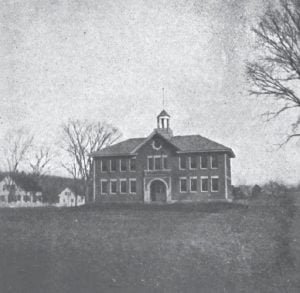
High School Building, Norwich Village, Erected in 1898

The history of education in Norwich, Vermont, traces back to efforts in 1782 to establish school districts. The first successful division occurred in 1785, creating the First School District. Over the years, multiple districts were formed, with the establishment of a committee for school supervision in 1824. Notable developments included the construction of a brick schoolhouse in 1845 and the incorporation of the Norwich Classical and English Boarding School in 1867, although it ultimately closed in 1877. The town’s education framework evolved significantly, culminating in a unified system in 1892.

A Brief History of Norwich University

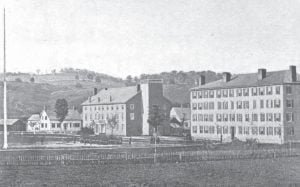
Norwich University 1862 - North Barracks South Barracks

In 1835, the American Literary, Scientific, and Military Academy was incorporated as Norwich University in Vermont. Established by Captain Alden Partridge, the institution was notable for its secular education, free from sectarian influence. It aimed to develop patriotic and educated citizens, emphasizing moral principles and religious respect without imposing specific beliefs. Throughout its early years, Norwich University contributed significantly to the training of military leaders during the Civil War, producing numerous distinguished officers for both the Army and Navy.

Norwich Vermont in the Civil War

During the Civil War, Norwich, Vermont, contributed 185 soldiers to the Union Army, representing over ten percent of its population of 1,759. Of these, 27 men died in service. The town provided substantial bounties totaling around $32,000 to support its troops. Although the community largely supported the war effort, some residents expressed disloyalty, yet over time, many reconciled their past by honoring the fallen soldiers on Memorial Days. Overall, Norwich’s commitment to the Union cause reflected a broader dedication seen throughout Vermont.

John Gyles Captivity Narrative – Indian Captivities

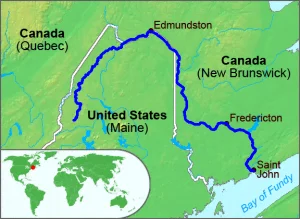
St John River Map

John Gyles captivity narrative provides a stunning display of Abenaki culture and lifestyle, as it was in the 1690’s. John was 10 years old when he was taken captive in the attack on Pemaquid (Bristol Maine) and his narrative provides an accounting of his harrowing treatment by his Indian captors, as well as the three years exile with his French owners at Jemseg New Bruswick. His faith in Christ remains central in the well-being of his mind throughout his ordeal.

Biographical Sketch of Payne Converse

Payne Converse, an early settler from Thompson, Connecticut, arrived in Bridport in 1793 with twelve children, including nine sons. Only three—Gardner, Hamblin, and Alfred—established themselves in the town, becoming notable figures. Gardner served as a surveyor and town clerk, while Hamblin was active in local governance. Alfred worked as a blacksmith. Payne settled on land east of the academy, now owned by E. L. Miner. His legacy continues through descendants, including great-grandson F. G. Converse.