Abington Massachusetts Marriage and Death Records
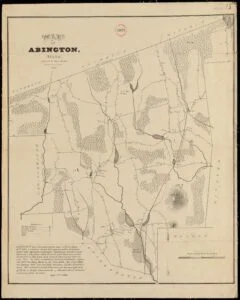
1830 Map of Abington, Massachusetts

Volume 2 of the Abington, Massachusetts vital records compiles marriage and death records up to 1850, complementing Volume 1, which contains birth records. Established in 1712, Abington’s boundaries have shifted, affecting historical jurisdiction. Extensive research from town records, cemeteries, and family Bibles ensured comprehensive documentation, including the identification of Black families recorded by given names. The volume is organized alphabetically by marriages and deaths.
Medway Massachusetts vital records

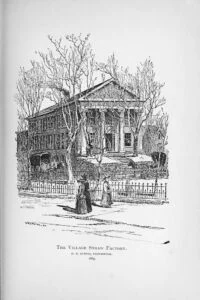
Medway Village Straw Factory

Alphabetical indexes to the vital records of Medway, Massachusetts, up to the year 1850, supplemented by information from church registers, cemetery inscriptions and other private sources to include Rev. Dr. Jacob Ide’s account of Marriages and Deaths, 1814-1849.

Genealogies of Cornish New Hampshire

History of Cornish New Hampshire

Volume II of History of the Town of Cornish, New Hampshire, with Genealogical Record, 1763–1910, compiled by William Henry Child and published in 1911, presents a detailed genealogical account of the families who settled in Cornish from its founding through the early 20th century.

Southborough Massachusetts vital records

Vital records of Southborough, Massachusetts, to the end of the year 1849 title page

The list of vital records of Southborough, Massachusetts, comprised in this volume includes all which were entered in the Town Books during the period from the earliest date there found to the end of the year 1849. Some additions and corrections of names and dates have been made from the records of the First Church, these being indicated in each instance by proper reference. There are a total of 6,267 births, marriages, and deaths recorded. This book is free to read or download.

Hartshorne-Hartshorn Family of Taunton, Massachussetts

The Hartshorne family has a rich history in Massachusetts, dating back to the 17th century. The lineage began with Thomas Hartshorne in Reading, who served as selectman in 1648. Over generations, the family contributed significantly to the local economy and society, particularly in Taunton, where prominent members like Jesse Hartshorn and his descendants played key roles in the cotton manufacturing industry. Jeremiah Hartshorn’s legacy continued through his son George Franklin, leading to George Trumbull Hartshorn, an influential chemist and community figure, who left a lasting impact in Taunton.

Brookfield Massachusetts Warnings 1737-1788

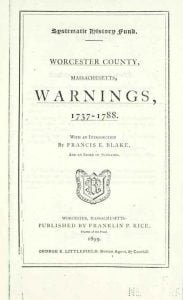
Worcester County MA Warnings

The document lists warnings issued in Brookfield, Massachusetts from 1737 to 1788, detailing names and dates of individuals and families warned out of town. Under the 1692-3 act, towns could warn newcomers not residing for three months to avoid supporting them if they proved to be burdensome. The returns include various residents, many of whom became notable citizens, emphasizing that being warned did not necessarily indicate poverty or need. Each entry is organized by names and dates, reflecting local governance practices.

History of Kossuth, Hancock, and Winnebago Counties, Iowa

History of Kossuth, Hancock, and Winnebago counties, Iowa

History of Kossuth, Hancock, and Winnebago Counties, Iowa together with sketches of their cities, villages and townships, educational, civil, military and political history; portraits of prominent persons, and 638 biographies of representative citizens. Also included is a history of Iowa embracing accounts of the pre-historic races, and a brief review of its civil and military history.

Biography of Honorable Daniel Azro Ashley Buck

Daniel Azro Ashley Buck, born April 19, 1789, in Norwich, Vermont, graduated from Middlebury College in 1807 and from West Point in 1808. He served in the military during the War of 1812, eventually becoming a captain. A significant figure in Vermont politics, he represented Chelsea in the state legislature, served as speaker, and held congressional office twice. Despite his early successes, Buck struggled with alcoholism, leading to a decline in his later years. He died in Washington, D.C., on December 22, 1841.

History of the Merchants of Norwich VT

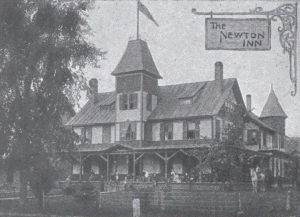
Newton Inn, Vermont

Peter Olcott operated a store in Norwich during the Revolutionary War, followed by Stephen Burton and Ichabod Marshall, early merchants who later moved west. The late 18th and early 19th century saw various merchants such as George Woodward, William Little, and Elias Lyman establishing businesses in the region. The mercantile landscape evolved with partnerships and new firms, including the Olds, Newton, and Lyman firms, adapting through various challenges, such as fires, until the late 19th century, reflecting Norwich’s commercial development.

Migration of Families out of Norwich VT

In the late 18th and early 19th centuries, Norwich, Vermont, experienced significant emigration, leading to a notable decline in its population. Initially home to 40 families in 1771, the town saw many residents relocate to newer settlements, such as Royalton and Randolph, during and after the Revolutionary War. Prominent families, including the Hibbards and Carpenters, contributed to the establishment of towns in northern Vermont and beyond. By the 1800s, the trend of outmigration intensified, marking a long-term shift in the region’s demographic landscape.

A Brief History of Norwich University

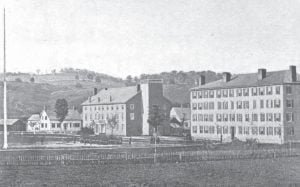
Norwich University 1862 - North Barracks South Barracks

In 1835, the American Literary, Scientific, and Military Academy was incorporated as Norwich University in Vermont. Established by Captain Alden Partridge, the institution was notable for its secular education, free from sectarian influence. It aimed to develop patriotic and educated citizens, emphasizing moral principles and religious respect without imposing specific beliefs. Throughout its early years, Norwich University contributed significantly to the training of military leaders during the Civil War, producing numerous distinguished officers for both the Army and Navy.

Norwich Vermont in the War of 1812

In June 1812, as war with Great Britain loomed, Norwich, Vermont, convened a town meeting to express their views. A carefully crafted document was adopted, voicing support for President Madison and Congress’s war measures, while denouncing critics. The resolutions outlined grievances against both Britain and France, affirming the right to declare war for just causes. Coincidentally, Congress declared war on the same day, prompting Norwich to raise taxes to support military efforts, reflecting strong local commitment to the war.

Norwich Vermont in the Revolutionary War

Norwich, Vermont provided modest participation in the Revolutionary War, highlighted by its formation of a Committee of Safety in March 1777. Evidence suggests a militia was established as early as 1774. The town contributed to regiments under Colonels Warner and Bedell. Local militias organized for defense amid threats from British forces in 1776, further demonstrating Norwich’s involvement. Despite lacking comprehensive records, the enlistment of local soldiers was significant, along with efforts to protect the community from loyalist activities and contribute to the war effort.

Church History of Norwich Vermont

The first generation of Norwich settlers accomplished a significant community milestone by constructing a meeting house for public worship within a decade of settlement. This project involved the entire community, showcasing their determination despite limited resources. A committee ultimately selected the location after significant debate, with the cornerstone laid in 1778. Delays due to the Revolutionary War slowed progress, but by 1785, the building was completed and became a site for various civic activities, including sessions of the Vermont Legislature. The meeting house served the town until 1817 when a new structure was erected due to growing needs.

History of the Congregational Church of Norwich Vermont

Congregational Church, Norwich Village

The Congregational Church of Norwich, one of Vermont’s oldest congregational churches, was established in 1770, primarily by former members from Connecticut. Reverend Lyman Potter became its first settled minister in 1775. Early meetings were held in private homes or barns until the first meeting house was built around 1784. After several pastors, including Reverend James W. Woodward, who served from 1804 to 1821, tensions over meeting house locations led to the formation of the South Congregational Church in 1819. Despite the split, the original church maintained a strong membership.

The Ministerial Act of Vermont

The Ministerial Act, enacted by Vermont’s legislature in October 1783, mandated local taxation for building meeting houses and supporting ministers. In 1785, Norwich decided to assume the cost of its meeting house via taxation, raising £694 from its citizens. This tax, payable in various forms, equalized expenses for all, regardless of prior contributions. The meeting house became a town property, leading to new seating arrangements based on age and contribution. The Act remained until 1801, fostering a unified religious practice among Norwich’s residents.

List of the Principal Pioneer Settlers in Norwich Vermont

In 1771, the population of Norwich, Vermont, was recorded at 206 people in forty families, highlighting its growth since being chartered by New Hampshire. The town was part of Gloucester County after 1772, previously belonging to Cumberland County. The census showed a predominance of youth, with 92 children under sixteen. The list of pioneer settlers includes notable names such as Daniel Baldwin, Ebenezer Ball, and Medad Benton, many of whom contributed to the establishment of the community by clearing land and building essential structures.

First Settlements in Norwich Vermont

The early settlement of Norwich, Vermont, began in 1762 when Samuel Slafter’s son, John, explored the area, reporting its fertile land and water sources. In 1763, after receiving his father’s rights, he commenced clearing lots but faced challenges, as his initial choice proved unsuitable. By 1765-66, a few families settled permanently, including the Hutchinsons and Manns, establishing homes and farms. Pioneers endured various hardships, yet they built foundations for a thriving community, characterized by a homogeneous population primarily from Connecticut.