History and Genealogy of Baltimore Vermont
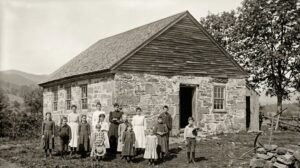
Old Stone Schoolhouse, Baltimore, Vermont

Annie M. Pollard’s 1954 work provides a detailed examination of Baltimore, Vermont’s history, tracing its origins as a part of Cavendish until its independence in 1793 due to geographic challenges. The book explores the town’s early years, highlighting the development of industry, education, infrastructure, and social welfare through town records and personal narratives. Pollard’s dedication as a public servant and her interest in local genealogy enrich the account, painting a picture of a resilient rural community with a unique identity shaped by its small size and self-reliance.
History of Rindge New Hampshire

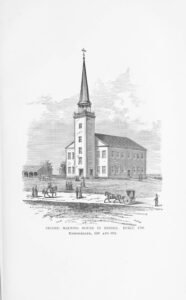
Second Meeting House in Rindge New Hampshire

The History of the Town of Rindge, New Hampshire by Ezra S. Stearns, was published in 1875, and covers the period from the original Rowley Canada grant or Massachusetts charter through the year 1874. Stearns traces the legal, territorial, and institutional development of Rindge, beginning with colonial land grants and boundary disputes and proceeding through settlement, incorporation into a town and development into a small manufacturing hub. More than half the volume is devoted to genealogical material. The genealogical register of Rindge families includes thousands of names compiled from a wide range of sources and assisted by contributions from residents and researchers beyond the town.

Vital Records of Bellingham, Massachusetts

Vital Records of Bellingham Massachusetts to the year 1850

Alphabetical indexes to the vital records of Bellingham, Massachusetts, up to the year 1850, supplemented by information from bible records, church registers, cemetery inscriptions and other private sources to include the diary kept by Samuel Wight and his daughters.

Medway Massachusetts vital records

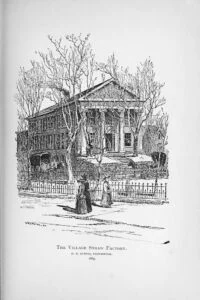
Medway Village Straw Factory

Alphabetical indexes to the vital records of Medway, Massachusetts, up to the year 1850, supplemented by information from church registers, cemetery inscriptions and other private sources to include Rev. Dr. Jacob Ide’s account of Marriages and Deaths, 1814-1849.

Genealogies of Cornish New Hampshire

History of Cornish New Hampshire

Volume II of History of the Town of Cornish, New Hampshire, with Genealogical Record, 1763–1910, compiled by William Henry Child and published in 1911, presents a detailed genealogical account of the families who settled in Cornish from its founding through the early 20th century.

Ashfield Massachusetts Vital Records

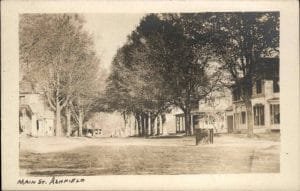
Main Street, Ashfield, Massachusetts

Alphabetical indexes to the vital records of Ashfield, Massachusetts, up to the year 1850, supplemented by information from bible records, church registers, cemetery inscriptions and other sources. PDF file is free to read and download.

Abstractions from Huron County Ohio, Will Book A

Volume A, Huron County Wills to 1852

This volume is “Abstractions from Huron County Ohio, Will Book A.” These will abstractions cover the years from 1828 to 1852. They have been taken out of order as they appeared in the original volume and sorted by name. This abstraction was done by Henry Timman of Norwalk, Ohio, in 1960.

Southborough Massachusetts vital records

Vital records of Southborough, Massachusetts, to the end of the year 1849 title page

The list of vital records of Southborough, Massachusetts, comprised in this volume includes all which were entered in the Town Books during the period from the earliest date there found to the end of the year 1849. Some additions and corrections of names and dates have been made from the records of the First Church, these being indicated in each instance by proper reference. There are a total of 6,267 births, marriages, and deaths recorded. This book is free to read or download.

The Amidon Family of Rehoboth, MA

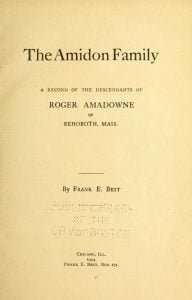
The Amidon Family

The Amidon Family genealogy book details the lineage of Roger Amadowne, a French Huguenot who fled to England and later to America after the revocation of the Edict of Nantes. Documented in Salem, Massachusetts in 1637, variations of his surname include Amadon, Amidown, and Ammidon. The work, organized with biographical sketches and two helpful indexes, presents the family’s history and is richly illustrated. Originally published in 1904, it serves as a valuable resource for descendants and historians alike.

History of Littleton New Hampshire

1895 Map of Littleton New Hampshire

The History of Littleton New Hampshire is comprised of three volumes, two volumes of history, and a final volume of genealogies. Considered one of the best examples of local history written in the early 20th century, is your ancestors resided in Littleton then you need these books. Read and download for free!

Descendants of Matthew Watson of Leicester, Massachusetts

Watson Coat of arms

Matthew Watson (d. 1720), of English lineage, married Mary Orr in 1695, and in 1718 the family immigrated from Ireland to Boston, Massachusetts and settled in Leicester, Massachusetts. Descendants and relatives lived in New England, New York, New Jersey, Pennsylvania, Ohio, Nebraska, Rhode Island, California, Nevada, Michigan and elsewhere. Includes Watson, Armington, Bemis, Denny, Draper, Kent, Washburn, Bailey, Barnard, Belcher, Bent, Biscoe, Bolles, Breckenridge, Bright, Browning, Bryant, Bullock, Burrage, Dennis, Fisher, Foster, Green, Hayward, Hobbs, Hodgkins, Holman, Howard, Jenks, Jones, Kellogg, Kitchell, Knight, Lazelle, Livermore, Loring, Mason, Maynard, Munger, Patrick, Prouty, Remington, Reed, Rice, Richardson, Rogers, Sadler, Sibley, Snow, Sprague, Stone, Studley, Symonds, Taitt, Thomas, Thompson, Trask, Tucker, Waite, Webster, Westcott, Wheeler, Whittermore, Wilson, Woods and related families.

Indians in Mason County Michigan 1870 Census

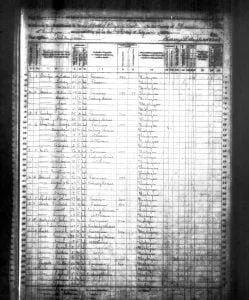
Mason County 1870 Census Reel 0689 page 492

These 229 people were identified as Indians (I) in column 6 (color) of the 1870 census for Mason County Michigan. In order to have been enumerated they are believed to have renounced tribal rule, and under state law, exercised their rights as citizens.

Biographical Sketch of Timothy Bemis

Timothy Bemis, originally from Marlboro, Massachusetts, arrived in Marlboro, New Hampshire, in 1776. His son James served as a commissioned officer in the Revolutionary War and married Hannah Frost, with whom he had nine children, with only one surviving today. Another son, Josiah, married Sibyl Emery and had three children, of whom two are living. The third son, Alvin J., married Mary Greenwood, and they had two children, neither of whom are alive. Alvin resides in East Jaffrey.

Biographical Sketch of James Bemis

James Bemis, originally from Weston, Massachusetts, moved to Dublin in 1793 and passed away on December 15, 1832, at the age of seventy-five. He was a Revolutionary War soldier, enlisting at eighteen, and participated in the lead-up to the Battle of Bunker Hill. Bemis married Hannah Frost and later Lois Walker, with whom he had several children including Jonathan, Hannah, and Thomas. His son Thomas married twice, having five children. Bemis’s legacy continued through his descendants in the region.

Biographical Sketch of Samuel D. Bemis

Samuel D. Bemis, born on February 8, 1833, was the son of Thomas Bemis. He dedicated his career to farming while also contributing to local governance as chairman of the selectmen from 1872 to 1884. Bemis served in the state legislature in 1872 and participated as a delegate in the constitutional convention of 1876.

Biography of Amos W. Bemis

Amos W. Bemis, a pioneer of San Bernardino County, was born in New York and later moved to Ohio before journeying to California. After facing hardships, including the loss of family members to bears and Indians, he established a successful farm of 200 acres in San Bernardino County. Married to Julia McCullough, they navigated the challenges of early frontier life together, raising seven children. Bemis’s resilience and dedication contributed significantly to the development of the region, reflecting the struggles and triumphs of early settlers.

Biography of Joseph Hancock

Joseph Hancock was born in Ohio in 1822 and later became a rancher near San Bernardino, California. His family, with roots in Massachusetts and Vermont, faced numerous hardships as pioneers. After moving through various states, they encountered perilous conditions while crossing rivers and deserts. Hancock’s perseverance led to successful land ownership and farming in California, supported by his second wife, Nancy Bemis. They had seven children and preserved historical artifacts from their journeys, reflecting on their challenging yet enriching pioneer experiences.