
Indian Villages, Towns and Settlements of New Jersey

This post presents an alphabetical compilation of villages, towns, and settlements that existed in New Jersey during the period covered by the Handbook of American Indian of North America. The list includes various locations, such as Ahasimus, Cashiehtunk, Edgpiiliik, and Hespatingh, highlighting the region’s historical diversity and significance in the context of American Indian heritage.
H New Jersey Indian Villages, Towns and Settlements

The post discusses the Indian village of Hespatingh, likely associated with the Unami Delawares, noted in 1657. It suggests a location in northern New Jersey, further supported by Nelson’s reference to “Espatingh” or “Ispatingh” as a hill near Bergen, dating back to 1650. This information contributes to the understanding of the Native American presence in New Jersey’s historical landscape.

G-New Jersey Indian Villages, Towns and Settlements

The Handbook of Americans North of Mexico provides a comprehensive catalog of Indian villages, towns, and settlements, including Gweghkongh. This village, recorded in 1657, is likely associated with the Unami Delawares and is believed to be located in Northern New Jersey, near Staten Island or in nearby New York.

E- New Jersey Indian Villages, Towns and Settlements

This entry provides a complete list of Indian villages, towns, and settlements in New Jersey that begin with the letter “E.” Notable mentions include Edgpiiliik, a Delaware village established in western New Jersey in 1792, and Eriwonec, a former Delaware village situated on the eastern bank of the Delaware River in the 17th century, with a population of approximately 200 around 1648, shortly after conflicts with the Conestoga tribe.

C- New Jersey Indian Villages, Towns and Settlements

The post details several Indian villages, towns, and settlements in New Jersey, as recorded in the Handbook of Americans North of Mexico. Key sites include Cashiehtunk, a Munsee village near the Delaware River from 1738; Chikohoki, a historic Manta Delaware village at Burlington; Communipaw, the principal village of the Hackensack around 1630; and Crossweeksung, a Delaware village in Burlington County with a mission established in 1745. Each site reflects the rich heritage of Native American communities in the region.

A- New Jersey Indian Villages, Towns and Settlements

The post provides a concise overview of Indian villages, towns, and settlements in New Jersey, as documented in the Handbook of Americans North of Mexico. It highlights Ahasimus, a village established in 1655 by the Unami Delawares, and Asomoches, a division of the New Jersey Delawares located along the eastern bank of the Delaware River, estimated to have around 100 warriors in 1648. These entries contribute to understanding the historical presence and organization of Native American communities in the region.

Unalachtigo Tribe

The Unalachtigo Indians, or Wnalātchtko, are a southern division of the Delaware people, residing primarily along the west bank of the Delaware River in Delaware and possibly the east bank in New Jersey. Known as the Turkey tribe, their totem is a symbol of geographic identity rather than a clan affiliation. Their main settlement was located at Chikohoki, present-day Burlington, New Jersey. They historically faced displacement, prompting some to migrate across the river to escape conflicts with the Conestoga.

Unami Tribe

The Unami Indians were a significant group within the Delaware tribe, originally located along the Pennsylvania side of the Delaware River. Many New Jersey Delaware are believed to be Unami who migrated to avoid conflict with the Conestoga. This division is associated with several northern New Jersey tribes, including the Navasink and Hackensack. The Unami were considered to hold a superior position among the Delaware and were symbolically represented by the turtle, which served as their totem and geographic identifier.

Lenape Tribe

The Lenape Tribe, also known as the Delaware Indians, once thrived in the Delaware River basin, encompassing parts of Pennsylvania, New York, New Jersey, and Delaware. They referred to themselves as Lenape, meaning “real men.” Comprised of three main tribes—Munsee, Unami, and Unalachtigo—they maintained a confederacy that evolved through pressures from colonial expansion and Iroquois dominance. Over time, the Lenape migrated westward, eventually consolidating in Ohio and later in reservations, with some merging into the Cherokee Nation in Oklahoma. Their population is now around 1,900.

Delaware Indian Tribe Villages

This post presents an alphabetical list of known villages associated with the Delaware Tribe, including a variety of names like Achsinnink, Beavertown, and Gnadenhuetten, among many others. Some entries are marked with question marks, indicating uncertainty about their origins or affiliations, such as Unami or Munsee connections. The document highlights the rich tapestry of Delaware tribal geography and cultural sites, demonstrating the historical significance of these locations within Delaware tribal history.

Munsee Tribe

The Munsee are one of the three principal divisions of the Delaware Indians, historically inhabiting areas of New York, New Jersey, and Pennsylvania. Their chief village was Minisink. Often regarded as a distinct tribe due to dialect differences, they consisted of several bands, including Minisink and Waoranec. Following fraudulent treaties and increasing white settlement, many Munsee relocated, with some merging into other tribes. By the late 19th century, their population had diminished significantly, with recognized groups primarily located with the Chippewa in Canada and Kansas.

Delaware Indian Tribe Clans

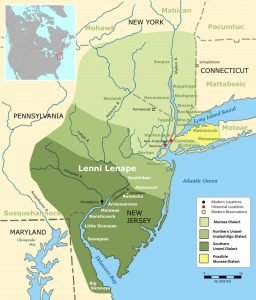
Map of Lenape languages and tribes

Morgan identifies three primary clans of the Delaware Indian Tribe, known as Took-seat (Wolf), Pokekooungo (Turtle), and Pullaook (Turkey), divided into 34 sub-clans, with some now extinct. These clans correlate with the geographic divisions of Munsee, Unami, and Unalachtigo. The Unami, in particular, held the hereditary chieftainship. Various subdivisions exist within each clan, highlighting the intricate social structure of the Delaware. Despite the traditionally recognized clans, some scholars argue these represent totemic symbols rather than distinct clans.

Brotherton Tribe

The Brotherton Indians comprised two distinct bands of Algonquian tribes. The more prominent band formed in 1788 from Mahican, Wappinger, Mohegan, and others in Oneida County, New York, under the leadership of Samson Occum. They adopted English and numbered 250 in 1791 before relocating to Wisconsin in 1833, where they assimilated as citizens. The second band included Raritan and other Delaware factions who occupied a New Jersey reservation until 1802 before joining the first band in New York, eventually dwindling to about 40 individuals.

Axion Tribe

The Axion Indians, a division of the New Jersey Delawares, inhabited the East bank of the Delaware River, between Rancocas Creek and present-day Trenton. In 1648, they were one of the largest tribes in the region, with an estimated 200 warriors. The tribe’s name may derive from Assiscunk, a nearby creek. For further exploration of the Axion, readers can refer to Evelin’s writings from 1648, published in Proud’s compilation.

Aquackanonk Tribe

The Aquackanonk Indians, a division of the Unami Delawares, inhabited areas along the Passaic River in New Jersey and interior lands, including the Dundee tract. The name Aquackanonk, meaning “a place in a rapid stream where fishing is done with a bush-net,” emerged in the late 17th century. In 1678 and 1679, the tribe’s territory was further defined, covering parts of Bergen County and the future city of Paterson. They sold portions of their land in 1676 and 1679.

Condition of Tribes by State in 1890

In 1890, the conditions of various tribes across states showed limited populations of self-supporting Indians. Arkansas had 218 civilized Indians, primarily in Pulaski and Sebastian Counties. Connecticut counted 228, many as fishermen and laborers. Delaware reported just four individuals, while the District of Columbia included 25 educated individuals. Florida listed 171, mostly Seminoles, and Georgia had 68 mainly of Cherokee descent. Each state reflected a blend of assimilation and cultural preservation among small, often indistinguishable populations.

Powhatan Indians

The Powhatan Indians, originally signifying a tribal name meaning “falls in a current of water,” were a chiefdom led by Wahunsonacock in Virginia. They comprised multiple subtribes, including the Pamunkey and Chickahominy, and were part of the Algonquian linguistic family. Their territory spanned from the Potomac River to the eastern shore of Virginia. The Powhatan Confederacy is noted for its interactions with early European settlers, particularly highlighted by the marriage of Pocahontas and John Rolfe, and the conflicts led by Opechancanough in the 17th century.

New Jersey Indian Tribes

The Delaware Indians, known as Lenni Lenape (“true men”), historically inhabited New Jersey and surrounding regions, including parts of New York and Pennsylvania. They were divided into three main subtribes: Munsee, Unalachtigo, and Unami, each with distinct dialects and territories. Early European contact began in the 17th century, leading to significant cultural exchanges and later conflicts, particularly with the English settlers. By the 19th century, many Delaware relocated westward, ultimately settling in Oklahoma, while some groups remain in Canada today.