A history of Parsonsfield Maine
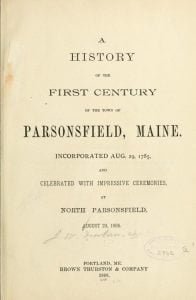
A history of the first century of the town of Parsonsfield, Maine. Incorporated Aug 29, 1785, and celebrated with impressive ceremonies at North Parsonfield August 29, 1885.

A history of the first century of the town of Parsonsfield, Maine. Incorporated Aug 29, 1785, and celebrated with impressive ceremonies at North Parsonfield August 29, 1885.

The ancestry of Sarah Stone, wife of James Patten of Arundel (Kennebunkport) Maine
Contains also the Dixey, Hart, Norman, Neale, Lawes, Curtis, Kilbourne, Bracy, Bisby, Pearce, Marston, Estow and Brown families.

The Massachusetts Tax Valuation List of 1771 contains the names and descriptions of taxable property of nearly 38,000 individuals who resided in 152 Massachusetts towns in 1771

Samuel Wakefield and Mary Burbank settled in Steuben, Maine, around 1756. After Mary’s death, Samuel married a widow named Small and had three children: James, Myriam, and Daniel. Their descendants include many notable figures, such as Cyrus Wakefield and Lydia, who married Ichabod Godfrey, yielding numerous offspring. A comprehensive lineage follows, listing marriages and children across multiple generations, showcasing the extensive family network established by the Wakefields in Narraguagus Valley.
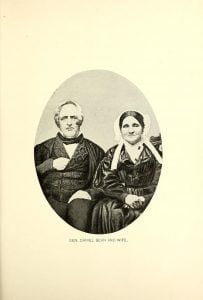
The Bean and Bane family genealogy traces origins to a supposed ancestor from the Isle of Jersey, though evidence suggests a Scottish lineage, with the surname derived from Gaelic meaning “fair.” Key figures include Lewis Bane, who settled in Boston around 1670, and his sons, who established roots in York, Maine. Captains Lewis and Joseph Bane played prominent roles in early settlements and conflicts with Native Americans. Generations of Beans and Banes contributed significantly to the region’s history, including military service and local governance.
Abraham Barrons, born January 17, 1756, likely in Wells, Maine, settled in Cornish post-Revolutionary War around 1778. He married Margaret Stackpole and had nine children, including Lydia, Abigail, and Polly. His son, also named Abraham, married Jane Estes and had twelve children, with descendants now commonly using the surname Barnes. Variations in the family name, including Barons and Barrows, reflect a lineage potentially connected to LeBarron, a French surname. Abraham Barrons passed away on October 24, 1819.
The Ayer family in Buxton, Maine, traces its roots to Haverhill, Massachusetts, where early settlers John, Peter, Robert, and Thomas Ayer made significant contributions in civic and military roles. Notably, Maj. Ebenezer Ayer participated in the Canada expedition with Arnold. The genealogy includes many descendants, such as Moses Ayer, who had several children born in Saco, and numerous branches established in Buxton. Noteworthy figures include Timothy Ayer, a preacher, and Dr. Aaron Ayer, reflecting a diverse family legacy across generations.
The Atkinson family, originally from Bury, England, emigrated to New England in 1634. Theodore Atkinson, the first of the line, settled in Boston and established a prosperous estate. His descendants include notable figures such as Hon. Theodore Atkinson of Portsmouth and various family members who became prominent in trade, religion, and community affairs across New England. The lineage continued through several generations, resulting in multiple branches in Buxton and Eaton, N.H., with individuals engaged in diverse occupations and contributing to local history.
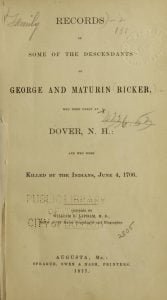
The descendants of two brothers, George and Maturin Ricker of Dover NH who’s descendants resided principally in New Hampshire and Maine.
At a meeting of the Maine Historical Society, held in Portland on the 23d of December, 1882, a communication was received from Mr. John T. Hull, proposing to publish the early volumes in the York registry of deeds and asking for the cooperation of the society. Messrs. Edward H. Elwell, James P. Baxter and William Goold were thereupon appointed a committee to present the matter to the legislature of Maine. The fruition of their collaboration are the following 20 volumes of York County Maine Registry of Deeds.
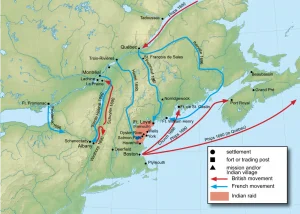
King William’s War (1688-1697) stemmed from territorial conflicts among the English, Spanish, and French, with Native American tribes often allying with the highest bidder. While the French aimed to expel the English from northern territories, the English targeted Canada. Initial hostilities began in Maine, escalating with brutal attacks, including the massacre at Schenectady. Despite military efforts, both sides suffered heavy losses, leading to a temporary peace in 1693. The war officially ended with the Treaty of Ryswick in 1697, restoring prior territorial claims and initiating a fragile peace.
John W. Staples, M.D., born on January 25, 1855, in Wells, Maine, was a respected physician in Franklin Falls, New Hampshire. After attending local schools and graduating from Dartmouth College in 1876, he began his medical practice in 1880. Staples married Martha L. Kimball in 1882, and they had one son, Charles. Active in his community, he served on the School Board and the Board of Health, earning a reputation as a dedicated Republican and member of the Unitarian Society.
Allen, Stillman Boyd, born September 8, 1830, in Maine, was educated at various academies before being admitted to the bar in 1853. He practiced law in Maine until moving to Boston in 1861, and later became senior partner of the firm Allen, Long & Hemenway. Renowned for winning substantial verdicts against corporations, he served in the Massachusetts House of Representatives and led significant reforms in the state reform school. A prominent figure in legal and civic circles, he was also active in Odd Fellowship and Masonry.
Alfred A. Plummer, Sr., born on March 3, 1822, in Maine, became a pioneering figure in Port Townsend, Washington. After moving to Boston to learn the saddlery trade, he journeyed to California during the Gold Rush and later settled in Port Townsend in 1850. As the first white settler, he recognized the area’s potential, establishing a homestead and engaging in trade. Married to Anna Hill, he raised nine children and served the community, notably as captain during the 1856 Indian War, until his death on May 19, 1883.
Charles William Burrows was born on December 21, 1849, in Hollis, Maine. He graduated from the U.S. Military Academy in 1870 and served as a second lieutenant in the 34th U.S. Artillery until 1872. Burrows founded Burrows Bros., a publishing and bookselling firm, in 1873. He married Lottie Thomas Mott in 1884 and was active in various organizations, including the Cleveland Chamber of Commerce and the Association of Graduates of the U.S. Military Academy, advocating for one-cent letter postage.
A. J. Sanborn, born in 1826 in Acton, Maine, became a prominent figure in railway mechanics after a childhood marked by loss. Leaving home at 11, he sailed for two years before returning to pursue a career in engineering. Sanborn honed his skills through various machine shops in Massachusetts before moving west to East St. Louis to lead departments for the O. M. R. R. and later the Vandalia R. R. By 1873, he was overseeing works for the I. St. L. R. R. in Mattoon, exemplifying a self-made man’s journey through hard work and experience.
L. F. Morse, M. D., was born on February 5, 1839, in Canterbury, New York. Raised as a farmer’s son, he pursued medicine under Dr. L. T. Weeks and attended Burlington Medical College. Morse served as a Contract Surgeon during the Civil War and later joined the U.S. Navy as an Assistant Surgeon. After graduating from the Homeopathic College of New York, he practiced in Biddeford, Maine, before settling in Mattoon in 1868. He married Harriet F. Chamberlain and has three children. Morse is also active as a School Director.
Luther C. Tibbets, born in South Berwick, Maine, in 1820, transitioned from farming to a successful mercantile career, opening stores in New Hampshire, Boston, and New York. Despite his commitment to ethical business practices during the Civil War, he suffered significant financial losses. After relocating to Virginia, he faced persecution for his Unionist views, prompting a move to California. There, he established himself in Riverside, contributing significantly to the community through land development and support of local enterprises. Tibbets was married twice and had four children.
Arthur C. Wentworth, born on November 13, 1871, in South Berwick, Maine, became treasurer of the Springfield Cooperative Bank in 1912. A graduate of Berwick Academy, he began his career at the Boston & Maine Railroad, eventually becoming city passenger agent in Springfield. He was deeply involved in local society, holding memberships in various organizations, including the Masons and the Rotary Club. Married to Annie H. Thompson in 1898, Wentworth’s lineage traces back to early colonial figures in New England.
Joseph Reed Burgess, born on May 21, 1893, in Rockland, is a prominent educator in Hampden County and Western Massachusetts. After graduating from Harvard and the Bridgewater Normal School, he served in various educational roles, including principal positions in Eastham, Sanford, and Gloucester, before becoming the superintendent of schools in Monson. A respected leader in the teaching community, he is also active in local fraternal organizations. Burgess married Doris R. Price in 1921, and they have one son, Price Bradford.