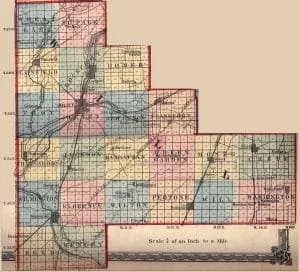
Will County Illinois School Records
The Fountaindale Public Library of Bolingbrook, Illinois has digitized school records, freely accessible online here. These records include administrative, teacher’s daily registers, and school enrollment cards.
William E. Durant, born April 25, 1843, in Illinois, is a prominent figure in Clay County, serving as the clerk of the District Court and a Civil War veteran. His father, Edward T. Durant, also a soldier, shaped his values and commitment to public service. William initially worked in flour mills before becoming involved in local governance, including roles as city marshal and deputy county clerk. Married in 1869, he raised two sons while remaining active in the community through various civic organizations.
Walter Robson, born February 26, 1875, in Illinois, became a prominent figure in Pottawatomie County, Kansas. A dedicated businessman and farmer, he managed significant landholdings and was involved in various ventures, including the Independent Packing Company. Robson served as a state legislator and city council member, contributing to public welfare and politics as a Democrat. A family man, he married Katharyn Arnold in 1900, and was actively engaged in the Congregational Church, Masonic organizations, and other community pursuits throughout his life.

Theodore H. Polace, born on March 12, 1860, in Illinois, has been a prominent lawyer in Marysville for over thirty-five years. Initially a teacher, he transitioned to law after studying at the University of Michigan. His father, Rev. Gustav W. Polack, was a dedicated Lutheran minister who immigrated from Germany. Married in 1887 to Florence McKee, Theodore and Florence had five children, contributing to both education and agriculture in their community. He remains active in legal practice, with a strong connection to his Lutheran roots.
James F. Kane, born on April 3, 1858, in Joliet, Illinois, was raised in a Catholic family of eight children. After farming in Nebraska, he worked as a traveling salesman and assistant bookkeeper in New York City. In 1890, he moved to Pocatello, Idaho, where he initially worked for the Oregon Short Line Railroad before founding a successful grocery business. Married to Myra L. Hollingsworth, they had three children and were well-regarded in their community. Kane was active in local fraternal organizations.
William Oliver has been a prominent figure in Kansas for over thirty years, excelling as a farmer and truck raiser near Topeka for the last fifteen. Born in Wisconsin to pioneer parents, he moved to Kansas in 1877, initially running a hardware business before transitioning to agriculture. His expertise in potato cultivation earned him recognition, with yields reaching up to 250 bushels per acre. Oliver married Phoebe Ann Fletcher in 1877, but she passed away in 1913. His family roots and agricultural success define his legacy.
Aaron B. Perine, a pioneering resident of Kansas since 1854, made significant contributions to the state’s development through his work with Native Americans and as a successful blacksmith and plow manufacturer. Born in New York in 1836, he faced early hardships but built a thriving business in Topeka, aided by his sons. A civic-minded individual, Perine remains active despite his age. His family lineage includes notable figures, and he is married to Mary E. Bodwell, a descendant of early Kansas settlers involved in the Underground Railroad.
George Bell, born in 1845 in Darlington, Yorkshire, immigrated to America in 1877, settling in Kansas by 1880 after a stint in Illinois. A successful farmer and livestock raiser, he married Jean M. Christy of a prominent Canadian family in Brantford, Ontario. Their union brought three children—Margaret, Edna, and Robert—who are pursuing education at Washburn College. The Bell family has been influential in their community for over thirty-five years and currently resides in Topeka, Kansas.
Silas R. Dague, born in Illinois in 1884 and raised in Kansas, is the founder and president of Dague Business College in Wichita. Established in 1914, the college stands out for its modern facilities and dedicated faculty, offering a comprehensive curriculum, including preparation for civil-service roles. By 1916, enrollment surpassed 600 students, reflecting its growing reputation. A prominent figure in the community, Dague is recognized for his civic engagement and business acumen. He is married to Grace B. Cooper and has one daughter, Virginia Belle.
Charles B. Murray, born on April 6, 1866, in Worcester, Massachusetts, was a distinguished chemist and metallurgist. He earned his B.S. degree from the Polytechnic Institute in 1887 and later held positions at various steel companies. Notably, he served as chief chemist at Eliza Johnson Works of Carnegie Steel Co. from 1893 to 1904 before establishing a commercial laboratory in Pittsburgh. In 1907, he partnered with Benedick Crowell, forming a prominent firm in Cleveland. Murray was also active in numerous professional societies and enjoyed tennis, squash, and bowling.
George W. Vaughn, known as Major Vaughn, was a prominent figure in American railroad engineering, with a career spanning from the early days of railroads in the U.S. until his death in 1916. Born in New York in 1829, he displayed remarkable mechanical talent despite limited formal education. He significantly contributed to various railroads across the country, including the Atchison, Topeka and Santa Fe Railway. His legacy includes innovative engineering feats and a lasting impact on the railroad industry in Kansas and beyond.
J. W. Moore, a prominent lumber merchant in Mattoon, was born in Kent County, England, in June 1832. After losing his father at a young age, his family immigrated to Chicago in 1850. They later moved to Cook County, where he and his brother farmed and ran a store. In 1865, Moore partnered with Mr. Dickson to start a lumber business in Monee, before relocating to Mattoon in 1874. Married to Cordelia Sisson, they have three children, and he serves on the local School Board.
William Francis Holcomb, born in Indiana in 1831, became a notable figure in California history as the discoverer of gold in a valley named after him. After enduring a grueling journey to California in 1850, he spent a decade mining with limited success before uncovering a significant gold deposit near San Bernardino in 1860. Holcomb later served as County Assessor and County Clerk, contributing to local governance. A devoted family man and renowned hunter, he remains a respected member of the Society of California Pioneers.
Dr. Nyland W. Rice, born in Wilmington, Delaware in 1850, was a distinguished physician and the first homoeopathist in San Bernardino. A graduate of Claveric University and Hahnemann Medical College, he excelled academically and practiced in the college hospital before relocating due to health issues. An influential community member, Rice served as Public Administrator and was active in Masonic and Pythian orders, helping to establish the latter in San Bernardino. He passed away on July 23, 1884, leaving a legacy of integrity and friendship.
Theron H. Palmer, born on February 14, 1849, in Joliet, Illinois, became a notable architect and builder in Southern California. After serving in the Nineteenth Illinois Infantry during the Civil War, Palmer pursued mining in Montana before settling in California in 1867. He established himself as a pioneering architect in San Bernardino, designing prominent buildings such as the Occidental block and the ornate new hall of records. Married to Mabel E. Smith in 1886, Palmer also invested in local infrastructure and land development.
William McConochie, born in Scotland in 1847, emigrated to America with his family, settling in Joliet, Illinois. He joined the Union Army as a drummer boy during the Civil War and later became a skilled stonecutter. Settling in Rock Island, he married Isabel Kitson and had six children. McConochie served multiple terms as mayor, implementing significant municipal improvements like paving, a fire department, and a park system. A respected Republican and community leader, he was also active in the Methodist Church and Masonic organizations, earning admiration for his integrity and dedication.