
Wayne County Indiana Marriage Records 1811-1903

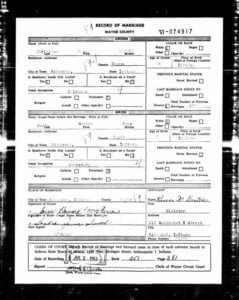
Indiana Marriage Certificate

Wayne County Indiana Marriage Records 1811-1903 represents 23,644 marriage records for Wayne County Indiana. The range of years covers 1811-1903. For additional information on the marriage records, or for any marriage certificate, researchers should contact the local clerk office. Wayne County was created in 1811 from Clark and Dearborn Counties. It is located in east-central Indiana on the Ohio border. The county seat is Richmond.
Murray, Robert Owen – Obituary

Robert Owen Murray, born January 4, 1847, in Fulton County, Indiana, passed away on October 29, 1902, at the age of 55. He married Mary Bowman in 1881, and they had four children, with three daughters surviving him. A member of the United Brethren church, Murray served as an ex-trustee of Wayne township. His funeral was conducted at home by Rev. S. P. Korster, and he was interred at Bowman Cemetery.

Biography of Rev. William Knipe

Rev. William Knipe, born on September 28, 1827, in Indiana, is one of the last surviving veterans of the Mexican War and a prominent figure in Methodist history in Kansas. A soldier in both the Mexican War and the Civil War, he settled in Kansas in 1857, where he became a successful farmer and influential preacher. He conducted the first religious service and funeral in Jackson County and was ordained in the Methodist Church. Knipe served in the Kansas legislature and remains respected within his community, highlighting a life of dedicated service.

Biography of Joseph Ralph Burton, Hon.

Joseph Ralph Burton, born in Indiana in 1852, moved to Kansas in 1878, where he became a significant political figure and lawyer. Recognized for his reliability and integrity, he served multiple terms in the Kansas Legislature, playing a crucial role in railway legislation and introducing an anti-trust law that influenced the federal Sherman Act. Elected to the U.S. Senate, Burton opposed the Cuban Reciprocity Bill, drawing criticism but advocating for Kansas’s interests. Post-retirement, he successfully managed a publishing company and contributed to education, supported by his wife, Carrie.

Biography of George M. Parsons

George M. Parsons, born on January 15, 1850, in Cambridge City, Indiana, advanced rapidly in his legal career after being admitted to the bar in 1885. A Civil War veteran, he served in the Ohio Infantry and later moved to Idaho, where he became a significant figure in state politics, holding positions such as attorney general. Additionally, Parsons was involved in law, mining, and the community, earning respect for his dedication and service. He is noted for his accomplishments without self-promotion and has become a well-regarded citizen in Idaho.

Biography of Theodore Saxon

Theodore Saxon, born on December 2, 1839, in Wayne County, Indiana, exemplified industriousness and community commitment. After moving to Kansas in 1869, he cultivated a 1,240-acre farm and became a successful livestock breeder. Saxon held various political roles, including a term in the Kansas Legislature, and was active in Masonry. Upon retirement to Topeka, he and his wife, Esther, raised three sons. Esther, an accomplished farmer in her own right, considered a run for the Kansas State Senate, highlighting women’s roles in legislation.

Biography of Charles Engler

Charles Engler, a respected pioneer of Shawnee County, Kansas, exemplified the industrious spirit of German immigrants. Born in Germany, he sought refuge from military duty by emigrating to America, eventually settling in Kansas in 1857. Over the years, he cultivated over 1,000 acres of land, demonstrating remarkable agricultural success. Married to Rosa Vascalda, they raised seven children, instilling values of honesty and hard work. Engler’s character and contributions to the community earned him enduring respect before his passing in 1901.

Biography of Joseph A. Clark

The Idaho canal, a significant irrigation project, derives water from the Snake River and spans thirty-five miles, irrigating one hundred thousand acres. Its success is largely attributed to Joseph A. Clark, who played a pivotal role in its promotion and secured funding for its construction. Born in North Carolina in 1837, Clark, a civil engineer, moved to Idaho Falls in 1885, where he recognized the need for irrigation. His efforts significantly contributed to the area’s agricultural prosperity. He married Eunice Hadley and raised a large family.

Biographical Sketch of Will P. Blair

Will P. Blair, born on June 28, 1849, in Plainfield, Indiana, was a notable figure in the brick manufacturing industry. He held leadership roles as president of the National Paving Brick Manufacturers Association and contributed significantly to engineering literature on brick pavement construction. An Earlham College alumnus, he married Viola V. Sanders and had one daughter. Blair’s involvement in various engineering societies and committees highlights his commitment to improving municipal construction practices throughout his career.

Biographical Sketch of Alonzo Eugene Hyre

Alonzo Eugene Hyre, born June 1, 1860, in Basil, Ohio, was educated in various Ohio public schools and Buchtel College, where he earned a B.S. degree. He married Sarah Emma Cadwallader in 1886 and had two sons. Hyre edited a Republican newspaper for twelve years and was active in politics, serving as cashier of the U.S. Internal Revenue office under McKinley. He helped establish and has been the secretary of The Cleveland Chamber of Industry. His career included significant contributions to local journalism.

Odell, Sarah Holman – Obituary

Sarah Holman Odell, born in Kentucky on December 10, 1803, was a pioneering figure who married John Odell in 1820. They settled in Indiana before moving to Carroll County, where they were among the first white families. Deeply religious, they raised ten children in the Methodist faith. The family relocated to Oregon in 1851. Following her husband’s death in 1870, Sarah lived until January 1, 1887, when she passed away peacefully, surrounded by family. She was laid to rest beside her husband.

Biography of Winfield Freeman

Winfield Freeman, born January 3, 1848, in Ohio, emerged as a key figure in Kansas law and politics. Admitted to the bar in 1869, he held various roles including prosecuting attorney and mayor of Minneapolis, Kansas. A prominent Republican speaker, he served on the city council and as county attorney of Wyandotte County. His extensive travels included a global trip in 1907-08, during which he lectured on Eastern cultures. Freeman’s notable historical contributions include writings on Indian history in Kansas. He married Reba Silver in 1876.

Biography of Harry Pray Study, A. B., A. M.

Harry Pray Study, born January 7, 1879, in Fountain City, Indiana, emerged as a prominent educator and superintendent of schools in Neodesha, Kansas. A product of Baker University and Boston University, he dedicated his career to enhancing educational standards and student well-being. After various teaching roles, including positions in high schools and specialized institutions across several states, he settled in Neodesha, overseeing four schools and 1,250 students. Married to Clara Louise Lord, he exemplifies a legacy of commitment to education and community service.

Biography of Harry A. Mendenhall

Harry A. Mendenhall, a prominent figure in Kansas City, Kansas, has dedicated nearly thirty years to improving local traffic and freight management. Born in Indiana in 1865, he later moved to Kansas, where he engaged in various businesses, including banking, and served as sheriff of Wyandotte County from 1901 to 1905. Active in civic life, he was involved in local politics, education, and community organizations. Mendenhall, a loyal Republican and family man, has contributed significantly to Kansas City’s growth and development.

Biography of Walter Roscoe Stubbs

Walter Roscoe Stubbs served as the Governor of Kansas from 1908 to 1912, recognized for his business acumen and integrity rooted in his Quaker heritage. Born in Indiana and raised in Kansas, Stubbs entered politics as a state representative, advocating for efficiency and reforms such as civil service and direct primaries. His tenure was marked by the successful enforcement of prohibition statewide, which he accomplished through strategic legal efforts and the use of a special fund. His leadership greatly impacted Kansas’s governance and political landscape.