Indian Warfare Between Texas and Mexico
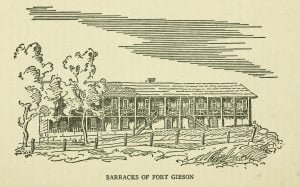
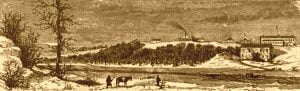
Barracks of Fort Gibson

In 1836, Major Chouteau explored the region between the Red River and the Colorado River, encountering numerous Comanche, Kiowa, and Kiowa Apache camps during their buffalo migration. Despite initial suspicion, he engaged in discussions with tribal leaders, ultimately facilitating a treaty in May 1837, aimed at peace among the tribes and protection for traders. However, amidst rising tensions due to Mexican influence and Indian warfare, further conflicts loomed, highlighting the precarious nature of relations between the tribes and the encroaching settlers in Texas.

Governor Stokes’s Uncompleted Plans

In March 1836, Governor Stokes became the sub-agent for the Cherokee, Seneca, and Shawnee tribes at Fort Gibson, receiving a modest salary of $750 annually. He faced numerous challenges, including a cramped office space and subordination to a disbursing officer, complicating his relations with the tribes. Stokes advocated for the rights of the Half-Breed reserves of the Osage Nation but struggled to secure assistance for them. Despite his dedication, his term ended without reappointment, and he passed away in November 1842, leaving a significant legacy.

The Old Gravois Coal Diggings

The Old Gravois Coal Diggings

Mary Joan Boyer’s “The Old Gravois Coal Diggings,” published by The Tri-City Independent in Festus, Missouri, in 1952, provides a comprehensive historical account of a once-thriving coal mining locality in St. Louis, Missouri. This photocopied book, consisting of 107 pages with irregular pagination and faint photos and text, preserves the history of an area that has largely faded from contemporary memory.

Governor Houston at His Trading Post on the Verdigris

Surrender of Santa Anna

In February 1828, Colonel Brearley led the Creek immigrants to the Verdigris, following governmental commitments from the 1826 treaty. During this time, Samuel Houston, a former U.S. Army officer and politician, was redefining his life among the Cherokee. After abandoning his political career and personal troubles, he became deeply involved with the Cherokee, adopting their customs and language. Houston’s influence grew as he criticized corrupt Indian agents and sought to improve conditions for Native Americans, eventually being adopted into the Cherokee tribe in 1829.

Western Garrison Life

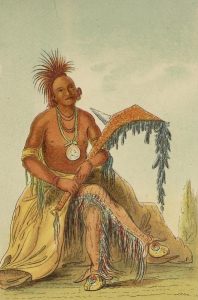
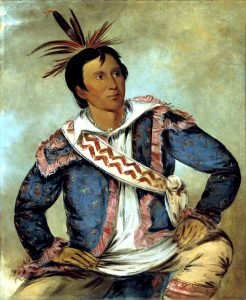
Clermont, Osage Chief

Holland Coffee, a trader at Fort Smith, led a trading expedition into western Indian territories alongside Robert M. French. They set up a trading post near the Red River, at the old Pawnee village, aiming to capitalize on friendly relations established by Colonel Dodge with western tribes. Despite challenges, including unrest among the tribes regarding treaty assurances, a significant conference was held at Fort Gibson in 1835, resulting in the first treaty with western prairie tribes, crucial for U.S. plans to relocate eastern Indians.

The Osage Massacre

Kiowa Calender

In the summer of 1833, following a treaty council breakdown, Osage warriors attacked a Kiowa village, resulting in a brutal massacre where many women, children, and elderly were killed, and the heads of the victims displayed in brass buckets. Among the captives were two children, Gunpä´ñdamä and Tunkahtohye, later purchased by Colonel Hugh Love for potential diplomatic gains. The ensuing U.S. military expeditions aimed to restore order and negotiate peace, but many faced logistical challenges and poor preparation, resulting in numerous setbacks and casualties.

Peace Attempts with Western Prairie Indians, 1833

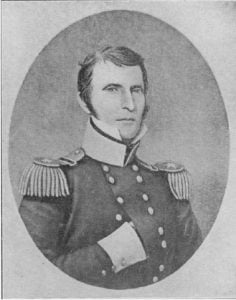
General Henry Leavenworth

In 1830, the Treaty of Dancing Rabbit Creek initiated the relocation of the Choctaw Indians to territories between the Canadian and Red rivers. However, the Choctaw faced threats from Comanche, Kiowa, and Wichita tribes, who attacked traders and settlers. In May 1833, Colonel Arbuckle sent a military expedition to protect the traveling Choctaw and assert U.S. power. Despite efforts, the expedition suffered losses, including ranger George B. Abbay, who was captured, and ultimately failed to achieve its objectives, highlighting the challenges of westward expansion.

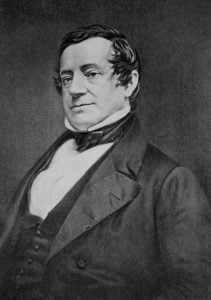
Washington Irving at Fort Gibson, 1832

Irving Washington

The McIntosh Creeks established productive farms along the Arkansas River, but their land was mistakenly included in the 1828 treaty with the Cherokee, leading to tensions and grievances. The Creeks petitioned the government for aid against attacks from other Indian bands. In response, Congress set up a commission to address these issues, appointing three commissioners, including Montford Stokes. Eventually, Washington Irving joined the commission’s journey from St. Louis to Fort Gibson, experiencing the rich tapestry of frontier life and the challenges faced by the tribes.

Earliest Known Traders on Arkansas River

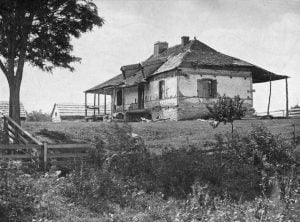
Country Home of Augustus Pierre Chauteau

Before the Louisiana Purchase, early French traders, notably Joseph Bogy, ventured along the Arkansas River, engaging in commerce with local Indian tribes, such as the Osage. Bogy’s expeditions included confronting Choctaw opposition in 1807, leading to government claims for losses. Prominent figures included Nathaniel Pryor and A. P. Chouteau, who established trading posts at the mouth of the Verdigris. These traders influenced the region’s economy, exchanging goods like furs and providing items such as tobacco and tools to Native Americans, fostering significant cultural exchanges.

Establishment of Fort Gibson in 1824

Fort Gibson in 1875

The Arkansas Territory was established by Congress in 1819, encompassing parts of present-day Arkansas and Oklahoma, with governance limited to the eastern section. James Miller became its first governor in 1819, tasked with overseeing relations with Native tribes. Efforts to broker peace between the Osage and Cherokee tribes were largely unsuccessful, leading to military reinforcements at Fort Smith. In 1824, troops were moved to a new post, Cantonment Gibson, established to enhance security and regulate tensions, which would eventually evolve into Fort Gibson, founded in 1824.

Free Missouri Historical Newspapers Online

Far West Masthead Page 1

This page represents 37 free historical newspapers spread out over the state of Missouri since its founding into the 1900’s. All of them have at least a partial online representation.

Biography of Hon. Joseph B. Crockett

Joseph B. Crockett, born in 1808 in Jessamine County, Kentucky, pursued law after studying under prominent mentors. He became a successful attorney, legislator, and Commonwealth’s Attorney before moving to St. Louis and later California, where he thrived. Crockett was appointed to the Supreme Court, eventually becoming Chief Justice, serving for twelve years until 1880. Notably respected for his integrity and legal acumen, he gained popularity for his kindness and talent, leaving a lasting legacy in both Kentucky and California. He passed away in 1883-84.

The Barbeau Family of Prairie du Rocher Illinois

Henry I. Barbeau, the current head of the well-respected Barbeau family in Randolph County, was born on February 1, 1863, on the farm he currently manages. His lineage in Prairie du Rocher spans generations, with his father, Henry Barbeau, having passed away in 1902. Married in 1882, he and his wife had seven children. In addition to farming 450 acres, Barbeau is active in public service and local politics, demonstrating a versatile engagement in both community and personal interests.

The Kribs Family of Prairie du Rocher Illinois

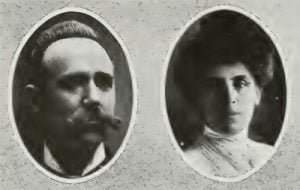
Mr. and Mrs. C. J. Kribs

C. J. Kribs, born in Belleville, Illinois, in 1867, had a diverse career before becoming the circuit clerk of Randolph County. He worked various jobs including harness making and in the Illinois Steel Works, before settling in Prairie du Rocher. In 1894, he opened a harness store and later expanded his business. Elected to public office, he served as mayor and held several fraternal society memberships. His wife, Susan, and their four sons, Harold, Lewis, Charles, and William, also contributed to the community’s educational and business landscape.

Choctaw Traditions – The Council Fire, The Nahullo

The Choctaw and Chickasaw tribes traditionally exhibited smooth faces, lacking beards, a trait that indicated full Native ancestry. Their council meetings, known as “The Council Fire,” emphasized order and respect, with elders recounting the tribe’s history and traditions. Central to their lore are the mammoths and the Nahullo, a race of giants believed to have once inhabited Mississippi. Despite skepticism from outsiders regarding their traditions, archaeological findings have validated aspects of their rich oral history, reinforcing the accuracy of their ancestral accounts.

Memoirs of John Pitchlynn

Peter Perkins Pitchlynn was the Choctaw Principal Chief from 1864-1866

John Pitchlynn was a notable figure in the Choctaw Nation, recognized as a benefactor who integrated into their society by marrying a Choctaw woman and serving as an interpreter for the U.S. government. He gained the respect of both the Choctaws and missionaries through his moral conduct. His son, Peter P. Pitchlynn, became a prominent leader and advocate for education and peace among tribes, notably facilitating a treaty with the Osages. Known for his integrity and leadership, Peter’s legacy reflects the potential for collaborative progress within Native communities.

The O’Hara Family of Prairie du Rocher Illinois

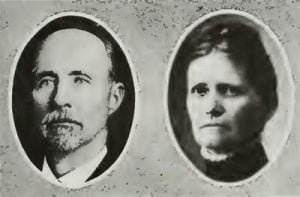
Mr. and Mrs. Charles O'Hara

Henry O’Hara and his family, including his wife Margaret and ten children, relocated from Frederick County, Maryland, to Nelson County, Kentucky, in late 1811. After six years, they journeyed to Illinois, settling near Prairie du Rocher by 1818. Henry established the O’Hara Settlement and constructed a reliable clock, which passed through the family for generations. His son James, a pioneer in Southern Illinois, ran a successful farm and store. The family expanded, with notable members Charles and James R. O’Hara contributing to the community’s development.

Indian Mounds throughout North America

Great Serpent Mound Postcard

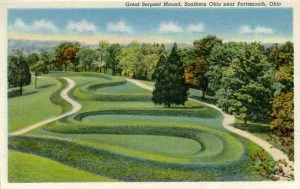
The region surrounding Lake Michigan was historically inhabited by skilled mound builders, including the Wyandots and Six Nations, who buried their deceased with treasures beneath earthen mounds. Excavations across North America, from Tennessee to Georgia, have uncovered European artifacts, suggesting cultural exchanges with early explorers. Similarities in mound structures and burial practices link the mound builders to contemporary Native American tribes. Mounds served varied purposes, including memorials and fortifications, reflecting the complex social practices of these ancient communities throughout the continent.

Prominent White Men among the Chickasaws

Holmes Colbert

In the early days, a few cultured white men, drawn by the Chickasaw way of life, integrated into the nation. Notably, figures such as James Gunn, Logan Colbert, and Malcomb McGee became part of Chickasaw society, aiding in moral and educational advancements. Despite myths of a McIntosh, who was misrepresented as influential, the true contributions of these men remain significant. They sought genuine connections with the Chickasaws, contrasting sharply with later intruders motivated by avarice, casting a long shadow over indigenous relationships.

Kit Carson, His Life and Adventures – Indian Wars

kitcarson

Christopher “Kit” Carson, born on December 24, 1809, in Kentucky, grew up in the dangerous wilderness of Missouri, fostering his adventurous spirit. At age 12, he rescued bear cubs, showcasing his bravery. After abandoning a saddler’s apprenticeship for a life of exploration, he became skilled in woodcraft and hunting tactics. Carson served as a scout and guide, notably for Colonel J.C. Fremont, and gained fame for his exploits. He died in 1868, remembered as a legendary figure in American frontier history.