Biographical Sketch of John Rowlee Fausey

John Rowlee Fausey, born March 19, 1870, in Elmira, New York, dedicated his career to enhancing public education in Massachusetts, particularly in Springfield and West Springfield. After receiving his education from Genessee Wesleyan Seminary and Syracuse University, he began teaching in various roles in Pennsylvania and Connecticut before becoming principal of Howard Street School in Springfield in 1906. Fausey later served as superintendent in West Springfield and Winchester, returning to West Springfield in 1923. He married Lena May Corbin in 1899.
Biography of Israel Newton

Israel Newton, born in Colchester, Connecticut, on May 6, 1839, was a prominent figure in his community. After moving to Suffield, he operated a general store for thirty years before relocating to Orange, where he worked with the Home Sewing Machine Company and served as clerk of the District Court and justice of the peace. A Civil War veteran, he was involved in local governance and church activities. Israel married twice, fathering several children, and left a lasting legacy in his community.

Biographical Sketch of James T. Brown

James T. Brown, born on February 24, 1885, in Luzeme, New York, is a prominent hotel manager in Springfield, Massachusetts. He began his career in the hotel industry after his family moved to Norwich, Connecticut, where he completed his studies. Since becoming the manager of Hotel Worthy in 1922, he has expanded his career to include management of the Worthy Inn and the Hotel Draper. Married in 1908, he has four children and is active in various fraternal organizations, including the Masons and the Elks.

Biography of William L. Learned

William L. Learned, born July 24, 1821, in New London, Connecticut, became a distinguished jurist in Albany, New York. A Yale College graduate, he began his legal career after studying under notable lawyers. Elected to the Supreme Court in 1870, he served for eighteen years, known for his clear, analytical opinions and commitment to judicial integrity. Additionally, he contributed to legal education at Albany Law School and was involved in various civic projects, reflecting his dedication to both law and community welfare.

Western Niantic Tribe

The Western Niantic Indians, an Algonquian tribe, originally inhabited the Connecticut coast from Niantic Bay to the Connecticut River. Historically linked to the Rhode Island Niantic, they were fragmented by the Pequot invasion. Their chief village was located near present-day Niantic. The tribe faced near annihilation during the Pequot War in 1637 and subsequently fell under Mohegan rule. By 1761, their numbers had dwindled significantly, and they eventually assimilated into other tribes, with traces of their lineage persisting among mixed descendants.

Pequot Tribe

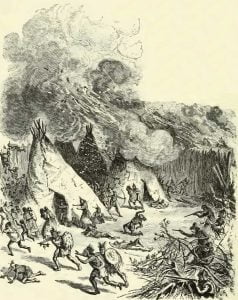
Pequot Fort

The Pequot Tribe, an Algonquian group in southeastern Connecticut, was a dominant force in the early 17th century, controlling vast territories and instilling fear in neighboring tribes. Under chief Sassacus, they faced significant conflict with colonial forces, culminating in the 1637 Pequot War, which devastated their population and led to their dispersal. Many Pequots were enslaved or merged with other tribes, but a distinct identity persisted. Over the centuries, their numbers dwindled, yet remnants continued to maintain cultural ties into the 19th and 20th centuries.

Mohegan Tribe

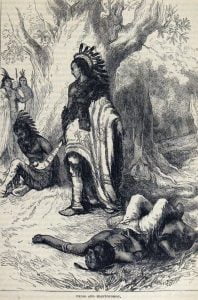
Uncas and Miantonomoh

The Mohegan, an Algonquian tribe, originated along the Thames River in southeastern Connecticut, claiming territories in parts of Massachusetts and Rhode Island. Emerging under Chief Uncas after the Pequot defeat in 1637, the Mohegan allied with English settlers, asserting control over rival territories. As colonial expansion progressed, they focused on a reservation near modern Mohegan and Norwich, leading to population declines through migration and intermarriage. Although their numbers dwindled to around 100 by the early 1800s, they maintained cultural traditions such as the Green Corn festival.

The Defense of Stonington, Connecticut

Battle of Stonington

Accounts the attack and defense of Stonington Connecticut during the War of 1812. Included will be found a muster-roll of the Borough company of militia, the official account furnished for publication by the magistrates, warden and burgesses; and a letter from Capt. Amos Palmer, chairman of the citizens’ committee of defense, to Mr. Crawford, secretary of war, containing a concise narrative of the action.

New London County Connecticut Cemeteries

This page lists known online cemetery transcriptions, burial records, and gravestone images for New London County, Connecticut. Resources vary by cemetery and may include full surveys, partial records, mapping, or photographs. Links lead to external sites providing the available data.

Biographical Sketch of Christopher Avery

Christopher Avery, born in England around 1590, emigrated to New England in the early 1630s, possibly accompanying Governor Winthrop. His early years were spent in Gloucester, Massachusetts, where he held several public offices. In 1658, he moved to Boston before eventually settling in New London, Connecticut, in 1665. Although there are varying accounts of his origins, it is noted that his wife and most of his children remained in England, leaving him to establish his family line in America. Avery died on March 12, 1679.

Biographical Sketch of James Avery

James Avery, born circa 1620 in England, was the sole recorded child of Christopher Avery and the founder of the Avery family in Groton, Connecticut. He immigrated to the Massachusetts Bay Colony and lived initially in Gloucester before settling in New London. Prominent in public life, he held various military and civic positions. He married Joanna Greenslade in 1643 and had nine children, several of whom married into other notable families, furthering the Avery legacy in the region.

Biographical Sketch of Samuel Avery

Samuel Avery, born on August 14, 1664, in Groton, was a prominent farmer and magistrate. He served as captain of the train band and was the town moderator upon Groton’s legal establishment in 1704. Avery was the first townsman at the inaugural town meeting in 1705, a role he maintained until his death on May 1, 1723. He married Susanna Palmes in 1686 and had eleven children, including notable descendants Jonathan and Christopher. Susanna passed away in 1747.

Biographical Sketch of Ensign John Rowley

Ensign John Rowley, born circa 1690 in Falmouth, Massachusetts, passed away in January 1763 in Colchester, Connecticut. He married Deborah Fuller on September 11, 1716, who died in 1752. Rowley relocated to East Haddam around 1722 and later to Colchester, where he attended the Westchester parish church. He had eight children with Deborah, including Patience, Content, and Joseph, among others. Rowley eventually remarried after his first wife’s death.

Biography of Kinney, Asa, Hon.

Asa Kinney, born on May 21, 1810, in Homer, New York, was the fourth son of Abel and Freelove Kinney, early settlers of Cortland County. He received a common school education and was an active public servant throughout his life, serving in various roles including Justice of the Peace and member of the Wisconsin Territorial Legislature. Kinney also participated in the Civil War and later held positions in California and Kansas. His life was marked by public service, military engagement, and multiple marriages until his death in good health at age seventy-one.

Biographical Sketch of Ezra Durand

Ezra Durand, born on March 8, 1833, in Seneca Falls, New York, was the youngest of thirteen siblings raised on a farm. Limited by formal education, he worked in musical instrument factories in Massachusetts and Connecticut before becoming a traveling salesman. In 1881, he moved to the Pacific Coast, initially settling in San Francisco, then relocating to Portland in 1882. There, he founded the successful Durand Organ and Piano Company in 1883. He married Jennie Smith in 1881, and together they built a notable home in Portland Heights.