Abbe-Abbey Genealogy

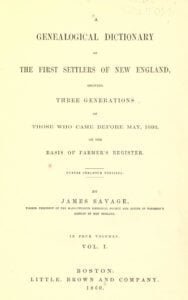
A genealogical dictionary of the first settlers of New England vol 1

The “Abbe-Abbey Genealogy” serves as a comprehensive and meticulously compiled homage to the heritage of the Abbe and Abbey families, tracing its roots back to John Abbe and his descendants. Initiated by the life-long passion of Professor Cleveland Abbe, this genealogical exploration began in his youth and expanded throughout his illustrious career, despite numerous challenges. It encapsulates the collaborative efforts of numerous family members and researchers, including significant contributions from individuals such as Charles E. Abbe, Norah D. Abbe, and many others, each bringing invaluable insights and data to enrich the family’s narrative.
Early Indian Wars in New England

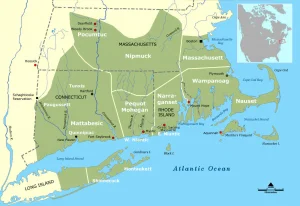
Early New England Tribes Map

The early Indian wars in New England, starting with Pilgrims landing in Plymouth in 1620, marked a turbulent period of settler-Indian relations. Initial friendly interactions, exemplified by Samoset’s visit and a lasting treaty with Massasoit, soon gave way to conflict, particularly with the Pequots. Tensions escalated into the Pequot War, culminating in their near annihilation after several battles in 1636. The defeat of the Pequots significantly altered power dynamics, instilling fear among other tribes and ensuring a temporary peace for settlers until future conflicts arose.

Biography of Hon. E. Hubbard

E. Hubbard, born April 7, 1818, in Middlesex County, Connecticut, moved west in 1839, initially working in book sales before selling clocks for sixteen years. He relocated to Harrison County, Missouri, in 1852, served in the legislature, and raised troops for the Union during the Civil War. After four years of military service, he returned to farming and later opened the Jameson House in 1870. He married Elizabeth Brown in 1844, with whom he had four children.

Biography of Paul Helmer Young

Paul Helmer Young, born on July 26, 1896, in Lander, Wyoming, is a prominent figure in St. Louis’s business community, serving as a representative in the bond department of the National Bank of Commerce and president of the St. Louis Junior Chamber of Commerce. Educated at various institutions, including Wesleyan University, he served in World War I before transitioning into finance. Young actively engages in community organizations, showcasing his commitment to service and leadership among the city’s younger business professionals.

Biography of John B. West

John B. West, born on July 31, 1861, in Leicester, North Carolina, was educated in local schools and Weaverville College. He studied law and was admitted to the bar before moving to Moscow, Idaho, in 1891. Appointed register of the land office by President McKinley in 1898, he was an influential Republican and dedicated public servant. West was involved in various social organizations and had a family with two children. His father, Erwin West, a Union supporter during the Civil War, also played a notable role in the community.

Biographical Sketch of William Andrew Leonard, Rt. Rev. D. D.

William Andrew Leonard, Rt. Rev. D. D., was born on July 15, 1848, in Southport, Connecticut. He attended Philips Academy, St. Stephens College, and Berkley Divinity School. Ordained in 1871, he served as Rector in Brooklyn and Washington, D.C., before becoming the Bishop of Ohio in 1889. Leonard was also a significant figure in the American Episcopal Church in Europe and held various leadership roles in educational and civic organizations, including being a trustee of Kenyon College.

Biography of Dennis Joseph Sheedy

Dennis Joseph Sheedy, born October 14, 1874, in Portland, Connecticut, emerged as a prominent attorney in Fredonia, Kansas, after graduating from the University of Kansas Law School in 1906. Renowned for his expertise in civil and criminal law, he maintained a successful practice and served as city attorney. A member of the Knights of Columbus and the Modern Woodmen of America, Sheedy was also active in the National Guard and participated in the Spanish-American War. He married Josephine Millar in 1909, and they had one son, Joseph.

Biography of Benton O. Johnson

Benton O. Johnson, born in Bethlehem, Connecticut, on April 20, 1855, became a prominent figure in Redlands, California. After moving from the South and returning to Connecticut due to the Civil War, Johnson began his career as a drug clerk before becoming a merchant in 1883 upon relocating to California. He built notable residences and was actively involved in local organizations, including Masonic and Oddfellows lodges. Johnson’s family life included marriage to Minnie R. Brown and two children, while he aligned politically with the Republican Party and attended the Congregational Church.

Biographical Sketch of E. P. Clarke

E. P. Clarke, a distinguished publisher and editor of the Ontario Record, hails from Maine, where he completed his education at Kents Hill Seminary and Wesleyan University. After working with the U.S. Geological Survey, he moved to California in 1885, founding the Ontario Record shortly thereafter. Clarke has significantly contributed to the community’s development, serving on the San Bernardino County Board of Education and the Board of Regents at Chaffey College, where he also taught. An active Republican, he writes for notable magazines and engages in public lectures.

Biography of Chauncey P. Williams

Chauncey P. Williams, born in Cromwell, Connecticut, in 1817, was a distinguished banker and financier in Albany. He began his career as a clerk and eventually led the Albany Exchange Bank during the Civil War, successfully navigating financial challenges. Williams was a lifelong student of finance and a vocal opponent of slavery, supporting abolitionist efforts. He published several influential papers on banking and currency, advocating for sound economic policies. Married with three children, he remains respected for his integrity and contributions to financial discourse.

Mattabesec Tribe

The Mattabesec Indians, an influential Algonquian tribe in Connecticut, occupied both banks of the Connecticut River, extending from Wethersfield to Middletown. Including subgroups like the Wongunk, Pyquaug, and Montowese, they were associated with the Wappinger and likely inhabited a territory that contributed to further colonial expansion. Their jurisdiction encompassed much of southwestern Connecticut, incorporating various tribes such as the Mahackeno, Uncowa, Paugusset, and Quinnipiac.

Middlesex County Connecticut Cemeteries

This page lists known online cemetery transcriptions, burial records, and gravestone images for Middlesex County, Connecticut. Resources vary by cemetery and may include full surveys, partial records, mapping, or photographs. Links lead to external sites providing the available data.