
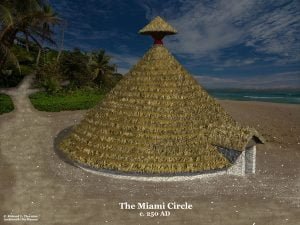
The Miami Circle

42 MiamiCircle

The Miami Circle, discovered in 1998 during a condominium excavation in Downtown Miami, features 24 holes in limestone, believed to date between 0 and 300 AD, possibly linked to the Tekesta Indians. Controversy arose regarding its age and purpose, with debates among archaeologists about its significance and claims regarding its origins. Public opposition halted initial construction plans, leading to a legal battle that resulted in the preservation of the site. Today, the Miami Circle is a designated National Historic Landmark, protected and managed by History-Miami Museum.

Slave Narrative of Rev. Eli Boyd

Rev. Eli Boyd, born on May 29, 1864, in South Carolina, grew up on a plantation where he worked after emancipation, earning a small wage. Although he did not experience slavery, he reflected on life on the plantation, including a childhood mishap involving food meant for hogs. He learned to read at 26 from a discarded textbook and became a preacher after working in a turpentine still. Rev. Boyd has served as assistant pastor at Bethel African Methodist Church in Miami for a decade. He is a member of the Geechee community, with African heritage.

Slave Narrative of Annie Gail

Annie Gail, interviewed in Dade County, Florida, recalls her childhood on Faggotts Place in Alabama, where she was born into slavery. She vividly remembers watching her mother work in the fields and feeling afraid of losing her. Following emancipation, her mother continued to be hired for work, and Annie felt a sense of security knowing her mother would not leave her. Gail’s recollections provide personal insight into the post-emancipation experience of former slaves and their families.

Slave Narrative of Millie Sampson

Millie Sampson, interviewed in Dade County, Florida, reflects on her early life in Manning, South Carolina, before the Civil War. She recounts that her parents were enslaved field hands on the same plantation, where she spent her childhood primarily playing with the white children and enjoying ample food. Her upbringing was shaped by the plantation environment, contributing to her early language development through interactions with the white children.

Slave Narrative of Frank Bates

Frank Bates, originally from Alabama, shares his early memories of life on a plantation, where he was too young to work but would carry water to the field workers. He recounts a vivid incident of witnessing his mother being whipped for a minor infraction in the kitchen. Bates also remembers the departure of three family members, Lundra, Oscar, and Luke, who left for war on horses, leaving him uncertain of their fate after they moved on the same day.

Slave Narrative of Jessie Rowell

Jessie Rowell, born on the Gaddis plantation in Mississippi, recalls her childhood experiences of slavery. Her grandmother worked inside the plantation house, while her mother labored in the fields. Jessie, too young to work, remembers anxiously awaiting her mother’s return home after long days. Although the family remained on the plantation after emancipation, Jessie’s mother was paid for her labor, though Jessie cannot recall the amount. These memories provide insight into the personal impact of slavery and the transition to freedom.

Slave Narrative of David Lee

David Lee, recalling his childhood in Dade County, Florida, describes his experiences on a plantation in Georgia, where he received a nurturing upbringing. Born around the time of emancipation, he reflects on his memories of Miss Ann Barefield, who taught him and encouraged him. While he enjoyed a comfortable life with ample clothing and food, he had little understanding of money or possessions. Lee fondly remembers his maternal figure and the mixed discipline he received, particularly regarding his love for sugar.

Slave Narrative of Fannie McCay

Fannie McCay, age 73, recounts her early experiences on a plantation in Dade County, Florida. Born into slavery, she doesn’t possess memories of emancipation but acknowledges being considered property during that time. Fannie recalls accompanying adults while they picked cotton and expresses nostalgia for her childhood, particularly her fondness for a calf owned by her master, which she wished to keep. She emphasizes that despite her youth, her memories of life on the plantation remain significant to her identity.

Slave Narrative of William Neightgen

William Neighten, interviewed in Dade County, Florida, reflected on his experiences despite being a baby at the time of emancipation. He remained in bondage conditions for an extended period and adopted the name Massys. Neighten recounted the extensive labor he performed, including plowing and hoeing, often feeling it was insufficient, which led to frequent whippings. His narrative illuminates the struggles faced by those who were enslaved, demonstrating the enduring impact of this system on their lives.

Slave Narrative of Banana Williams

Banana Williams, born in Grady County, Georgia, recalls his childhood under slavery, specifically his experiences with Mr. Sacks, his owner. He vividly remembers witnessing violence against enslaved individuals, which left a lasting impression on him. Although he left before he was old enough to work, he later labored in Mitchell County’s fields. Now residing in Miami with his daughter, Williams reflects on his life, having raised five children, but notes his inability to work due to old age.

Slave Narrative of Margaret White

Margaret White, an 84-year-old interviewee from Dade County, Florida, reflects on her life as a slave under John Eckels in North Carolina. Born just before the Emancipation Proclamation, she describes her experience as relatively positive, noting that she was treated well and never sold. Her father, a tailor, provided clothing for both their master and the servants. Margaret worked primarily in the household, performing maid duties and caring for the children, sharing a unique perspective on her life during slavery.

Slave Narrative of Salena Taswell

Salena Taswell, born in 1844 in Perry, Georgia, reflects on her life as a child on Dr. Jameson’s plantation. She describes a childhood spent working as a servant rather than playing. Although she was treated kindly, her family’s life involved hard work: her mother was a seamstress, and her father a blacksmith. Guests at the plantation enjoyed rich meals, while Salena cleaned and waited on the table. After the Civil War, she experienced little change, continuing to live in her master’s household alongside other freed individuals.

Slave Narrative of Charley Roberts

Charley Roberts, born on the Hogg plantation in South Carolina, recalls the day he learned of his freedom while tending to a calf. He describes life under Confederate soldiers, who seized livestock for their needs. Scarcity forced him to cook salt from smokehouse boards for flavor in meals. Charley favored eating pork rinds and learned to read using McGuffey’s speller. Now residing in Perrine, Florida, he values family and strives to live by the Golden Rule, seeking independence despite financial challenges.

Slave Narrative of Taylor Gilbert

Taylor Gilbert, interviewed at age 91 in Titusville, Florida, reflects on his life as the son of a colored mother and a white father. Born in Shellman, Georgia, he remembers the harsh realities of slavery, including brutal punishments for disobedience and the risks of moving without passes. Gilbert’s parents worked on a plantation, where his mother was a cook and his father a butler. After emancipation, he became a farmer, a profession he continues today, despite personal struggles and the loss of his wife.

Tequesta Indians

The Tequesta Indians, whose name meaning remains unknown, inhabited the Miami area along Florida’s southeast coast. They likely spoke a language related to the Calusa and possibly Muskhogean. Historical accounts from the mid-1500s mention their interactions with Spanish explorers and their attempts at conversion to Christianity, which ultimately failed. By the late 17th century, their population was estimated at around 1,000. The Tequesta are recognized as one of the earliest groups to occupy the Miami site, despite their name lacking geographic permanence.

Biography of Rev. B. L. Baldridge

Rev. B. L. Baldridge was born on February 9, 1821, in Ohio. His father, Rev. William Baldridge, a Revolutionary War veteran, was a long-serving minister. B. L. was educated at Miami University and ordained in 1851. He pastored in Michigan and later became a missionary in Kansas, where he founded a church. He served as a U.S. Army Chaplain until 1884. After retirement, he managed a fruit ranch in California and advocated for Prohibition. He married Sarah M. Gilmore and had two children.