
Guion Miller Miscellaneous Testimony, Pages 41-50
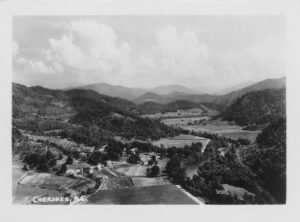
1930s Valley of the Eastern Cherokee Reservation in North Carolina

Pages 41-50 of Guion Miller miscellaneous testimony document sworn statements from Eastern Cherokee applicants and witnesses in North Carolina and Virginia. The records cover claimed Cherokee ancestry, family lines, residences, prior enrollment attempts, and community recognition, with testimony from Mary Catherine Marion, William Cobb Dennis, Andrew Slate, Peter E. Slate, Drucinda Snow, Sarah J. Wolfe, Lelia Edwards, Annie E. McClenore, Babe Payne, James A. Slawter, and Leander Nelson.
Guion Miller Miscellaneous Testimony, Pages 31-40

1930s Valley of the Eastern Cherokee Reservation in North Carolina

Pages 31–40 of Guion Miller miscellaneous testimony document sworn statements from Eastern Cherokee applicants and witnesses in North Carolina and Virginia. The records cover claimed Cherokee ancestry, family lines, residences, prior enrollment attempts, and community recognition, with testimony from William P. Doby, Charley Doby, Edmond E. Kingsbury, Edward W. Stanly, Thena C. Holinsworth, John W. White, Joseph B. White, Charles Greenwood, Hanna Moore, Easter Stuart, Anna Reeves, John W. Booth, and Ben Booth.

Biographical Sketch of Charles Howard

Charles Howard, originally from Halifax County, Virginia, married Nancy Lewis and later settled in Warren County, Kentucky. His son Joseph moved to Montgomery County, Missouri, in 1818, where he and Malinda Lennox had several children. After Nancy’s death, Charles married multiple times, first to Phoebe Saylor, then to a woman named McCormack, and subsequently to Sydney Hall, with whom he had two more children. His fifth marriage was to Nancy Bladenburg, with whom he had no offspring.

Biographical Sketch of Alexander Harding

Alexander Harding, originally from Halifax County, Virginia, was married to Mary Hightower, and together they had six children: Archibald, Anna, Benjamin, Elizabeth, Mary, and Sally. Harding passed away in 1816; Mary later remarried Josiah Rodgers and relocated to Alabama. Archibald moved to Missouri in 1833, while Anna settled in Montgomery County the same year with her husband James Anderson. Benjamin, a War of 1812 veteran, married Mary Nunnelly and also moved to Montgomery County in 1831, where they had one child who died young.

Biography of Clement Richardson

Clement Richardson, born June 23, 1878, in Virginia, is an influential educator and president of the Lincoln Institute in Jefferson City. He overcame early hardships and pursued education, studying at notable institutions like Harvard. His career includes teaching at Morehouse and Tuskegee Institutes, where he engaged students through literary activities. Recently, he has focused on rural education and contributed extensively to various publications. Under his leadership, the Lincoln Institute has seen significant growth, bolstered by community support and state funding. He is also a dedicated family man and active in Masonry.

Biography of William Thomas Rye

William Thomas Rye, born on September 2, 1879, in Virginia, has been a notable attorney in Vinita, Oklahoma, since 1908. Educated at the Cluster Springs Academy and Hampden Sidney College, he also studied law at the University of Michigan. Rye initially taught school and later partnered with prominent lawyers, demonstrating his expertise in legal matters. A veteran of World War I and a Democratic supporter, he is committed to civic engagement and continual professional development, recognized for his contributions to law and public welfare.

Virginia African American Cemeteries – Black Cemeteries

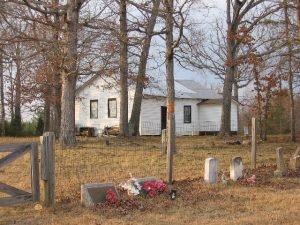
Cladstone Church of God and Cemetery

Virginia is home to numerous African American cemeteries that serve as a vital link to its historical narrative. The state features many burial grounds, such as the Freedmen’s Cemetery in Arlington and various family cemeteries across counties like Albemarle and Amherst. The AACAAC Project is focused on documenting and preserving these sites, ensuring the stories of past residents and their contributions to the community are not forgotten. These cemeteries offer essential biographical details vital to understanding the African American experience in Virginia.