Chief Pontiac of the Ottawa’s

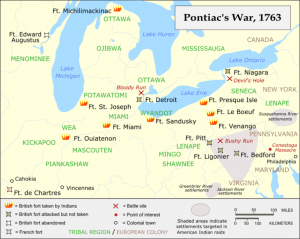
Map of Pontiacs War

Following the 1763 peace, English troops occupied former French forts, prompting widespread Indian apprehension of encroachment. Pontiac, the Ottawa chief, emerged as a pivotal leader advocating for resistance. He organized a council of tribes to unite against the English, inspired by a prophetic vision asserting divine support for their fight. Pontiac orchestrated a coordinated attack on English forts, aiming for liberation. Despite initial efforts, including a siege of Detroit, betrayal foiled his plans. Eventually, Pontiac was assassinated, symbolizing the decline of Indian resistance.

An Account of the Sufferings of Mercy Harbison – Indian Captivities

On the 4th of November, 1791, a force of Americans under General Arthur St. Clair was attacked, near the present Ohio-Indiana boundary line, by about the same number of Indians led by Blue Jacket, Little Turtle, and the white renegade Simon Girty. Their defeat was the most disastrous that ever has been suffered by our arms when engaged against a savage foe on anything like even terms. Out of 86 officers and about 1400 regular and militia soldiers, St. Clair lost 70 officers killed or wounded, and 845 men killed, wounded, or missing. The survivors fled in panic, throwing away their weapons and accoutrements. Such was “St. Clair’s defeat.”

The utter incompetency of the officers commanding this expedition may be judged from the single fact that a great number of women were allowed to accompany the troops into a wilderness known to be infested with the worst kind of savages. There were about 250 of these women with the “army” on the day of the battle. Of these, 56 were killed on the spot, many being pinned to the earth by stakes driven through their bodies. Few of the others escaped captivity.

After this unprecedented victory, the Indians became more troublesome than ever along the frontier. No settler’s home was safe, and many were destroyed in the year of terror that followed. The awful fate of one of those households is told in the following touching narrative of Mercy Harbison, wife of one of the survivors of St. Clair’s defeat. How two of her little children were slaughtered before her eyes, how she was dragged through the wilderness with a babe at her breast, how cruelly maltreated, and how she finally escaped, barefooted and carrying her infant through days and nights of almost superhuman exertion, she has left record in a deposition before the magistrates at Pittsburgh and in the statement here reprinted.

Biographical Sketch of Abbot, Francis Ellingwood

Francis Ellingwood Abbot, born in Boston on November 6, 1836, was educated at home and the Boston Latin School before graduating from Harvard in 1859. He attended the Harvard Divinity School and served as a principal and minister in various capacities, including the Unitarian society in Dover, NH, and the Independent society in Toledo, OH. Abbot was also an editor and established a classical school and a “Home for Boys” in Cambridge. He published works in notable journals and authored “Scientific Theism.” Abbot earned a Ph.D. from Harvard in 1881 and had three children with his wife, Katharine.

Biography of O. W. Anderson

O. W. Anderson, born on November 18, 1850, in Erie County, Pennsylvania, became a prominent blacksmith and businessman in Billings, Missouri. He learned the blacksmith trade after initially working as a saw miller and opened his first shop in 1875. After several business ventures, including a hardware store, he returned to blacksmithing, forming Anderson Keightley. Active in the community, he held minor political offices and was involved in fraternal organizations. Married in 1873, he and his wife raised four children and are respected members of the local Methodist Episcopal Church.

Biography of David C. Chase

David C. Chase, born on April 26, 1853, in Ohio, is the secretary and treasurer of the Payette Valley Mercantile Company in Idaho. With roots tracing back to early Connecticut settlers, he overcame a challenging childhood following his father’s death. Educated in Pennsylvania, he began as a newsboy, later working in telegraphy for two decades with the Union Pacific Railroad. In 1891, he co-founded the mercantile company, contributing significantly to its success. Married to Alary A. Piatt, they have two children and are active members of their community.

Biography of William J. Bovaird

William J. Bovaird, born on March 25, 1863, in Allegheny County, Pennsylvania, is the president of the Bovaird Supply Company in Independence, Kansas. He started in the oil supply industry at a young age, learning under his father’s guidance in Pennsylvania. In 1903, he established the Bovaird Supply Company, which rapidly grew and became separately incorporated by 1907. The company specializes in manufacturing oil drilling tools and operates branches in Oklahoma. Bovaird was also an active community member, serving in military and local government roles throughout his life.

Biography of Richard Watson Argue

Richard Watson Argue (1845-1916) was a prominent figure in the Mid-Continent oil industry, establishing significant operations in Pennsylvania, New York, Ohio, Kansas, and Oklahoma. Born near Ottawa, Canada, he began his career in Pennsylvania before moving to Buffalo and later to Independence, Kansas. A dedicated community member, he actively contributed to local church and civic affairs. After his death, his widow, Eva Jean Allport Argue, adeptly managed their extensive properties. Together, they had four children, all of whom pursued education and careers in various fields.

Biography of Freeman R. Foster

Freeman R. Foster, a pioneering figure in Topeka’s early history, played a crucial role in the town’s foundation in 1854. Born in Pennsylvania in 1832, Foster’s journey west began with a wagon and led him to assist in platting the new settlement. He preempted land in Topeka and, despite early hardships, established a successful homestead. An ardent opponent of slavery, he served as a sergeant in the Civil War and was active in local governance, including a term in the Kansas House of Representatives. Foster’s legacy as a community leader endures, remembered for his integrity and dedication to Topeka.

Biographical Sketch of Frank A. Arter

Frank A. Arter was born on March 8, 1841, in Hanoverton, Ohio. Educated at Hanover High School and Allegheny College, he earned A.B. and M.A. degrees. He married Eliza Kingsley and had three children. Arter held various leadership roles, including director of multiple companies and president of the Board of Trustees at Allegheny College. His community service extended to St. Lukes Hospital and the Children’s Industrial School, alongside active memberships in several clubs and honor societies. He retired from his career and dedicated his life to service.

Biographical Sketch of Ellis Jones Chesbro

Ellis Jones Chesbro, born on December 25, 1868, in Cleveland, was a dentist educated at Willoughby High School, Allegheny College, and the University of Pennsylvania, where he earned his D.D.S. He married Eugenna C. Davis in Washington, D.C., on May 9, 1906, and they had one son. Chesbro was an active member of the Northern Ohio Dental Association and the Phi Delta Theta Fraternity.

Biographical Sketch of Clifford W. Fuller

Clifford W. Fuller, born on February 6, 1864, in Garrettsville, Ohio, was a prominent lawyer and public figure. He attended local schools and graduated with degrees from Allegheny College. A captain in the 10th Ohio Volunteer Infantry during the Spanish-American War, Fuller was admitted to the Ohio bar in 1890 and practiced law in Cleveland. He held various leadership roles in local companies and clubs and was involved in several organizations, dedicating his leisure time to big game hunting and fishing.

Biographical Sketch of James McCreary Gee

James McCreary Gee, born December 24, 1875, in Kingsville, Ohio, was a real estate broker with a diverse professional background. After completing his education at Allegheny College and Western Reserve University, he worked as a traveling salesman and later in life insurance and sales management. He held leadership roles in various companies before becoming engaged in real estate brokerage in Cleveland. A Republican and active in local organizations, Gee’s family included four children from his marriage to Helen Mills.

Biography of Elias Emerson Morris

Elias Emerson Morris, born on November 2, 1859, in Pennsylvania, has served as the probate judge of Riley County for eight years, demonstrating fairness and dedication, particularly towards the welfare of widows and orphans. An educator and public servant, he moved to Kansas in 1880, working as a teacher and township trustee before becoming a county commissioner and finally probate judge in 1908. A Republican and Masonic member, he was married to Mary Elizabeth Zeller, with whom he had three children.

Biographical Sketch of William Francis Lyon

William Francis Lyon, born on August 16, 1868, in Meadville, Pennsylvania, was a prominent merchant. He graduated from Meadville High School in 1885 and married Lisette Baus in 1892. Lyon began his career in Cleveland in 1885, later becoming secretary and treasurer of The Cady-Ivison Shoe Co. in 1897 and its president in 1913. He was a founding member and president of the Cleveland Association of Credit Men and belonged to the Knights of Columbus and the Catholic Mutual Benefit Association.

Biographical Sketch of Audley P. McCallie

Audley P. McCallie, born on October 15, 1888, in Kansas City, Missouri, was the son of Jack and Jennie Purcell McCallie. He received his education in grammar school in Buffalo, New York, and attended high schools in West Springfield and Meadville, Pennsylvania. McCallie became the managing partner of The Superior Peanut Company and was also a member of the Cleveland Athletic Club.

Biography of Charles Hiram Cook

Charles Hiram Cook, born January 31, 1863, in Pennsylvania, has significantly influenced the Kansas oil industry since arriving in Coffeyville in 1912. After graduating from various educational institutions, he pursued a career in the oil and gas business across numerous states. A Republican and active community member, Cook is known for his extensive drilling operations and has interests in Oklahoma as well. Married to Maude I. Best in 1887, he has four children, contributing to both his family and the industry’s growth.

Biographical Sketch of Frederick Augustine Sterling

Frederick Augustine Sterling, born on May 26, 1831, in Chapinville, Connecticut, was a prominent merchant based in Cleveland since 1850. Educated in Geneva, New York, he married Emma Betts in 1856 and had one son. Throughout his career, he held various roles in companies such as T. S. Beckwith & Co. and Sterling & Welch Co., serving as president of the latter. Additionally, he was active in banking and church leadership and enjoyed golf as a pastime.

Biographical Sketch of Jacob Streitberger

Jacob Streitberger was born on June 23, 1871, in Germany, to parents Jacob and Carolyn Streitberger. He received his education in Germany before marrying Lena Duer in Meadville, Pennsylvania, on July 4, 1895. The couple had three children. Jacob was an active member of the Eagles and Foresters organizations.

Biographical Sketch of Franklyn Breed Tabor

Franklyn Breed Tabor, born on February 23, 1868, in Titusville, Pennsylvania, was educated in Painesville, Ohio. He served as superintendent of the Painesville Water Works from 1893 until the city purchase in 1898, after which he became the secretary until 1899. Moving to Cleveland, Tabor was the auditor and subsequently secretary of the Telling Bros. Ice Cream Company from 1900 to 1904. He also holds positions as secretary and treasurer of the Cable-Trace Company and is involved in various business ventures, identifying as a Republican.

Biographical Sketch of Daniel H. Pond

Daniel H. Pond, born on March 11, 1870, in Petroleum Center, Pennsylvania, became the president and general manager of the Economy Building and Loan Company. Educated in Trumbull County and at Allegheny College, he began his career in various roles, including a factory worker and messenger. He served in the U.S. Cavalry and transitioned to real estate and insurance, achieving leadership in the Economy Building and Loan Company and the Pond Brothers insurance firm. A Republican and Methodist, he was active in civic organizations and military service.