
Beaufort County, North Carolina – Wills 1703-1799
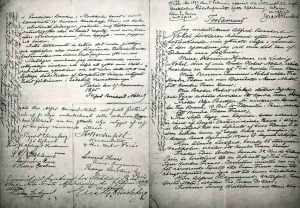
Sample Last Will and Testament

These abstracts were made on all Beaufort County, North Carolina Wills dating from 1703-1799. The information contains the year of the will, the individual who wrote the will, and any family members mentioned in the will.

Slave Narrative of Uncle David Blount

Uncle David Blount recounts his experiences on a plantation in Beaufort County, North Carolina, under Major Wm. A. Blount. He describes both the hard work and moments of joy, such as swimming on Saturdays. While noting a cruel overseer, Blount recalls the tension that arose when slaves contemplated rebellion and how he alerted his master to thwart their plans. He also shares post-war challenges, the impact of the Civil War, and his eventual move to Raleigh. Blount’s narrative concludes with his passing in 1937.

Machapunga Indians

The Machapunga Tribe, meaning “bad dust” in Algonquian, was part of the broader Algonquian linguistic stock and inhabited areas in present-day Hyde, Washington, Tyrrell, and Beaufort Counties. Their notable village was Mattamuskeet, and they likely embraced descendants of the Secotan tribe. By 1701, they had dwindled to a single village and participated in the Tuscarora War. Their population declined significantly over the years, with only a handful remaining by the late 18th century. The name Machipongo is now associated with a village in Virginia.

J. R. Willand

J. R. Willand, born on July 29, 1896, in Beaufort County, North Carolina, served in the 8th Regiment, Depot Division. He was the son of A. and Mary D. Willand. His military service began on August 27, 1917, and included assignments at Camp Jackson in South Carolina and Camp Hill in Virginia, before returning to Camp Jackson, where he was mustered out.

A. G. Willis

Private B. Willis served in Battery B of the 30th Division, 113th Regiment, hailing from Beaufort County. He enlisted on June 2, 1917, in Washington, N.C., and experienced several transfers through Camp Sevier, Kelly Field, Camp Richfield, and Camp Jackson. He achieved the rank of Sergeant before being mustered out at Camp Jackson on December 31, 1919.

John R. Selby

John R. Selby, born in Beaufort County to S. T. and Beulah Selby, began his military service in April 1917, enlisting in Washington, N.C. He was first stationed in Raleigh and later transferred to Portsmouth, where he served in a detached capacity. Selby was later notified to join active service on November 11 at Camp Jackson, ultimately being mustered out in Raleigh on December 19, 1919.

Charles E. O’Donovan

Chief Yeoman Charles E. O’Donovan, born in Beaufort County to J. J. and C. A. O’Donovan, enlisted in the Navy in October 1914 in Seattle. He served on the U.S.S. Huntington and later aboard the hospital ship Mercy, completing 14 overseas voyages. His ship was officially credited with sinking one submarine and received unofficial recognition for another. O’Donovan was discharged from service on July 26, 1920, in Charleston, South Carolina.

Edward James Mitchell

Edward James Mitchell, a mechanic from Beaufort County, was the son of N. E. and Frances Mitchell. He enlisted on June 14, 1918, at Washington, N.C., and underwent training at Clemson College, S.C., before moving to various military posts in South Carolina and North Carolina. Mitchell sailed for France on November 9, 1918, and returned to the United States on January 14, 1919, before being mustered out at Fort Monroe, Virginia, on January 19, 1919.

Frank White Miles

Frank White Miles served as 1st Sergeant in the Machine Gun Company of the 119th Regiment, 30th Division. Hailing from Beaufort County, he was the son of S. Miles and the husband of Lillian Miles. He entered military service on June 7, 1917, in Goldsboro, N.C., training at Camp Royster and later at Camp Sevier. Miles was promoted to 1st Sergeant in October 1918 and was mustered out at Camp Sevier on December 9, 1918.

Thad H. Hodges

Corporal Thad H. Hodges, from Beaufort County, enlisted in the military on December 13, 1917. He underwent training at various camps, including Ft. Thomas, Camp Hancock, and Camp Merritt, before departing for Brest, France, on March 26, 1918. Promoted to Corporal in June 1918, he returned to the United States on July 3, 1919, and was mustered out at Camp Lee, Virginia, on July 17, 1919.

Grover C. Lilley

Grover C. Lilley served as Mess Sergeant in Battery B of the 113th Field Artillery, 30th Division. Born in Beaufort County to James R. Lilley and his wife, he enlisted on June 29, 1917, in Washington, N.C. After training at Camp Sevier and Camp Mills, he deployed to France on May 8, 1918, participating in key battles including St. Mihiel, Argonne Forest, and Woevre. He returned to the United States on March 17, 1919, and was mustered out at Camp Jackson that same month.

W. C. Lupton

Sergt. W. C. Lupton, of Beaufort County, served in Medical Ambulance 115 of the 29th Division, 57th Regiment. He entered the military on August 3, 1917, and was initially stationed at Camp McClellan. After sailing to Liverpool in July 1918, he participated in the Meuse-Argonne campaign, where he was gassed. He was promoted to corporal in June 1918 and sergeant in November 1919. Lupton returned to the U.S. on May 22, 1919, and was mustered out on June 3, 1919.

Jehu Gurgaus

Jehu Gurgaus served as a machinist in Battery B of the 30th Division, 113th Regiment, during World War I. He was the son of John and L. Gurgaus from Beaufort County, enlisting on June 29, 1917, in Washington, N.C. After training in South Carolina and a transfer to Camp Mills, he sailed to France on May 26, 1918. Participating in all battles of the 113th until he was wounded by gas in the Argonne Forest on October 6, 1918, he returned to the U.S. on February 22, 1919, and was mustered out on March 8, 1919.

Claud G. Gardner

2nd Lieutenant M. G. Gardner, hailing from Beaufort County and the son of A. B. and Frances Gardner, was married to Juanita O’Brien. He entered military service in April 1918 in Washington, N.C., trained at A. M. College, and was transferred to Camp Jackson and Camp Hancock. Gardner achieved the rank of 2nd Lieutenant on October 11, 1918, and was mustered out of service at Camp Hancock on November 25, 1918.

Loris W. Gardner

Loris W. Gardner, a musician in Headquarters Company of the Field Artillery, was born to A. B. and Frances Gardner. He enlisted in July 1917 in Washington, North Carolina, and trained at Camp Sevier before being transferred to Camp Mills. In 1918, he sailed to France, where he participated in significant battles including those at Argonne Forest, St. Mihiel, and the Toul Sector. Gardner returned to the United States in March 1919 and was mustered out at Camp Jackson later that same month.

J. C. Gaylord

J. C. Gaylord served as a 1st Class Fireman in the Navy Reserve during World War I. A resident of Beaufort County and son of Sam and Hallie Gaylord, he entered service on June 5, 1917, in Washington, N.C., and was stationed at Hampton Roads the same day. Promoted to 1st Class Fireman in August 1918, he participated in convoy duty aboard the U.S.S. New Jersey, completing three transatlantic trips before being mustered out in Boston, Massachusetts, in March 1919.

C. C. Deuke

Corporal C. C. Deuke, enlisted from Beaufort County, served in Company G of the 6th Division, 54th Infantry during World War I. He entered military service on May 10, 1918, in Washington and underwent training at Ft. Scrivens and Camp Wadsworth before being deployed to France. Promoted to corporal on June 6, 1918, he participated in key battles at Meuse-Argonne and Alsace-Lorraine. Deuke returned to the United States on July 6, 1918, and was mustered out at Camp Lee on July 24.

Lionel R. Cayton

Corporal Lionel R. Cayton, from Beaufort County, served in Company D of the 81st Division, 324th Regiment. He entered military service on May 24, 1918, in New Bern, North Carolina, and underwent training at various camps before deploying to France on August 5, 1918. During his service, he fought in significant battles including Verdun and the Meuse-Argonne. He achieved the rank of Corporal in August 1918 and was mustered out at Camp Jackson, South Carolina, on June 21, 1919.

Thomas R. Boyd

Thomas R. Boyd’s son served as a first-class radioman in the U.S. Navy during World War I. He hailed from Beaufort County and began his military service on January 11, 1918, at the U.S. Radio School in Cambridge, Massachusetts. He completed his service and was mustered out on February 28, 1919, in Cambridge.

William G. Black

William G. Black served in the Air Service Headquarters Company, 1st Regiment, during World War I. Born in Beaufort County to F. R. and M. L. Black, he enlisted on December 12, 1917, in Washington, N.C. After training at multiple camps, he deployed to France on January 8, 1918, and participated in battles at Marne and Lorraine. Black returned to the United States on July 8, 1919, and was mustered out of service on July 20, 1919, at Camp Lee, Virginia.