Abbe-Abbey Genealogy

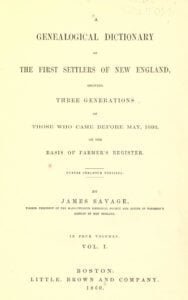
A genealogical dictionary of the first settlers of New England vol 1

The “Abbe-Abbey Genealogy” serves as a comprehensive and meticulously compiled homage to the heritage of the Abbe and Abbey families, tracing its roots back to John Abbe and his descendants. Initiated by the life-long passion of Professor Cleveland Abbe, this genealogical exploration began in his youth and expanded throughout his illustrious career, despite numerous challenges. It encapsulates the collaborative efforts of numerous family members and researchers, including significant contributions from individuals such as Charles E. Abbe, Norah D. Abbe, and many others, each bringing invaluable insights and data to enrich the family’s narrative.

Biography of Albert S. Wait

Albert S. Wait, born on April 14, 1821, in Chester, Vermont, is recognized as Sullivan County’s oldest lawyer in active practice. A descendant of early settlers, he began his legal career in 1846 after studying under Judge Kellogg. After practicing in Alstead, he moved to Newport in 1857, partnering with Hon. Edmund Burke for a decade. Married three times, he is involved in local governance and Masonic organizations, and is regarded as a legal authority, contributing to historical societies and legal literature.

General History of Alstead New Hampshire

Alstead, New Hampshire, located in the northern part of Cheshire County, encompasses 24,756 acres. Originally granted as New Town by Governor Benning Wentworth in 1761, its charter was confirmed on August 6, 1763, to Samuel Chase and associates. The town’s land features irregular terrain with several water bodies, including Warren Pond and various brooks. In 1880, the population was 1,037, with a notable education infrastructure comprising thirteen school districts and a total expenditure of $2,387.50 for school purposes.

Alstead Village, Cheshire County NH

Alstead, a notable post village in northwestern Alstead, New Hampshire, lies along Cold River and features two churches, several shops, and approximately 100 residences. Once known as Paper Mill Village due to its extensive paper manufacturing, its post office adopted the name Alstead two decades ago. Nearby, the Cocked Hat hill, named for its resemblance to a hat, marks the confluence of Cold River and Warren Brook. The area displays an ancient stream bed with large pot-holes carved into solid rock, evidence of its geological history.

Biographical Sketch of Thomas R. Prentiss

Thomas R. Prentiss, born in 1803 in Langdon, New Hampshire, settled in Alstead around 1834. Initially engaged in mercantile activities for ten years, he later transitioned to paper manufacturing. He and his son, Frederick L., established a paper mill on the site of a previous one destroyed in 1868, which also burnt down in 1881. Prentiss passed away on September 27, 1899, leaving behind eight children, two of whom, Lewis M. and Frederick L., survived. Frederick L. served as a drummer in the Civil War and is the current town clerk.

Biographical Sketch of Thomas Dinsmore

Thomas Dinsmore settled in Alstead near the village, where he engaged in blacksmithing and farming, raising a large family before his death around 1842. His son, Calvin, followed in his footsteps in both professions and passed away in 1868. Among Calvin’s twelve children, eight reached adulthood, with five still residing in town. Notable descendants include John G., president of the Connecticut River National Bank, and Thomas, who returned to Alstead after a lengthy career in Boston and served in the state senate in 1882.

Biographical Sketch of Emerson Smith

Emerson Smith arrived in Alstead around 1800, having previously lived in Hollis, N.H., and Maine as a carpenter. His son, Ralph E. Smith, born in 1791 in Hollis, became a clothier and married Bia Hale, with whom he had eight children before his death in 1854. Two of Ralph’s sons and two daughters survive him. Bia’s father, Esq. Moses Hale, was a prominent figure, serving as a land surveyor, justice of the peace, and a captain in the Revolutionary War.

Biographical Sketch of Samuel Thurston

Samuel Thurston settled in Alstead around 1800 after moving from Marlboro, N.H. He was both a schoolteacher and a farmer, living to the age of ninety-eight before his death on December 23, 1873. Of his five children, three survive: Franklin R. in Concord, Joseph in Keene, and Alden S. in Alstead, who has taught for fifty-five terms and held various local offices, including selectman and justice of the peace.

Biographical Sketch of Dea. Noah Vilas

Dea. Noah Vilas, born to Peter Vilas, an immigrant, was the sole child who settled in Alstead in 1779 after moving from Grafton, Massachusetts. He fathered six sons and two daughters, though his first son, Joseph, and one daughter did not survive infancy. Notably, Wm. F. Vilas, who served as Postmaster General under President Cleveland, is among his descendants.

Biographical Sketch of Lieut. Nathaniel Vilas

Lieut. Nathaniel Vilas, a Grafton, Mass. native, settled in Alstead in 1778, where he farmed and manufactured boots and shoes. He innovated by developing Boston’s first water works. Married twice, he fathered twenty children. A militia lieutenant, he held various town offices before his death in 1853. His son, Cyrus K., engaged in the drug business, served in the state legislature, and was a town treasurer. His descendants include a physician in New York and two daughters in Massachusetts.

Biographical Sketch of Abraham Browne

Abraham Browne and his sons, Abraham Jr., Nathaniel, and Oliver, settled near Warren Pond around 1775 after moving from Grafton, Massachusetts. They established homes in different locations, with Abraham Sr. passing away in 1808. Abraham Jr. married Lucy Golding and had ten children, while Nathaniel served in town government and married Molly Gee. Oliver later moved to Surry. Abijah, son of Abraham Jr., became a justice of the peace and had a notable descendant, Gardner Shepard Browne, who had a diverse career in ministry and medicine before his death in Chicago in 1876.

Biographical Sketch of Thomas Wood

Thomas Wood, originally from Brookfield, Massachusetts, settled in Alstead in March 1780 after marrying Molly Taylor. The couple had ten children, including seven sons. An active participant in the American Revolution, Wood fought in key battles such as Bunker Hill and White Plains. His lineage continues through his grandson Edwin, the sole male descendant currently living in Alstead.

Biographical Sketch of Sylvester Partridge

Sylvester Partridge settled in Alstead in 1783 from Londonderry, Mass., at the age of twenty-one. After losing his first wife, he married Rachel Fay, with whom he had three children, followed by four more with his third wife. His only son, Capt. Theron, had a lasting legacy with grandsons Alfred W. and James S. Partridge, and grandsons Alva W. and Edward M. Smith, who continue to reside in Alstead. Tragically, four of Sylvester’s children died during the spotted fever epidemic of 1812-14. Theron passed away in 1858.

Biographical Sketch of Samuel Chandler

Samuel Chandler, originally from Enfield, Massachusetts, settled in the southwestern part of town in 1767 with his brothers. He served as one of the first selectmen and died in 1784. His son James, active in local governance, lived from 1771 to 1857. Nathan, son of Joel, had three children and passed in 1824. Samuel, engaged in the shoe trade for about forty years, married Mary L. Kilburn in 1841 and had four children: Austin N., Herbert E., Emma E., and Charles S.

Biographical Sketch of James Kidder

James Kidder established himself in Alstead early in the community’s development. His son, Ezra, operated a cloth manufacturing business and also produced starch. James, Jr. raised seven children, three of whom survive today, including James A., who lives on road 47.

Biographical Sketch of Amos Kidder

Amos Kidder, born to Samuel Kidder from Massachusetts, died in 1873 at 94. He had six children, three of whom survive: Amos in Newport, Mrs. John McNeil in Vermont, and Samuel M. on the family farm. Samuel M. Kidder, born in Dalton in 1811 and a resident of Alstead since age two, has been an active member of the Methodist church for over 50 years and has contributed to local governance as selectman and postmaster. He married Harriet N. Atwood in 1839 and has three daughters.

Military History of Alstead New Hampshire

In 1773, the first militia company in Alstead, New Hampshire was formed, reflecting the settlers’ strong spirit of independence during the Revolutionary War. Notably, only one resident supported Britain, leading to actions against him by the town. Alstead saw internal conflict regarding state boundaries but ultimately returned to New Hampshire’s authority in 1782. During the Civil War, the town contributed 135 men, with significant financial commitments for bounties and support for soldiers and their families, totaling over $35,500 in expenses.

Biographical Sketch of Isaac Cady

Isaac Cady, originally from Pomfret, Connecticut, settled in Alstead around 1763-64 with his wife, who was the first white woman in the town. A Revolutionary War soldier, he gained respect in the community. His son Joseph remained a lifelong farmer in Alstead, raising six children; only two, William and James B., are still living. James resides with his son, F.O., who served as selectman in 1883.