
The Middlebury Campus

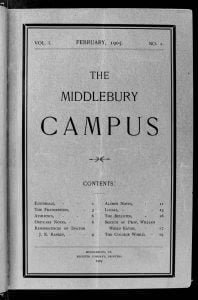
1905 Inaugural issue of the Middlebury Campus Newspaper

The Middlebury Campus was a newspaper published by the Middlebury college since 1905 and most issues from 1905-2007 have been placed online digitally. You may read, search, print, or download these papers. The paper when it originally came out included obituaries of past alumni and attendees, so if your ancestor attended Middlebury College it’s possible there is an obituary published within its pages.
History of Addison County Vermont

This collection is a resource on the history and people of Addison County, Vermont. It includes detailed town histories, covering topics such as early settlements, churches, industries, military service, and municipal organization for communities like Addison, Bridport, Bristol, and Cornwall. In addition to these town histories, the collection features hundreds of individual biographies and biographical sketches of the men and women who shaped the county’s development—from early settlers and local officials to business leaders, clergy, and veterans. Each title listed serves as a link to its respective article, allowing readers to explore Addison County’s history through its communities and the lives of its residents.

Biographical Sketch of Horatio E. Needham

Horatio E. Needham, born on September 10, 1827, in Addison County, Vermont, moved with his family to St. Lawrence County, New York, and later to Cuyahoga County, Ohio. He worked on a farm and as a stone cutter before enlisting in the Twenty-ninth Iowa Volunteer Infantry in 1862, serving until 1865. After the war, he farmed in Fremont County, Iowa, before relocating to Daviess County, Nebraska, in 1875. Needham married Lucina Bagley in 1852 and had eight children, five of whom survived.

Biographical Sketch of Shadrach Norton

Shadrach Norton settled in 1784 on a farm in the area now owned by Charles Stevens. Other early settlers included Benjamin Hall and Barzillai Stickney, the latter being elected constable. The Scovel brothers, Daniel and Ezra, also arrived in 1784, with Daniel passing away in 1813. Eliakim Mallory, Elisha Field, and Franklin Hooker were notable residents, contributing to the community’s development. The area saw a mix of settlers, with various farms changing ownership and families establishing their roots in the growing town.

Cornwall Vermont

Cornwall, Vermont, was chartered on November 3, 1761, by Governor Benning Wentworth and populated primarily by residents from Litchfield County, Connecticut. Early disputes arose regarding town boundaries, particularly with Whiting and Weybridge, leading to litigation and eventual compromise in 1789, which allocated land between the towns. The early organization of Cornwall faced challenges due to the loss of records in a fire in 1788, complicating land claims and delays in settlement. Despite these issues, the town developed from its founding in a context of contention and evolving governance.

Cornwall Vermont – Early Settlements

The first settlers of Cornwall arrived in 1774, primarily led by Asa Blodget, Joseph Throop, and several members of the Bentley family. They established claims mostly in the eastern and northern parts of the township. Subsequent arrivals in the following years contributed to the community’s growth, despite disruptions during the Revolutionary War. Many settlers returned post-war to rebuild their homes and farms, laying the groundwork for future generations, with notable figures including Ebenezer Stebbins and Solomon Linsley playing significant roles in early township development.

Cornwall Vermont – Town Organization

Cornwall, Vermont, was organized on March 2, 1784, electing various officers including Moderator Jeremiah Bingham and Treasurer Hiland Hall. The town’s early settlers were primarily agricultural, drawn to its fertile land despite limited water power for milling. Various tradesmen such as blacksmiths, carpenters, and shoemakers emerged to support the community’s needs. Over the years, attempts at establishing mills were limited, with several small operations, including a saw-mill and grist-mill, ultimately facing challenges in sustainability and success.

Cornwall Vermont – Mercantile

The mercantile history of Cornwall, Vermont, began with early merchants like Mr. Ballard and Israel C. Jones. Prominent figures included Joshua Stockwell and Benjamin F. Haskell, who operated the store through various partnerships and ownerships from the early 1800s. The original building dates back before 1820, with the current structure established around 1853. Fred S. Haskell, the current proprietor since September 1878, maintains the town’s sole store, continuing a long-standing commercial tradition.

Biographical Sketch of Isaac Mead

Isaac Mead, born in Panton in 1775, was an early settler on the farm later occupied by B. B. Rice, which was also home to General Somers Gale, a notable figure who commanded a detachment at Plattsburgh in 1814. Mead’s family experienced displacement during the Revolution, seeking refuge at Fort Ticonderoga. His legacy continues through his son, Dr. Nathan Gale of Orwell, and descendants including Mrs. S. A. Sanford and Mrs. Charles H. Lane.

Biographical Sketch of Deacon Jeremiah Bingham

Deacon Jeremiah Bingham was a founding member of the Congregational Church and one of its first deacons. A Revolutionary War soldier, he participated in the Battle of Bennington and served in the quartermaster’s department at Ticonderoga. Known for his remarkable energy and intelligence, Bingham was a diligent student of the Scriptures and a devoted believer. He also composed poetry for personal reflection. He lived to the age of ninety-four, leaving behind a legacy of faith and service.

Biographical Sketch of James Campbell

In 1793, James and Nathan Campbell settled on a lot within the Benjamin Stevens farm, living in log houses until they sold the property and left town. Stevens, originally from Pittsford, Vermont, endured a harsh three-year imprisonment in Quebec during the Revolutionary War. He passed away on June 16, 1815, at the age of fifty-three. The land where James Campbell resided later became the home of Dr. Solomon Foot, father of Hon. Solomon Foot and Dr. Jonathan Foot, whose biographies are detailed elsewhere.

Biographical Sketch of Nathan Campbell

James and Nathan Campbell settled in 1793 on a part of the Benjamin Stevens farm, residing in log houses until their departure in 1793 when they sold the land to Stevens. Stevens, who had previously endured a harsh three-year imprisonment in Quebec during the Revolutionary War, died on June 16, 1815, at fifty-three. Notably, the site where James Campbell lived later became the residence of Dr. Solomon Foot, father of Hon. Solomon Foot and Dr. Jonathan Foot, whose biographies are discussed elsewhere.

Cornwall Vermont – Military History

During the War of 1812, Cornwall residents united to defend against British invasion. In spring 1814, they mobilized to protect McDonough’s fleet and later responded to the threat of a British force marching on Plattsburgh. Local militia, led by Captain E. B. Hill, joined others encamping south of the fort, ready to confront the enemy. Notably, they displayed commendable patriotism, with many men quickly abandoning their work to serve in the defense, exemplifying the town’s commitment to military service throughout conflicts.

Cornwall Vermont – Eccleiastical

The Congregational Church of Cornwall, established on July 1, 1785, was the first religious organization in the town. Its founding members included Jared Abernathy and Stephen Tambling, with Rev. Thomas Tolman serving as the first pastor. Initially holding services in Captain Benton’s barn, the church built its first edifice by 1791. Subsequently, Cornwall saw the establishment of a Baptist church in 1792 and intermittent efforts for a Methodist presence since 1855. Population fluctuated from 826 in 1791 to 1,070 in 1880.

Biographical Sketch of Solomon Mead

In 1795, Solomon Mead acquired a farm from Abel Wright, which is currently held by Azial Hamilton. This property subsequently changed hands to Timothy Turner, Zenas Skinner, and Reuben P. Bingham. Additionally, Silas Mead settled on a farm located further north, presently owned by S. S. Andrus.

Biographical Sketch of John Douglass

John Douglass resided on land currently owned by C. and C. E. Ward, while Colonel Benajah Douglass lived on a property now occupied by his son, N. B. Douglass. N. B. and his three children, James, Maria, and Lilian, represent the last descendants of James Marsh Douglass in the town.

Biographical Sketch of William Slade

William Slade, originally from Washington, Connecticut, moved to Clarendon, Rutland County, around 1780, later settling in Cornwall where he lived until his death in 1826 at age seventy-three. A vigorous politician, he served as sheriff from 1810 to 1811 and was a Revolutionary War soldier, including time on the Jersey prison ship. He supported Madison during the War of 1812 and notable events at his home include the birth of Rev. Henry H. Hudson, a prominent Shakespearean critic.

Cornwall Vermont – 1885 Town Officers

In March 1885, Cornwall, Vermont, elected its town officers, including C. H. Lane as town clerk and P. N. Cobb, E. D. Searle, and A. S. Bingham as selectmen. Other positions filled were listers, constables, treasurer, overseer of the poor, superintendent of schools, auditors, inspector of wood and shingles, agent for legal matters, and representative. Notable appointments included A. W. Frost as constable and R. A. Foot overseeing the poor, reflecting the community’s governance structure during that period.

Biographical Sketch of Rufus Mead

Rufus Mead, sibling to Ezra and Isaac, acquired a farm from Abel Wright in 1786, initially constructing a home at the base of a hill before relocating to the current highway. His legacy continued through his sons; Hiram, Martin L., and Charles M. all graduated from Middlebury College, while Rufus served as the editor of the Middlebury Register for several years.

Biographical Sketch of James Marsh Douglass

James Marsh Douglass, originally from Cornwall, Connecticut, settled in the southern part of town around 1784 after bringing his family. He owned approximately five hundred acres in the area, indicating his intention for his sons to establish themselves nearby. Douglass passed away in 1790, at which point his estate was divided among his sons.