
Biographical Sketch of A. D. Peck

Rachel Barnes, born November 27, 1834, married Jenkins Whiteside Maxfield, with whom she had a daughter, Mary, before her death in 1861. Mary Maxfield wed James M. Milner, and they had several children. After Mr. Milner’s death, Mary married Adolpha D. Peck on March 4, 1894. Peck, born January 25, 1863, in Mahaska County, Iowa, became the father of Charles Everett and Jesse Bushyhead Peck, continuing the family lineage.
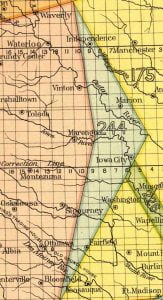
Treaty of October 21, 1837

Land Cession 244

On October 21, 1837, a treaty was signed in Washington D.C. between Carey A. Harris and the confederated tribes of Sacs and Foxes. The tribes ceded 1,250,000 acres of land to the United States, while receiving various financial and logistical support, including the payment of debts and provisions for agricultural assistance. The treaty mandated the establishment of blacksmith and gunsmith services on their retained land and outlined the tribes’ relocation terms, with a provision for Keokuck’s village to remain for two years.

Treaty of September 28, 1836 – 2

On September 28, 1836, a treaty was established between the United States, represented by Henry Dodge, and the Sac and Fox Indian tribes at the Mississippi River. The tribes ceded 400 sections of land, originally reserved in a prior treaty, seeking additional support and to pay debts. In return, the United States agreed to annual payments, compensation for a deceased agent, and provisions for half-breed children. The tribes agreed to vacate the ceded lands by November 1, 1836.

Treaty of September 21, 1832

On September 21, 1832, the United States and the confederated Sac and Fox tribes signed a treaty at Fort Armstrong. The agreement, addressing hostilities initiated by a faction of the tribes, involved the cession of substantial Sac and Fox lands to ensure peace and security. In return, the U.S. pledged annual payments for thirty years, established a reservation for the tribes, and provided provisions and goods, including a settlement to traders for prior debts. The treaty aimed to restore relationships and maintain peace between the parties.

Treaty of July 15, 1830

On July 15, 1830, a treaty was signed between the United States, represented by William Clark and Willoughby Morgan, and several Native American tribes including the Sacs and Foxes, and various Sioux bands. The tribes agreed to cede significant land for compensation, including monetary payments and provisions for blacksmiths and agricultural tools. Additionally, the treaty outlined the establishment of land for half-breeds and ensured annual allowances for education. The treaty aimed to foster peaceful relations and secure a future beyond hunting grounds.

Treaty of October 21, 1837-2

On October 21, 1837, a treaty was signed between the United States, represented by Carey A. Harris, and the Sacs and Foxes of Missouri. The tribes ceded all claims to land between the Missouri and Mississippi rivers, along with rights from previous treaties. In return, the U.S. agreed to pay $160,000, allocate funds for essential services such as education and agriculture, and cover treaty negotiation expenses. The treaty aimed to ensure ongoing support and stability for the Sacs and Foxes, pending ratification.

Biography of Benjamin H. Charles

Benjamin H. Charles, born on April 26, 1866, in Chester, Illinois, is a distinguished municipal bond lawyer based in St. Louis. He graduated from Westminster College and Yale Law School, and established his legal career amid the challenges of competition in 1892. His work as second and first associate city counselor saw him handle significant municipal cases. In 1917, he partnered with W. T. Rutherford, further cementing his reputation in municipal law. Charles is also active in various educational and social organizations. He is married with three sons.

Biography of Edmund Raymond Kinsey

Edmund Raymond Kinsey, born on January 24, 1873, in Muscatine, Iowa, was a prominent municipal engineer and public servant in St. Louis. After beginning his career under Robert E. McMath, he played a significant role in the Louisiana Purchase Exposition and later served as president of the city’s board of public improvements and subsequently the board of public service until 1921. Kinsey was also active during World War I, serving as a captain in the Home Guard. He was married to Inez Viola Wheeler and had four sons, all of whom have notable military or academic achievements.

Biography of Francis Eugene Nipher, LL. D.

Francis Eugene Nipher, born December 10, 1847, in Port Byron, New York, was a distinguished physicist and educator. Graduating from the State University of Iowa, he later served as a professor at Washington University in St. Louis. His extensive research contributions include studies on electric discharge, magnetic measurements, and photography. Nipher held leadership roles in various scientific societies and spoke on political issues, including the silver question. His writings encompassed scientific literature and broader topics, showcasing his diverse intellectual pursuits throughout his career.

Biographical Sketch of William Kassebaum

William Kassebaum, born in 1870 in Farmington, Iowa, served as secretary of the Herman Oak Leather Company in St. Louis. His German immigrant father was a wagon-maker, while his mother was a well-known local contractor. Kassebaum was educated in St. Louis schools and began his career in the hide and fur industry before joining the leather company in 1892. He actively supported World War I efforts and was married to Addelyn Helmkamp, with whom he had a son. Kassebaum is a Methodist and a Mason.

Biography of Sol. E. Waggoner

Sol. E. Waggoner, born on March 8, 1851, in Ohio, became a prominent figure in Missouri’s Masonic fraternity and served as president of the Masonic Home of St. Louis. Educated at Oskaloosa College, he worked for the Western Union Telegraph Company before establishing a successful insurance career. Married to Catherine White, he was a father to three children. A dedicated community member and Masonic leader, Waggoner’s contributions to the Masonic Home and various charitable organizations reflect his commitment to civic welfare and the advancement of Masonry in Missouri.

Biography of James W. Shankland, M. D.

Dr. James W. Shankland, born April 4, 1867, in Ohio, is a distinguished surgeon practicing in St. Louis. He served as surgical chief at the Embarkation Hospital during World War I and has contributed significantly to the medical field through his work and publications. Educated at the University of Minnesota and St. Louis University, he previously worked in dentistry. He is affiliated with professional organizations and has held various positions in the medical community. Dr. Shankland is married and has one son, and he is active in civic and fraternal organizations.

Biography of Henry Greve

Henry Greve, born on March 6, 1856, in Velen, Westphalia, Germany, immigrated to the U.S. in 1873, settling in St. Louis in 1875. He became a prominent businessman as the sole owner and president of the John Wahl Commission Company, specializing in lead and zinc. Greve’s business acumen and leadership have positioned him as a key figure in St. Louis commerce, where he is also a director of the Liberty-Central Trust Company. A devoted philanthropist, he actively supports many charitable causes, including his local Catholic community.

Biography of James Harvey Stewart

James Harvey Stewart, born on October 9, 1854, in Ohio, became a prominent figure in Wichita, Kansas, after moving from Iowa. A lawyer by profession, he served as a state senator and held influential roles in local businesses and civic organizations, including vice president of the National Bank of Commerce. Stewart’s extensive public service included positions with the Chamber of Commerce and the Wichita Board of Education. He married Kate Martin in 1885 and had three children. His career reflects a blend of legal expertise and community commitment.

Biography of Henry C. Lindsey, Col.

Henry C. Lindsey, born in 1844 in Iowa City, Iowa, is a notable figure in Kansas history. His family, deeply rooted in American frontier life, actively participated in the fight for Kansas’ statehood. A Civil War veteran, he also served in Indian campaigns and the Spanish-American War. Lindsey became a prominent businessman in Topeka, establishing his livery service over 50 years ago, and held various public offices, including Chief of Police. He married Mary Stewart, with whom he had two children, and remains a respected member of the community.

Biographical Sketch of Eugene F. Ware

Eugene F. Ware, born in Hartford, Connecticut, on May 29, 1841, was an influential figure in Iowa and Kansas as a soldier, lawyer, editor, and author. Educated in Burlington, Iowa, he served as a captain in the Fourth Iowa Cavalry during the Civil War. After moving to Kansas in 1867, he practiced law and held two terms in the Kansas Legislature. Ware was also a U.S. pension commissioner and active in various organizations. He authored several notable works and passed away on July 1, 1911, in Cascade, Colorado.