
Black Kettle
A Cheyenne chief and famous warrior whose village on Sand Creek, Colorado, was attacked by a force of Colorado militia under Col. Chivington in 1864 and a large number of innocent men, women, and children were massacred and their bodies mutilated. Black Kettle had come in by the direction of Gov. Evans of Colorado, and surrendered to Maj. Wynkoop, U. S. A., who had promised him protection. 1 On November 27, 1868, United States troops under command of Gen. P. H. Sheridan attacked Black Kettle’s village on the Washita, and destroyed it, Black Kettle being killed in the fight. He was a brother of Gentle Horse.
Consult Further:
Dull Knife
Dull Knife. A chief of a hand of Northern Cheyenne who first came into public notice in 1868 when, as one of the representatives of his tribe, he signed the treaty of Ft Laramie, May 10, made by the Northern Cheyenne and Northern Arapaho with the United States, his name appearing as “Tah-me-la-pash-me, or Dull Knife.”
In 1875, or early in 1876, Dull Knife’s band, numbering about 400 warriors, suddenly attacked Washakie’s band of Shoshoni, at that time on Bighorn River near the mouth of Gray Bull River. In 1876 the Northern Cheyenne, including Dull Knife’s band, joined the Sioux under Sitting Bull in their general uprising during this and the following year.
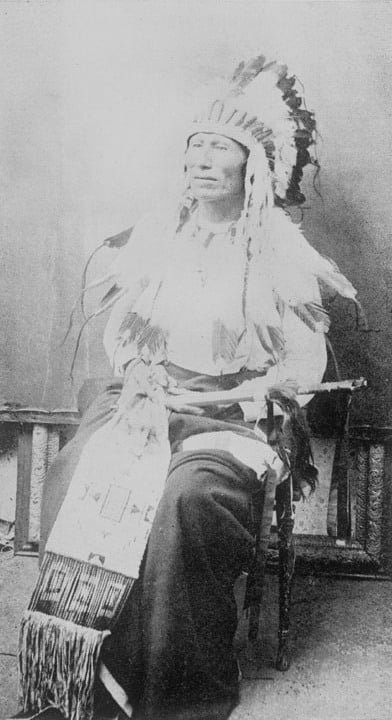
They were present at and were participants in the Custer massacre on the Little Bighorn in June, 1876, and according to Chief Gall’s statement, at the beginning of the battle the Cheyenne fought Custer’s command while the Sioux attacked Reno’s force, and after the latter had been driven back, the entire body of warriors turned on Custer’s command. On Nov. 25, 1876, the cavalry under Col. Mackenzie attacked Dull Knife’s camp at daybreak, destroying 173 lodges and capturing 500 ponies. Although the Indians escaped, with heavy loss, they later surrendered and were moved to Oklahoma and placed with the Southern Cheyenne. Greatly dissatisfied with their new home, an attempt was made by a large party under Dull Knife to escape to the north in Sept., 1878. They were pursued and a part of them captured and confined at Ft Robinson, Nebraska, whence they made a desperate attempt to escape on the night of Jan. 9, 1879, during which most of them, including Dull Knife, were killed. See Cheyenne Tribe
Consult further:
- Dunn, Massacres, 1886;
- Ellis, Ind. Wars, 1892;
- Ind. Aff. Rep. 1877-79;
- Mooney in 14th Rep. B. A. E., 1896.
Hishkowits
Hishkowits (Hǐshkowǐ’ts, ‘porcupine’, known to the whites as Harvey Whiteshield). A Southern Cheyenne interpreter, born in west Oklahoma in 1867; eldest son of the chief White-shield (see Wopohwats). After 5 years’ attendance at the agency schools lie entered Carlisle School, Pa., in 1881, afterward attending other schools at Ft Wayne, Hanover (Ind.), and Lawrence (Kan.). In 1893 he became assistant teacher in the Mennonite mission school among the Cheyenne at Cantonment, Okla., which position he held for 4 years. He still serves as interpreter for the mission and has been chief assistant of the Rev. Rudolph Petter, missionary in charge, in the preparation of a number of translations and a manuscript dictionary of the Cheyenne language.
Roman Nose
See: Roman Nose, Cheyenne War Chief
Standing Elk
See: Standing Elk
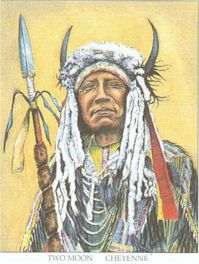
Chief Two Moon
The Cheyenne were old allies of the Sioux and in the early summer of 1876 Chief Two Moon caped at Charcoal Butte alongside Crazy Horse’s Sioux. Below them camped on the Missouri River was Sitting Bull. This huge gathering of warriors alter moved to the edge of the Little Big Horn River and attacked the 7th US cavalry under General Custer.

Wolf Robe 1841-1909, Southern Cheyenne.
Wolf Robe
Wolf Robe was in a hunting party, which was led by White Leaf, when they were attacked by soldiers. Before they could make good their escape Wolf Robe recognized that they were in fact Pawnee dressed as soldiers. The Pawnees had for many years acted as scouts for the US Army in their fight against most tribes.
Wopohwats
Wopohwats (Wo’poh’´wăts, White Shield Owner, commonly known to the whites as White Shield). A former chief of the Southern Cheyenne, born about 1833 on an upper branch of North Platte River Wyoming; died in 1883 near the present Kingfisher, Oklahoma. In accordance with Indian custom, he had different names, at different periods. As a young man he was known as Mouse Road His more famous name was bestowed on him in 1862 by his uncle, the noted Black Kettle, killed in the battle of the Washita, who had previously borne the name himself. About the year 1878 he assumed his grandfather’s name of Buffalo Beard, which he kept until his death.
Having distinguished himself as a warrior, particularly in two engagements with the Pawnee, he became a leader in the Bowstring soldier society, and in 1870 was formally elected to the council of chiefs. In the next year he was one of a delegation sent to Washington to represent the allied Cheyenne and Arapaho tribes then established on a reservation in Oklahoma, and with his companions received from President Grant a treaty medal bearing the device of a pipe, a plow, a globe, and a Bible, which were explained to symbolize peace, agriculture, education, and Christianity. White Shield accepted all this literally, and on his return became an earnest advocate of civilization, schools, and mission work. Throughout the outbreak of 1874-75 he held his band quiet at the agency. In 1881 he was again chosen as delegate, but was unable to go by reason of the death of his daughter, tribal custom forbidding participation in public business by anyone in mourning. As was common with the Plains Indians, he had two wives, who were sisters. His son, Harvey White Shield (see Hishkowits), is one of the best educated young men in the tribe and an efficient mission helper and interpreter.
Citations:
- Indian Affairs Reports, 1865; Condition of Indian Tribes, Report Joint Special Committee, 1865.[
 ]
]
